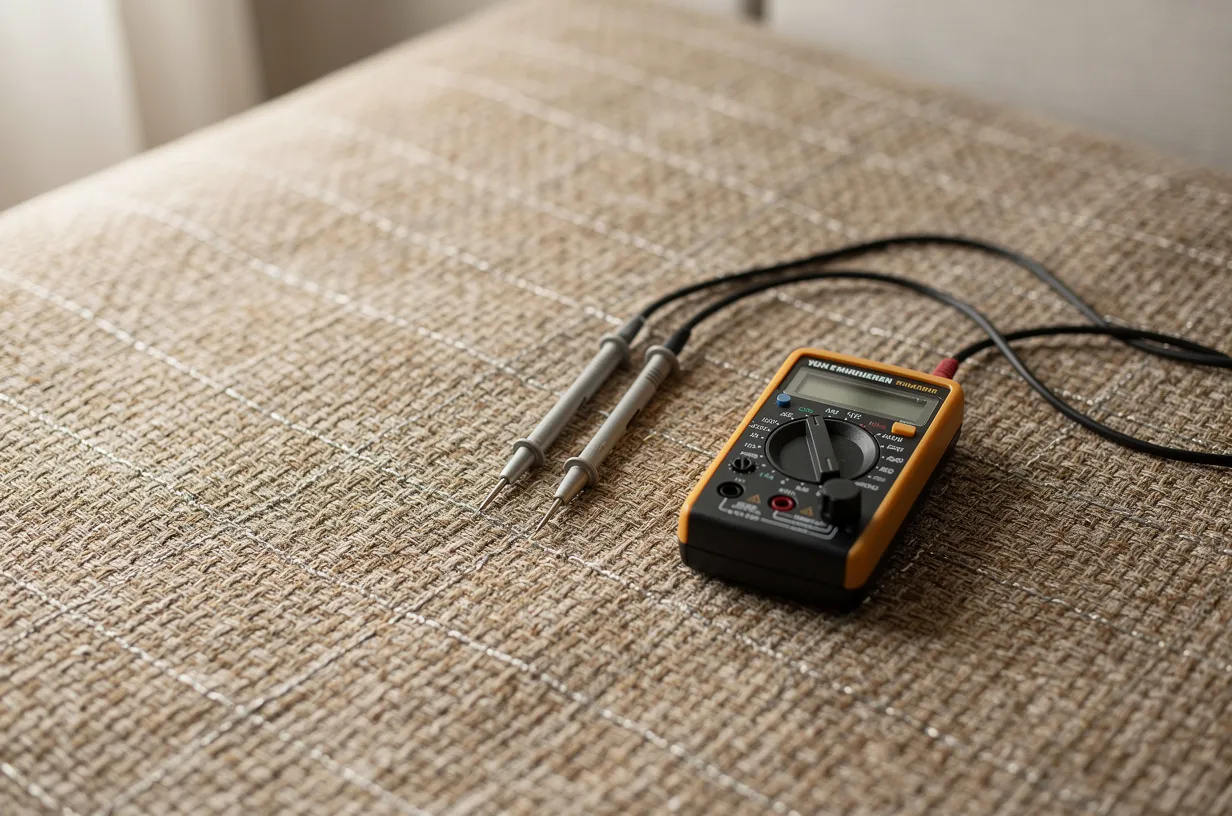
Yes, a properly made grounding sheet is genuinely conductive. It’s not a marketing claim you have to take on faith. The conductive threads woven into the fabric carry a real electrical path from the surface you sleep on to the ground pin in your wall outlet, and you can confirm that with a fifteen-dollar multimeter in under a minute. What’s still debated isn’t whether the connection exists. It’s what that connection does for your body once it’s made.
Yes, working grounding sheets are measurably conductive. Set a multimeter to resistance or continuity mode, touch one probe to the conductive panel and the other to the metal prong on the grounding cord, and a healthy sheet reads well under a few hundred ohms. If it reads open (no continuity) or in the megaohm range, something’s wrong with the sheet or the connection, not with the concept.
What does “conductive” actually mean here?
In this context, conductive just means electrons can move through the fabric with low resistance, the same basic property that lets a copper wire carry current. Whether the sheet is a working conductor is testable with a meter. Whether sleeping on one changes your physiology is a separate, softer question, and I’ll get into what the research actually supports further down.
How do they build conductivity into a bed sheet?
Manufacturers weave a percentage of conductive fiber into an otherwise ordinary cotton or cotton-blend fabric, usually in a grid or panel pattern you can sometimes feel or faintly see. Two materials dominate the market. Silver vs Stainless Steel Grounding Fiber
Silver-thread sheets conduct extremely well when new, since silver is one of the best conductors available. The tradeoff is that silver tarnishes and oxidizes with repeated washing, and oxidized silver conducts noticeably worse than fresh silver.
Stainless-steel fiber sheets, like the 30% stainless-steel blend used in the Premium Grounding sheet I test with, conduct a little less aggressively than brand-new silver on paper, but that gap barely matters in practice. Steel doesn’t oxidize the way silver does, so the conductivity holds up better wash after wash. What Are Grounding Sheets Made Of? Silver vs Stainless Steel Fibers
Can you test conductivity yourself?
You can, and I think you should if you’re spending real money on one of these. Set a basic multimeter to the ohms or continuity setting, then measure resistance between the conductive fabric and the metal prong of the grounding plug. A working sheet should read low resistance, generally in the tens to low hundreds of ohms. How to Test if Your Grounding Sheet Is Actually Working
If your meter shows infinite resistance or “OL,” the fabric isn’t connected to the cord, or the cord itself is damaged. That’s a returnable defect, not a reason to write off the category. For a deeper walkthrough of what specific readings mean, see our guide to grounding sheet conductivity and ohms. Grounding Sheet Conductivity and Ohms Explained
Silver vs stainless: how conductivity compares over time
| Factor | Silver thread | Stainless steel fiber |
|---|---|---|
| Conductivity when new | Very high | High, slightly behind silver |
| Oxidation risk | Tarnishes with washing and air exposure | Doesn’t oxidize the same way |
| Conductivity after 1-2 years of use | Can drop noticeably if not cared for | Stays much closer to its starting reading |
| Typical practical lifespan | Shorter, more washing-sensitive | Longer, roughly five times in brand testing claims |
Neither material is “fake” or non-conductive. The real difference shows up a year or two in, when a silver sheet that tested great out of the box may read noticeably higher resistance than a stainless one that’s been through the same number of washes.
Does the connection fade with washing and time?
Yes, for silver especially. Oxidation builds a thin, less conductive layer on the metal surface, and every wash cycle adds a little more. That’s the honest, unglamorous reason some grounding sheets feel less effective a year in. Do Grounding Sheets Oxidize? Silver vs Steel
Gentle, cold washes and air drying slow this down but don’t stop it. If durability matters more to you than a marginally higher conductivity number on day one, stainless steel is the more forgiving choice. See our breakdown of grounding sheet lifespan for more. How Long Do Grounding Sheets Last?
What if my outlet isn’t actually grounded?
A grounding sheet’s cord plugs into the ground pin of a standard outlet, the same pin that protects your other appliances. It connects to that ground, not to live power, so the sheet doesn’t introduce new voltage into your bedroom. What Is a Grounding Cord and How It Works
The real risk sits upstream, in the wiring. Older homes sometimes have a ground pin present that isn’t properly bonded to a real earth connection. A cheap outlet tester, the three-light kind sold at any hardware store, checks this in seconds. I’d test the outlet before I’d worry about the sheet.
Does “conductive” mean it’s doing something for your health?
Here’s where I want to be careful, because this is where skeptics are right to push. The electrical connection from your skin to the sheet to the outlet’s ground pin is real and measurable, full stop. What that connection does inside your body is a separate, much less settled question.
The most-cited human study is Ghaly and Teplitz (2004), a small, unblinded pilot that found grounding during sleep shifted cortisol rhythm toward a more typical day-night pattern and improved participants’ self-reported sleep, pain and stress. It’s the strongest single data point the field has for sleep, and it’s still small and self-reported.
Oschman, Chevalier and Brown (2015) published a narrative review proposing that Earth’s surface electrons might act as antioxidants, neutralizing reactive oxygen species in the body. That’s a hypothesis worth testing, not a settled fact. Other small pilots, including Sokal and Sokal (2011) on metabolic markers and Chevalier et al. (2013) on blood viscosity, point in interesting directions but share the same limitation: tiny samples, often from overlapping research groups, few independent replications.
My honest read after years in this niche: the electrical premise checks out, and the sleep and relaxation research is the best-supported, if still modest, part of the picture. Claims about treating or curing anything else are getting ahead of the evidence. If you have a pacemaker, are pregnant, or take medication affecting your electrolytes, talk to your doctor before adding grounding to your routine.
If you want a sheet that actually holds its measured conductivity past year one instead of just at unboxing, that’s the durability question I keep coming back to, and it’s the main reason stainless steel is my default recommendation over silver for anyone planning to keep a sheet long term.
Premium Grounding Sheet
30% stainless-steel fibers instead of silver, so it will not oxidize and lasts about five times longer. Fits under your fitted sheet, ships worldwide, and comes with a 90-night trial and a 3-year warranty.
Check price on Premium GroundingFrequently asked questions
How do I know if my grounding sheet is still conductive?
Use a multimeter set to ohms or continuity between the fabric panel and the cord’s metal prong. Low resistance, generally under a few hundred ohms, means it’s working. An open or “OL” reading means the connection has failed somewhere.
Is a grounding sheet dangerous if my house isn’t grounded properly?
The sheet itself connects to your outlet’s protective ground, not to live power, so it doesn’t create new voltage. The real risk is a miswired or ungrounded outlet, which you can check with an inexpensive outlet tester before you plug anything in.
Why does my grounding sheet feel less effective after a year?
If it’s silver thread, oxidation from repeated washing is the most likely cause, since tarnished silver conducts less efficiently than new silver. Stainless-steel sheets are far less prone to this and tend to hold their original conductivity longer.
Does being conductive prove grounding sheets are medically beneficial?
No. Conductivity is a physical property you can measure with a meter. Whether that connection meaningfully changes your body is a separate, much less settled question, best supported so far for subjective sleep and relaxation in small studies, not for treating or curing any condition.
Can I test a grounding sheet before buying one, or only after?
Only the specific sheet you own, since conductivity depends on its actual fibers and cord. Beforehand, check the material (stainless resists oxidation better than silver) and confirm the brand offers a trial period so you can test it once it arrives.
- What Is Earthing? The Practice Behind Grounding, Explained
- How Do Grounding Sheets Work? The Mechanism Step by Step
- Grounding Sheets vs Earthing Sheets: Same Thing, Different Name?
- What Are Grounding Sheets Made Of? Silver vs Stainless Steel Fibers
- The History of Grounding: How Cultures Slept Connected to the Earth
- How to Test if Your Grounding Sheet Is Actually Working
- Grounding Sheet Conductivity and Ohms Explained
- Silver vs Stainless Steel Grounding Fiber
- Do Grounding Sheets Oxidize? Silver vs Steel
- How Long Do Grounding Sheets Last?
- Grounding vs Earthing: Is There a Difference?
- What Is a Grounding Cord and How It Works
← What Are Grounding Sheets? How Earthing Bedding Actually Works