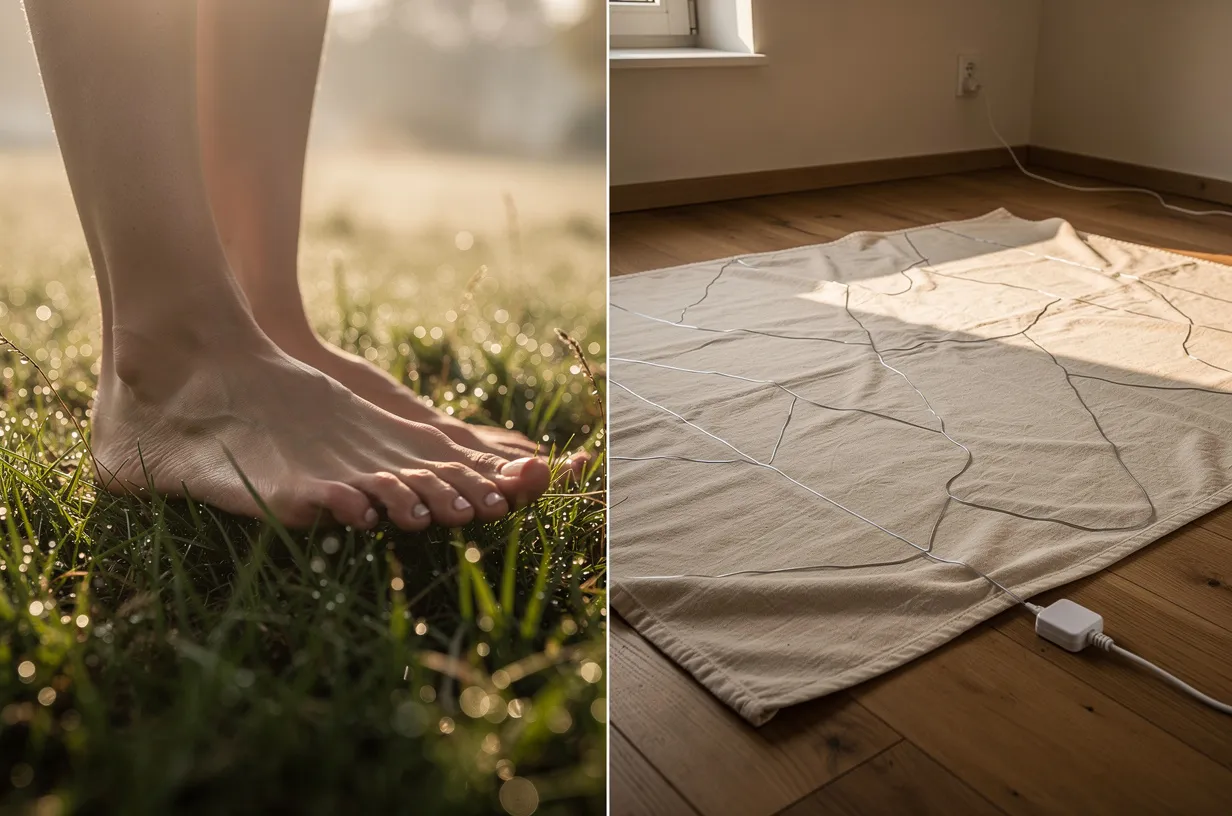
Outdoor grounding means direct skin contact with the earth, bare feet on grass, sand or soil. Indoor grounding uses a conductive sheet, mat or patch wired to your wall outlet’s ground pin, which gives you the same electrical connection without leaving the bedroom. Neither is “better” in a strict sense. They solve different problems.
Outdoor grounding is free and the most direct connection you can get, but it depends on weather, bare skin and dry ground. An indoor grounding sheet trades a little of that directness for something you’ll actually use every night, which for most people matters more.
What’s actually different between the two?
Outside, your skin touches conductive earth directly. Soil, grass and sand carry a natural negative charge, and bare skin contact lets your body equalize with it. There’s no wire, no outlet, nothing electronic involved.
Indoors, a grounding sheet or mat does the same job through a cord plugged into the ground pin of a standard three-prong outlet. We cover exactly how that connection works in How Do Grounding Sheets Work? The Mechanism Step by Step, but the short version is that a properly wired outlet’s ground pin is bonded to the same earth a barefoot walk would touch, just routed through your home’s wiring instead of soil.
Does walking barefoot outside work as well as a sheet?
For the hour or two you’re actually standing on the right surface, yes, arguably better, since there’s no intermediary. The catch is duration and consistency. Most people don’t spend eight hours barefoot on wet grass. A grounding sheet lets you stay connected for a full night of sleep, which is where the small pilot studies (Ghaly & Teplitz, 2004) reported the clearest effect, on subjective sleep and stress, not on any specific daytime dose of “earth time.” We go deeper on the outdoor side in Barefoot Grounding vs Grounding Sheets.
Which outdoor surfaces even count?
Not every surface conducts. Grass, sand, bare soil and concrete in contact with earth generally work. Asphalt, painted decking, and most modern flooring don’t, because they’re sealed or insulated. Wet surfaces conduct better than bone-dry ones, which is one reason “grounding outside” tends to work best after rain or near dawn dew. Full breakdown of what qualifies in Best and Worst Surfaces for Grounding Outside.
| Factor | Outdoor (barefoot) | Indoor (grounding sheet) |
|---|---|---|
| Cost | Free | One-time purchase |
| Consistency | Depends on weather, time, location | Same connection every night |
| Duration per session | Usually short, minutes to an hour | A full night, 6-8 hours |
| Directness of connection | Skin to soil, no intermediary | Skin to sheet to outlet ground |
| Practical for most lifestyles | Hard to do daily, especially in winter or cities | Passive, happens while you sleep |
| Depends on | Dry vs wet ground, surface type, climate | A correctly grounded outlet |
Why bother with an indoor sheet if outside is free?
Because most of us don’t live near a patch of damp grass we can stand on for eight hours a night. Winters, apartments, city sidewalks and rain all get in the way of consistent outdoor grounding. A sheet solves the access problem, not the science problem. The mechanism proposed for why grounding might help, that the earth’s surface electrons act as antioxidants (Oschman, Chevalier & Brown, 2015), is a hypothesis either way, indoor or outdoor. Neither setup proves the theory. Both give you the same electrical connection the theory is built on.
Does climate or season change which one makes sense?
Yes, more than most guides admit. If you live somewhere warm and dry with a yard, ten or fifteen minutes barefoot most mornings is realistic and free. If you’re in a cold climate, a high-rise, or somewhere it rains for months at a stretch, that same routine falls apart by November. This is less about which method “works better” and more about which one you’ll actually keep doing. Grounding you do for two weeks and then quit doesn’t tell you much either way.
Is the indoor version measurably weaker?
Body voltage measurements, the kind used to check whether a person is actually grounded, tend to show similar results for bare feet on damp earth and for a properly connected sheet, because both are completing the same circuit to the same reference point. The variable that swings results is contact quality, dry skin or a loose cord versus damp soil or a well-seated sheet, not indoor versus outdoor as categories. We break the readings down in Body Voltage and Grounding Sheets Explained if you want the specifics.
Can you do both?
Sure, and plenty of people who take grounding seriously do. A morning barefoot walk when the weather allows it, then a grounding sheet for sleep. There’s no evidence that combining them multiplies any benefit, the small studies we have don’t test that. But there’s no real downside either, beyond the effort of standing outside longer.
If you’re leaning toward the indoor route,
Premium Grounding Sheet
30% stainless-steel fibers instead of silver, so it will not oxidize and lasts about five times longer. Fits under your fitted sheet, ships worldwide, and comes with a 90-night trial and a 3-year warranty.
Check price on Premium GroundingOne honest caveat either way: none of this treats or cures anything. The best-supported outcome in the research is sleep and subjective stress, from small, mostly unblinded pilot studies. If you want the fuller picture on what “grounded” even means electrically, Earth Potential and Grounding, Explained Simply walks through it plainly. And if you’re weighing whether a sheet is worth it at all, start with What Are Grounding Sheets? How Earthing Bedding Actually Works.
Frequently asked questions
Is outdoor grounding stronger than a grounding sheet?
In the moment, direct skin-to-earth contact is the most literal version of the connection. But strength isn’t really the issue, duration and consistency are. A sheet keeps you connected for a full night, which outdoor sessions rarely match.
Do I need a grounding sheet if I already walk barefoot outside daily?
Not necessarily. If you genuinely get regular, extended barefoot time on grass or soil, you’re getting the same electrical connection a sheet provides. A sheet mainly helps when weather, location or your schedule make that hard to do consistently.
Does concrete count as grounded?
Bare, unsealed concrete in direct contact with soil can conduct. Painted, sealed, or elevated concrete usually doesn’t. Grass, sand and bare soil are the more reliable outdoor bets.
Is an indoor grounding sheet as safe as standing outside?
The sheet connects to your outlet’s ground pin, not to live power, so it’s not carrying current into you. The real safety question is whether the outlet itself is correctly wired. A cheap outlet tester settles that in seconds.
Which one do the studies actually test?
Most of the small pilot studies people cite, including Ghaly & Teplitz (2004), used indoor conductive setups (sheets, mats, patches) during sleep, not outdoor barefoot sessions. The outdoor practice is older and less formally studied.
- What Is Earthing? The Practice Behind Grounding, Explained
- How Do Grounding Sheets Work? The Mechanism Step by Step
- Grounding Sheets vs Earthing Sheets: Same Thing, Different Name?
- What Are Grounding Sheets Made Of? Silver vs Stainless Steel Fibers
- The History of Grounding: How Cultures Slept Connected to the Earth
- How to Test if Your Grounding Sheet Is Actually Working
- Grounding Sheet Conductivity and Ohms Explained
- Silver vs Stainless Steel Grounding Fiber
- Do Grounding Sheets Oxidize? Silver vs Steel
- How Long Do Grounding Sheets Last?
- Grounding vs Earthing: Is There a Difference?
- What Is a Grounding Cord and How It Works
← What Are Grounding Sheets? How Earthing Bedding Actually Works