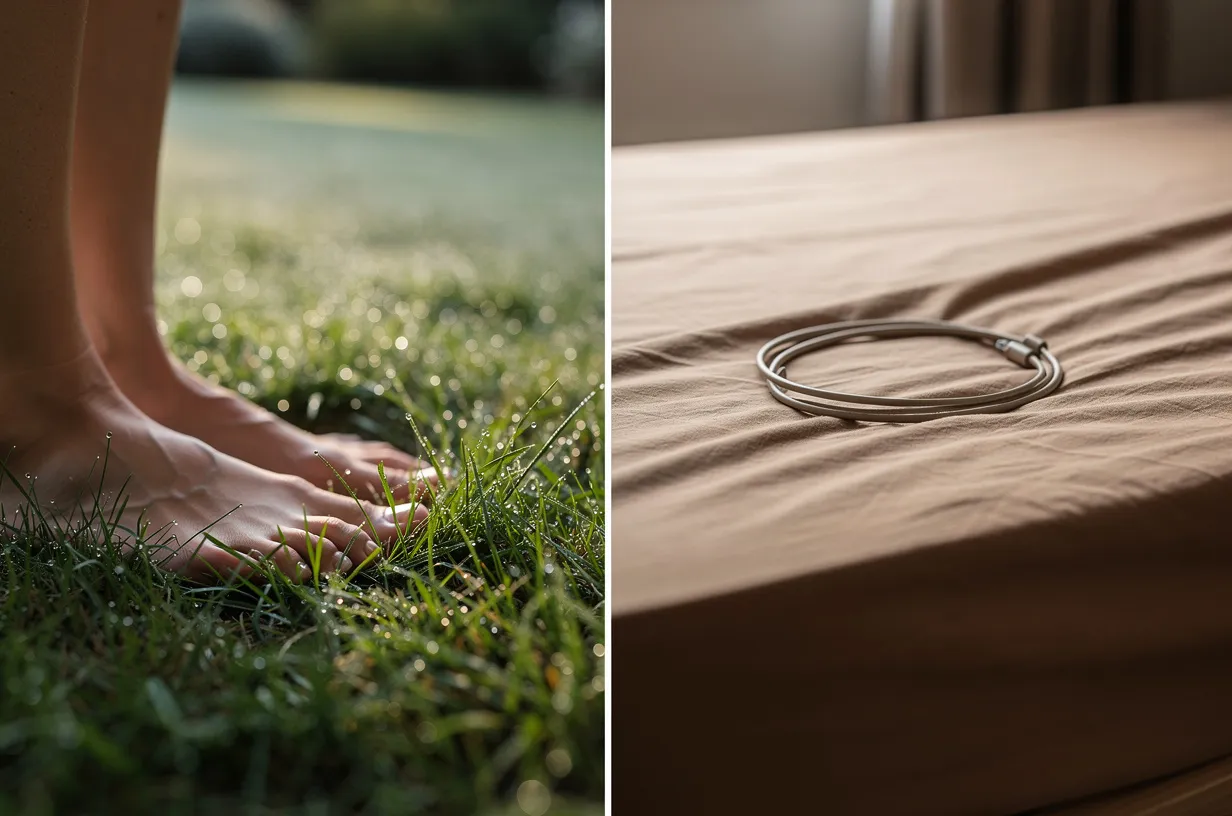
Barefoot grounding wins on raw connection quality, bare skin on damp grass or sand is about as direct as it gets. A grounding sheet wins on consistency, it works while you’re asleep, every night, regardless of the weather or whether you have a yard.
Barefoot outside gives the strongest, most literal connection to the earth, but only for as long as you’re standing there. A grounding sheet trades some of that intensity for eight hours of contact, night after night, which is why most of the sleep research is built around sheets, not bare feet.
What’s actually different between the two?
Barefoot grounding is the original idea: skin touching the earth directly, no product involved. You step onto grass, sand, or bare soil and your body equalizes with the electrical potential of the ground beneath you. It costs nothing and there’s no wiring, no cord, no outlet to think about.
A grounding sheet is a proxy for that same contact. Conductive thread, usually silver or, in the case of our top pick, stainless steel, runs through the fabric and connects through a cord to your wall outlet’s ground pin, which is bonded to the earth outside your home. You’re not touching soil, you’re touching a fabric that’s wired to the same ground point. We walk through the wiring itself in How Do Grounding Sheets Work? The Mechanism Step by Step.
Which one gives a better connection?
If you’re judging purely on conductivity, barefoot on wet grass or sand is hard to beat. Damp, mineral-rich earth is an excellent conductor, and there’s zero resistance between your skin and the ground. A sheet has to pass through fabric, thread, a cord, and your home’s wiring before it reaches the same earth, so some resistance is inevitable, even with a well-made sheet on a properly grounded outlet.
That said, “stronger” for ten minutes outside isn’t automatically “better” for your body over a full night. Nobody has run a study directly comparing a short barefoot session to eight hours grounded in bed, so we can’t say one produces a bigger physiological effect than the other. What we do know is that the sleep and cortisol findings from Ghaly and Teplitz (2004) came from people grounded overnight in bed, using a setup closer to a sheet than a quick walk outside.
Which is more practical day to day?
This is where sheets usually pull ahead for most people. Barefoot grounding depends on having safe outdoor access to a conductive surface, grass, sand, bare soil, which rules out a lot of city apartments, cold climates for half the year, and rainy or icy conditions. See Best and Worst Surfaces for Grounding Outside for which surfaces actually work and which don’t.
A grounding sheet doesn’t care about your weather or your zip code. Once it’s installed under your fitted sheet and plugged into a tested, properly grounded outlet, you’re connected for as long as you’re in bed, every night, without having to plan around anything. The tradeoff is you’re relying on a product and your home’s wiring instead of just your own feet.
| Factor | Barefoot grounding | Grounding sheet |
|---|---|---|
| Cost | Free | One-time purchase |
| Connection strength | Direct, generally stronger per minute | Slightly reduced by fabric, cord and wiring |
| Duration typically achieved | Minutes, occasionally longer | Hours, every night while you sleep |
| Weather/season dependent | Yes | No |
| Works indoors | No | Yes |
| Requires safe outdoor surface | Yes | No |
| Setup | None | Cord to a tested, grounded outlet |
Does the research favor one over the other?
Honestly, most of the commonly cited grounding research was built around indoor grounding setups, sheets, mats, patches, not barefoot walking outside. Ghaly and Teplitz (2004) looked at overnight sleep grounding. Sokal and Sokal (2011) and Chevalier et al. (2013) also used grounding equipment rather than sending people outside. The Oschman, Chevalier and Brown (2015) review, which proposes that earth-sourced electrons act as antioxidants, is a hypothesis paper built on the same body of equipment-based studies.
None of these are large or independently replicated, and it’s worth saying plainly that several of the researchers involved have commercial ties to grounding products. Barefoot walking on grass is essentially unstudied as its own intervention, it’s more of an assumption borrowed from the same underlying idea than something tested on its own. So the honest answer is that neither option has strong, independent proof behind it, but the existing studies at least map more closely onto how a sheet is used than how a barefoot walk is used.
Should you do both?
There’s no reason not to, if you enjoy time outside. A morning walk barefoot on grass costs nothing and plenty of people find it grounding in the non-electrical sense too, it gets you outside, moving, in daylight. Pairing that with a sheet at night just means you’re not depending on the weather or your schedule to get consistent grounding during sleep, which is the part the research leans on most. For more on how the two ideas relate conceptually, see Indoor vs Outdoor Grounding: What’s the Difference? and What Is Earthing? The Practice Behind Grounding, Explained.
If you’re deciding where to start and sleep is your main goal, a sheet is the more practical entry point precisely because it doesn’t ask you to change your routine. If you already spend real time barefoot outdoors and sleep well, you may not need one at all.
Premium Grounding Sheet
30% stainless-steel fibers instead of silver, so it will not oxidize and lasts about five times longer. Fits under your fitted sheet, ships worldwide, and comes with a 90-night trial and a 3-year warranty.
Check price on Premium GroundingWhat to check before you buy or rely on either
Before trusting a grounding sheet, verify the outlet you’re using is actually, safely grounded. A cheap outlet tester takes seconds and tells you whether the ground pin is wired correctly, this matters far more for safety than which brand of sheet you buy. If you want to confirm a sheet itself is conducting properly once it’s set up, see Are Grounding Sheets Actually Conductive?.
Before relying on barefoot grounding, make sure the surface is actually conductive. Dry sealed decking, most driveways, and painted concrete don’t count, even though they’re technically “outside.” And treat either approach as a low-risk, unproven-for-most-things habit rather than a treatment for any health condition. If you have a pacemaker, are pregnant, or manage a condition with medication, talk to your doctor before adding either practice to your routine.
Frequently asked questions
Is barefoot grounding stronger than a grounding sheet?
In terms of raw skin contact with the earth, yes, bare feet on damp grass or sand touch the ground directly with no fabric or cord in between. But a sheet delivers a steadier, longer connection because you’re on it for hours every night, not just the twenty or thirty minutes most people manage outside.
Can I get the same benefit from 10 minutes barefoot outside as 8 hours on a sheet?
Nobody has directly compared the two head to head, so there’s no real data to answer that precisely. The studies behind grounding for sleep, mainly Ghaly and Teplitz (2004), used overnight grounding, not short barefoot sessions, so the sheet is the better-supported route to that specific sleep benefit.
Do I need a grounding sheet if I already walk barefoot outside daily?
Not necessarily. If you already spend real time barefoot on grass, sand or bare earth most days and you sleep fine, a sheet is optional. It’s more useful for people whose daily routine, climate or housing makes regular barefoot time hard to fit in.
What surfaces count for barefoot grounding?
Grass, sand, bare soil, and unsealed concrete in contact with the earth all conduct. Asphalt, sealed decks, most modern concrete slabs, and anything painted or varnished generally don’t. We break this down surface by surface in Best and Worst Surfaces for Grounding Outside.
Is it safe to combine barefoot grounding and a grounding sheet?
Yes. There’s no conflict between the two, plenty of people do both, a walk outside in the morning and a grounded sheet at night. Just treat them as separate habits rather than assuming one replaces the other.
- What Is Earthing? The Practice Behind Grounding, Explained
- How Do Grounding Sheets Work? The Mechanism Step by Step
- Grounding Sheets vs Earthing Sheets: Same Thing, Different Name?
- What Are Grounding Sheets Made Of? Silver vs Stainless Steel Fibers
- The History of Grounding: How Cultures Slept Connected to the Earth
- How to Test if Your Grounding Sheet Is Actually Working
- Grounding Sheet Conductivity and Ohms Explained
- Silver vs Stainless Steel Grounding Fiber
- Do Grounding Sheets Oxidize? Silver vs Steel
- How Long Do Grounding Sheets Last?
- Grounding vs Earthing: Is There a Difference?
- What Is a Grounding Cord and How It Works
← What Are Grounding Sheets? How Earthing Bedding Actually Works