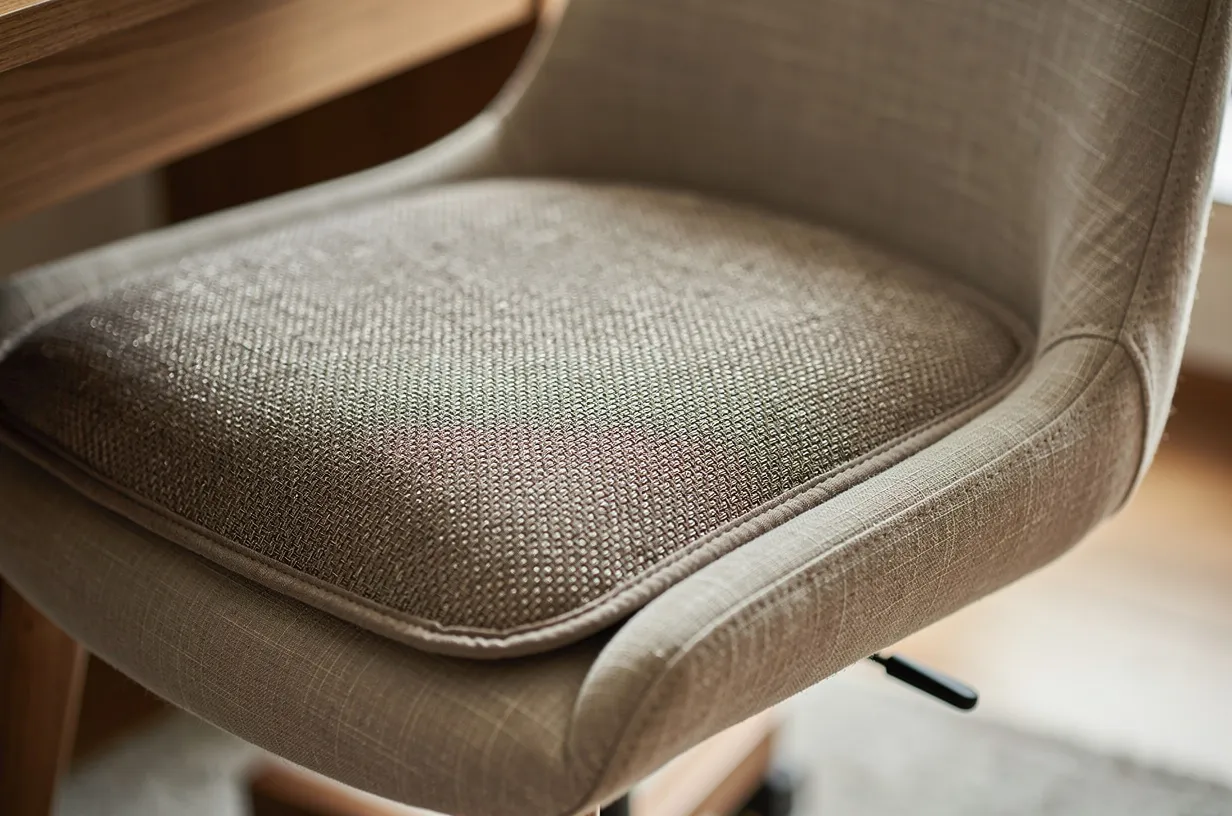
A grounding pad for an office chair works the same way a grounding sheet does at night: a conductive patch sits against your skin, a cord runs to the ground pin of a nearby outlet, and you stay electrically tied to the earth while you sit through a nine-to-five. It’s one of several Grounding Products Beyond Sheets: Blankets, Socks, Pillowcases & More beyond sheets, and it’s genuinely simple to set up once you know what to check first.
A grounding chair pad is worth trying if you already use a grounding sheet at night and want the same connection during the day. It only works with a properly grounded outlet and bare-skin contact, and the evidence behind it is the same small, early-stage research that supports grounding sheets, nothing more.
What does a grounding chair pad actually do?
The pad itself is usually a small conductive mat, often carbon-fiber or a silver-thread fabric, that lays over your seat cushion. A cord with a built-in resistor connects it to the ground terminal of a nearby wall outlet, the same three-prong ground that a grounding sheet uses. Your bare skin, or thin clothing pressed against it, completes the circuit.
The claim isn’t that sitting on a pad does something different from lying on a sheet. It’s the same mechanism, just applied to a chair instead of a mattress. If you already use Grounding Fitted Sheets: How They Differ at night and liked the setup, a chair pad is a natural extension for the workday.
How do you set one up at a desk?
Plug the cord into any outlet near your chair, tuck the mat under a thin layer of clothing or against bare calves, and you’re connected. Most office setups already have a power strip under the desk for a monitor or laptop charger, and that’s fine, the ground pin passes straight through a normal three-prong strip.
The part people skip is checking the outlet itself. A cheap three-light outlet tester, plugged in for ten seconds, tells you whether that particular plug is actually grounded. Do this once when you set up and you’re done, you don’t need to retest weekly.
Does it work through clothes?
Thin fabric, like dress pants or a skirt, usually still passes enough current to register a connection, though weaker than bare skin. Thick fabric, like jeans with a heavy lining, can block it almost entirely. Skin contact on the back of your legs or a bare forearm works better than trusting fabric to conduct.
Chair pad vs. desk mat vs. wristband: which fits your workday?
These aren’t competing products, they’re different contact points for the same wall-outlet ground, and which one fits depends on how you actually sit and type.
| Option | Contact point | Best for | Setup effort |
|---|---|---|---|
| Chair pad | Seat, thighs, lower back | People at a desk most of the day | Low, drapes over the cushion |
| Desk or wrist mat | Forearms, wrists while typing | People who want contact while working, not just sitting | Low, sits flat on the desk surface |
| Wristband | Wrist | Standing desks or moving around the office | Very low, straps on and off |
A desk mat under your forearms keeps a connection even when you stand up to stretch, which a seat pad obviously can’t do. If your setup is more standing desk than chair, our guide to Grounding Desk Mats: Earthing While You Work covers that version in more depth, and Grounding Bands and Wristbands: Do They Work? walks through the wristband option for anyone who moves around a lot during the day.
Is it safe to use at the office?
The safety picture is identical to a grounding sheet: the pad connects to the outlet’s protective ground, not to live power, so normal use carries very little risk. The real hazard is the same one too, a miswired or falsely grounded outlet, which is more common in older office buildings than most people expect. Test the specific outlet you’re using rather than assuming the building’s wiring is fine because the lights work.
If you have a pacemaker or another implanted electrical device, talk to your doctor before adding a grounding pad to your routine, the same caution that applies to grounding sheets and mats generally.
What does the evidence say about sitting and earthing?
Almost none of the research on grounding was done with someone sitting at a desk. The small pilot studies people cite, Ghaly and Teplitz’s 2004 work on sleep and cortisol, Chevalier’s blood-viscosity study, Sokal and Sokal’s work on metabolic markers, were done with participants grounded during rest or sleep, not typing for eight hours. The 2015 Oschman, Chevalier and Brown review that proposes an antioxidant mechanism is a hypothesis paper, not a trial, and it doesn’t test office use either.
A chair pad is a logical extension of that research, not something it directly tested. If grounding feels worthwhile at night, using a pad during the day isn’t a stretch, but don’t expect it to sharpen your focus or fix afternoon fatigue. That’s not what the existing studies were even looking at.
Premium Grounding Sheet
30% stainless-steel fibers instead of silver, so it will not oxidize and lasts about five times longer. Fits under your fitted sheet, ships worldwide, and comes with a 90-night trial and a 3-year warranty.
Check price on Premium GroundingFrequently asked questions
Can I use a grounding chair pad without a grounded outlet?
You can plug it in, but it won’t do what it’s meant to do. Without a real ground path, the cord has nowhere to send the connection, so you’re sitting on a mat that looks functional but isn’t earthing you to anything.
Do grounding chair pads wear out or need replacing?
Yes, especially silver-thread versions, which oxidize with repeated contact and washing over months of daily use and slowly lose conductivity. Carbon-fiber and stainless-steel-thread pads tend to hold up longer under the same daily friction. If durability matters more than upfront cost, the fabric it’s made from is worth checking before you buy.
Can I use it over pants at the office?
You can, but thick fabric weakens the connection, sometimes enough that the pad isn’t really doing anything. Thinner fabric or direct skin contact on your calves or forearm gives a more reliable result than trusting a full layer of jeans to conduct.
Will office electronics or a nearby power strip interfere with it?
No. The pad’s cord shares the same ground pin as your monitor, laptop charger or desk lamp, and none of them compete with each other, they each use their own hot and neutral connection. The one thing to check is that the strip itself is plugged into a genuinely grounded outlet.
Is a chair pad as effective as a full grounding sheet?
Effective isn’t really the right word since neither has been tested head-to-head in the research. What’s true is that a chair pad gives you less total skin contact than a sheet you sleep on for hours, so if you’re only going to use one, the sheet is the setup most of the existing sleep-focused studies actually looked at. A chair pad is a reasonable add-on for the daytime, not a replacement.
- Grounding Blankets: How They Work and When to Pick One Over Sheets
- Earthing Blanket Guide: Conductive Throws Compared
- Grounding Pillow Cases: Small Upgrade, Real Contact Hours
- Grounding Socks: Do Conductive Socks Actually Ground You?
- Grounding Mattress Pads: Full-Coverage Earthing Under Your Sheet
- Grounding Shoes and Footwear: Earthing While You Walk
- Grounding Fitted Sheets: How They Differ
- Grounding Flat Sheets: Pros and Cons
- Grounding Half Sheets: A Simpler Option
- Grounding Mattress Covers: Full Coverage Earthing
- Grounding Throw Blankets: Earthing on the Couch
- Grounding Patches: Targeted Earthing Explained
← Grounding Products Beyond Sheets: Blankets, Socks, Pillowcases & More