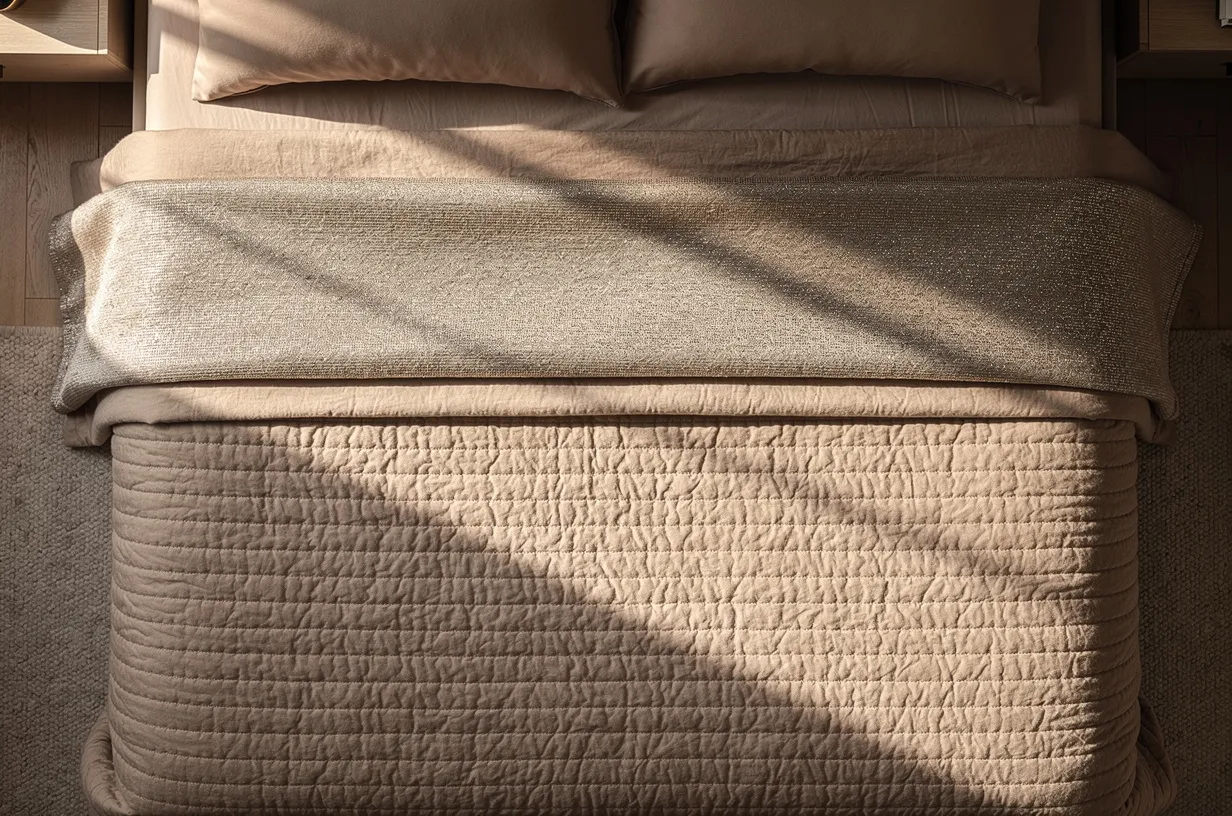
A grounding blanket and a weighted blanket solve two different problems, so this isn’t really an apples-to-apples fight. A grounding blanket is woven with a thin conductive thread and plugs into your wall outlet’s ground port, aiming to mimic the effect of walking barefoot on grass. A weighted blanket has no electrical component at all; it’s filled with glass beads or poly pellets and works through plain physical pressure. If you want calmer, more restful sleep, either one can help, and plenty of people end up using both.
A weighted blanket has the stronger, better-studied case for anxiety and restlessness. A grounding blanket is the lighter, more experimental option, best-supported for subjective sleep quality. They aren’t competing for the same job, so you don’t have to pick just one.
What’s actually different between the two?
A grounding blanket needs skin contact to do anything. The conductive thread, usually silver or stainless steel, carries a tiny connection from your body to the earth pin in a wall outlet. We cover how that mechanism works in our Grounding Blankets: How They Work and When to Pick One Over Sheets guide, but the short version is: no skin contact, no effect. That’s why grounding blankets are thin and made to be used directly against you, not layered over a comforter.
A weighted blanket works through weight alone, usually somewhere between 5 and 25 pounds depending on your body size. There’s no plug, no cord, no outlet involved. The idea is deep pressure stimulation, the same sensory input you get from a firm hug or a swaddle, which some people find calming before sleep.
Does the science actually back either one?
Weighted blankets have the longer research trail. They came out of occupational therapy work with autistic and ADHD populations before crossing into the general sleep market, and there’s a reasonable body of independent research on deep pressure and anxiety, even though results for insomnia specifically are still mixed.
Grounding is newer and thinner on evidence. The most-cited study, Ghaly and Teplitz (2004), was a small, unblinded pilot that found grounding during sleep shifted cortisol toward a more normal rhythm and improved how people rated their own sleep, pain and stress. That’s the best-supported use case for grounding products generally, and it’s still a small, self-reported study. The proposed mechanism, that Earth’s electrons act like antioxidants, comes from a 2015 review by Oschman, Chevalier and Brown in the Journal of Inflammation Research. It’s a hypothesis paper, not proof, and it’s worth saying plainly: nobody should expect a grounding blanket to treat or cure anything. If it helps, sleep and general relaxation is where you’ll likely notice it.
Grounding blanket vs weighted blanket, side by side
| Grounding blanket | Weighted blanket | |
|---|---|---|
| How it works | Conductive thread, plugs into an outlet’s ground port | Physical weight (glass beads or pellets), no electrical part |
| Best evidence for | Subjective sleep quality (small pilot studies) | Anxiety and restlessness (broader research base) |
| Feel | Thin, light, sits directly on skin | Heavy, usually 5-25 lbs depending on size |
| Machine washable | Usually yes, gentle cycle, check the care label | Depends on the fill; some covers are washable, some inserts aren’t |
| Heat retention | Minimal, it’s a thin conductive layer | Can run warm, weight traps body heat |
| Setup | Needs a properly grounded outlet nearby | None, works anywhere |
| Price | Check current price, generally mid-range | Check current price, varies a lot by weight and fabric |
Can you use a grounding blanket and a weighted blanket together?
Yes, and it’s a fairly common combination. Because a grounding blanket has to touch skin to work, it needs to go closest to you, with the weighted blanket layered on top rather than underneath. Some people find the pairing works well on the couch too, where a lighter conductive throw sits under a heavier weighted layer; our Grounding Throw Blankets: Earthing on the Couch and Earthing Blanket Guide: Conductive Throws Compared guides cover the couch setup if that’s your use case. One practical note: keep the weighted blanket’s fill away from the grounding blanket’s cord and connection point so nothing pinches or frays it over time.
Who should be careful with either one?
Weighted blankets aren’t recommended for infants or for anyone who can’t easily move or reposition themselves, since the weight can restrict movement. If you tend to sleep hot, a heavy blanket can make that worse.
Grounding products carry a different set of cautions. The electrical connection runs to your outlet’s ground, not to live power, so the real-world risk is a miswired outlet rather than the product itself; a cheap outlet tester is worth the few dollars before you plug anything in. Anyone with a pacemaker or another implanted device, anyone pregnant, and anyone on medication that affects nerve or muscle function should talk to their doctor first, since manufacturers of implanted devices are typically the ones who can confirm what’s safe for that specific device.
Which one should you buy first?
If restlessness and racing thoughts are your main problem at bedtime, start with a weighted blanket. It’s the better-evidenced pick for that specific complaint, and you’ll feel the effect the first night. If you’re more curious about the grounding research, or you already sleep hot and don’t want extra weight, a grounding product is the lower-commitment starting point, especially since most versions are washable and cheap to test for a few weeks.
For anyone leaning toward grounding, we’d point you to a fitted sheet over a throw blanket as the easiest first step, since it stays in contact with more of your body all night without you having to remember to use it. Our tested top pick there is the Premium Grounding Sheet, mostly because it uses stainless-steel fibers instead of silver, so it doesn’t oxidize and lasts noticeably longer through regular washing.
Premium Grounding Sheet
30% stainless-steel fibers instead of silver, so it will not oxidize and lasts about five times longer. Fits under your fitted sheet, ships worldwide, and comes with a 90-night trial and a 3-year warranty.
Check price on Premium GroundingWhichever direction you go, neither product replaces a real sleep routine. Think of them as one small lever among several, not a fix on their own. If you want the full lineup of grounding formats beyond sheets, our Grounding Products Beyond Sheets: Blankets, Socks, Pillowcases & More hub breaks down blankets, socks, pillowcases and mats side by side.
Frequently asked questions
Can a grounding blanket and a weighted blanket be the same product?
Not really. A handful of brands sell hybrid weighted-and-grounding blankets, but they’re uncommon and the added weight can interfere with keeping the conductive layer flush against your skin. Most people are better off buying the two separately if they want both.
Will a weighted blanket block a grounding blanket’s effect?
It shouldn’t, as long as the grounding layer stays directly against your skin underneath. Once fabric, even a thin sheet, sits between your body and the conductive thread, the connection is weaker.
Is a grounding blanket safe to use every night?
For most healthy adults using a properly grounded outlet, yes. The main caution is for anyone with a pacemaker, another implanted device, or a condition where a doctor should weigh in first.
Which one actually helps you fall asleep faster?
Weighted blankets have more research behind faster sleep onset and reduced restlessness. Grounding’s best-supported outcome is overall sleep quality rather than speed of falling asleep, based on small studies.
Do I need a special outlet for a grounding blanket?
You just need a standard three-prong outlet that’s actually grounded. If your home only has two-prong outlets or you’re unsure whether they’re wired correctly, test with a cheap outlet tester before use.
- Grounding Blankets: How They Work and When to Pick One Over Sheets
- Earthing Blanket Guide: Conductive Throws Compared
- Grounding Pillow Cases: Small Upgrade, Real Contact Hours
- Grounding Socks: Do Conductive Socks Actually Ground You?
- Grounding Mattress Pads: Full-Coverage Earthing Under Your Sheet
- Grounding Shoes and Footwear: Earthing While You Walk
- Grounding Fitted Sheets: How They Differ
- Grounding Flat Sheets: Pros and Cons
- Grounding Half Sheets: A Simpler Option
- Grounding Mattress Covers: Full Coverage Earthing
- Grounding Throw Blankets: Earthing on the Couch
- Grounding Patches: Targeted Earthing Explained
← Grounding Products Beyond Sheets: Blankets, Socks, Pillowcases & More