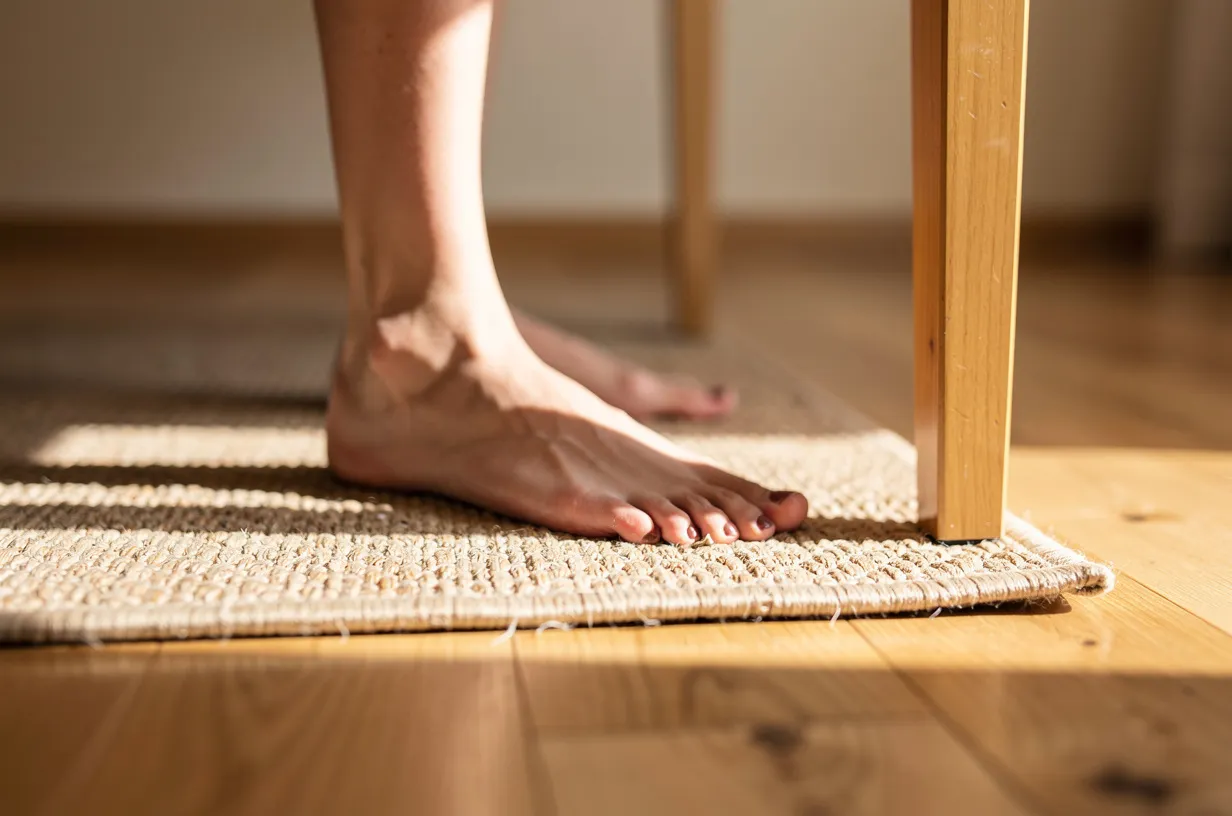
A grounding desk mat is a small conductive pad you rest a bare foot or hand on while you work, wired to your outlet’s ground pin the same way a grounding sheet is. It’s a way to add earthing minutes to your day without changing anything about how you sleep.
A desk mat is a low-cost, low-risk way to get daytime grounding contact, but the research behind grounding is still thin, mostly small sleep studies, and there’s nothing published specifically on desk-mat use. Worth trying if you’re already curious. Not worth expecting a fix for anything.
What is a grounding desk mat, exactly?
It’s a conductive mat, usually carbon rubber, leatherette with a conductive coating, or woven fiber, that sits under your feet or your forearms at a desk. A cord runs from a snap on the mat to a plug that goes into the ground pin of a standard outlet. Skin contact with the mat completes the same electrical path a grounding sheet uses at night.
The difference is dose. A sheet gives you six to eight hours of near-continuous contact while you sleep. A desk mat gives you contact only while your foot or hand is actually touching it, which in practice is less consistent than people assume once you factor in shoes, fidgeting, and getting up.
Does sitting on a grounding mat actually do anything?
Here’s where I have to be straight with you. The studies this whole industry leans on, Ghaly and Teplitz’s 2004 sleep and cortisol pilot, the Sokal and Sokal work on blood markers, Chevalier’s blood viscosity study, were all done with participants grounded overnight or for extended stretches, not sitting at a desk for a few hours with breaks. Nobody has run a dedicated trial on desk mats specifically.
So any claim about focus, energy, or afternoon fatigue from a desk mat is an extrapolation, not a finding. What we can say honestly is that the electrical mechanism, skin to conductive surface to outlet ground to earth, works the same regardless of whether you’re sitting or lying down. Whether that translates into something you’d notice during a workday is unproven either way.
How do you set one up safely?
Plug the mat’s cord into a standard grounded outlet near your desk, not a power strip you’re unsure about, and rest a bare foot on it while you type. A few practical points that actually matter:
- Test the outlet with a cheap three-light outlet tester first. A miswired outlet is the actual electrical risk here, not the mat itself.
- Keep the mat away from spilled coffee and the area under a rolling chair, where the cord gets crushed over time.
- If a GFCI outlet trips when you plug in, unplug and check the mat and cord before assuming the outlet is faulty.
- Skip it during an active thunderstorm, same rule as any grounded electronics.
Desk mat vs other ways to get grounding time during the day
If you’re weighing a desk mat against other daytime options, contact time and convenience are the real trade-offs.
| Option | Typical daily contact | Setup effort | Best for |
|---|---|---|---|
| Grounding desk mat | 1-4 hours, interrupted | Low, plug and rest a foot on it | Desk-bound work, easy to try |
| Grounding mat for feet under a desk | Similar to a desk mat, foot-focused | Low | People who want hands free for typing |
| Grounding sheet | 6-8 hours, continuous | Moderate, fits under a fitted sheet | The longest, most consistent daily dose |
| Barefoot outside on grass or sand | Whatever time you spend outdoors | None, free | Anyone near a safe, dry outdoor surface |
If your real goal is the most contact time for the least effort, a sheet still wins on raw hours. A desk mat is more about not letting your daytime hours go completely ungrounded if you already believe in the practice, not a replacement for it.
What should you look for before buying one?
Material matters for durability more than for any claimed effect. Carbon rubber mats are cheap and durable but can feel stiff underfoot. Leatherette mats with a conductive coating feel nicer but the coating can wear thin with daily foot traffic. Look for a mat with a resistor-protected cord (limits current to a safe level even if something goes wrong), a snap connection you can test with a multimeter, and a cord long enough to reach your outlet without a cheap extension.
Size is a personal call. A mat just big enough for both bare feet under a desk is enough. Bigger forearm mats exist for people who want contact while typing instead of, or in addition to, foot contact.
Who should be careful or skip it
If you have a pacemaker or another implanted electrical device, talk to your doctor or the device manufacturer before adding any grounding product to your routine. The same goes if you’re pregnant or managing a condition where you’d want a clinician’s input before changing your daily routine, even a low-risk one like this. None of this is because a desk mat is known to be dangerous. It’s because “talk to your doctor first” is the responsible answer whenever a device connects to your body and you have a relevant medical situation.
If your workday setup runs on a shared power strip you don’t fully trust, or an old building with ungrounded two-prong outlets, sort that out first, or use an adapter with a genuine ground, before adding a desk mat.
For a chair-height option instead of a floor mat, our guide to Grounding Chair Pads: Seated Earthing covers seated setups. And if you’re weighing daytime add-ons against the bigger investment of nighttime grounding, our guide to Grounding Fitted Sheets: How They Differ breaks down what a full night of contact actually looks like. For the broader category this sits in, see our hub on Grounding Products Beyond Sheets: Blankets, Socks, Pillowcases & More, and if portability matters more than a fixed desk setup, our Grounding Travel Mats: Earthing on the Road guide covers mats built to pack.
Premium Grounding Sheet
30% stainless-steel fibers instead of silver, so it will not oxidize and lasts about five times longer. Fits under your fitted sheet, ships worldwide, and comes with a 90-night trial and a 3-year warranty.
Check price on Premium GroundingThe honest takeaway: a grounding desk mat is a cheap, low-risk way to layer a bit more earthing into your day if you’re already sold on the practice for sleep. It won’t undo a bad night or fix afternoon slump on its own, and there’s no study that isolated desk-hours as a variable. Treat it as a small addition, not the main event.
Frequently asked questions
Do grounding desk mats really work?
They complete the same electrical path as a grounding sheet, skin to conductive mat to outlet ground, so the mechanism is real. Whether sitting on one for a few hours a day produces any noticeable effect hasn’t been tested directly in published research, which mostly looked at overnight sleep, not desk time.
How long do I need to use one for it to matter?
There’s no established minimum. The studies behind grounding used hours of continuous overnight contact, which a desk mat can’t fully replicate since you’re moving, wearing shoes part of the day, or stepping away from your desk.
Can I use a grounding desk mat without a grounded outlet?
No. The mat relies on your outlet’s ground pin to complete the connection to earth. If your outlet isn’t properly grounded, the mat won’t do what it’s designed to do, and you should get the wiring checked or use a genuinely grounded outlet instead.
Is a grounding desk mat as good as a grounding sheet?
Not in terms of contact hours. A sheet gives you six to eight hours of continuous contact overnight; a desk mat gives you a few interrupted hours during the workday. If you only pick one, the sheet delivers the larger daily dose.
Is it normal to feel a slight tingle when I first touch the mat?
A brief, faint sensation when you first make contact is commonly reported and usually harmless, similar to what some people notice with grounding sheets. If you feel anything stronger than a mild tingle, unplug it and have the outlet and cord checked before using it again.
- Grounding Blankets: How They Work and When to Pick One Over Sheets
- Earthing Blanket Guide: Conductive Throws Compared
- Grounding Pillow Cases: Small Upgrade, Real Contact Hours
- Grounding Socks: Do Conductive Socks Actually Ground You?
- Grounding Mattress Pads: Full-Coverage Earthing Under Your Sheet
- Grounding Shoes and Footwear: Earthing While You Walk
- Grounding Fitted Sheets: How They Differ
- Grounding Flat Sheets: Pros and Cons
- Grounding Half Sheets: A Simpler Option
- Grounding Mattress Covers: Full Coverage Earthing
- Grounding Throw Blankets: Earthing on the Couch
- Grounding Patches: Targeted Earthing Explained
← Grounding Products Beyond Sheets: Blankets, Socks, Pillowcases & More