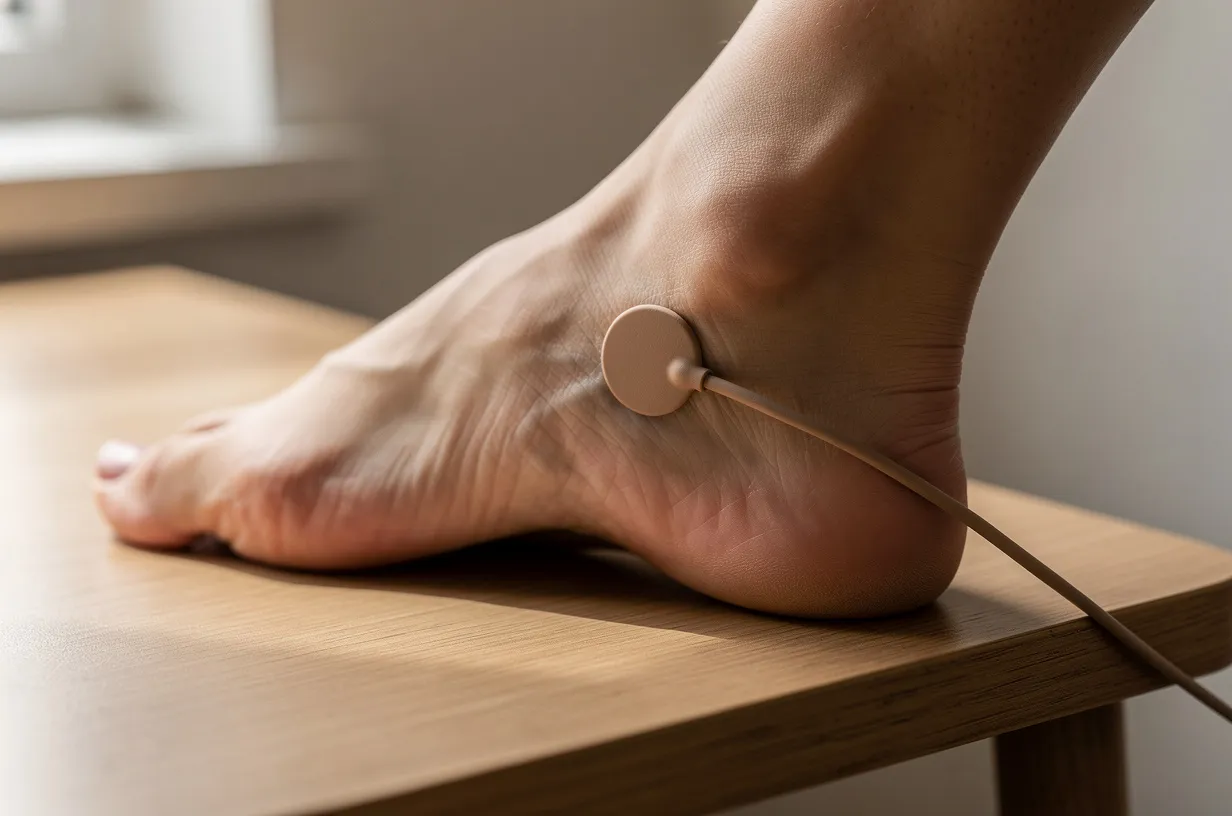
A grounding patch is a small conductive pad, usually a few inches across, that sticks to bare skin and connects by a cord to a grounded outlet or a ground rod outside. It gives you targeted earthing at your desk, on the couch, or on the road, without setting up a full sheet.
Grounding patches work the same way sheets do, just on a smaller patch of skin. They’re a smart add-on for daytime spot use, but the sleep research behind grounding was done with mats and sheets, not patches, so don’t expect them to replace a bed setup if better sleep is your actual goal.
What exactly is a grounding patch?
Picture a small adhesive pad, often the size of a large sticker, made from conductive material with a snap or clip for a grounding cord. You press it onto clean, bare skin (the sole of a foot, a wrist, a palm) and plug the other end into the ground port of a wall outlet, or into a rod pushed into the soil outside.
It’s the most stripped-down version of grounding gear that exists. No fabric to wash, no fitted-sheet corners to wrestle with, just a patch and a cord.
How do grounding patches work?
The mechanism is identical to a grounding sheet or mat. Your skin makes contact with a conductive surface, that surface runs through a cord to the ground pin of an outlet, and the outlet’s ground wire ties back to the earth through your home’s electrical system. You’re not tapping into live power at any point, only the neutral, protective earth path.
The one real variable is contact area. A grounding sheet touches most of your body for eight hours. A patch touches one small spot, for however long you leave it on. Less surface area and shorter, more sporadic wear time are the honest tradeoffs.
Grounding patches vs mats vs sheets: what’s actually different?
| Feature | Grounding patch | Grounding mat | Grounding sheet |
|---|---|---|---|
| Skin contact | One small spot (foot, wrist, palm) | Foot or hand-sized area | Most of the body, all night |
| Best for | Desk work, travel, spot use | Sitting at a desk or in a chair | Sleep |
| Portability | Very portable, easy to pack | Portable, needs some space | Stays on the bed |
| Setup effort | Peel, stick, plug in | Set on a surface, plug in | Fits under a fitted sheet |
| Evidence base | No patch-specific studies we could find | Some daytime and recovery pilots | Most of the cited sleep studies used a mat or sheet on the bed |
None of this means patches don’t conduct, they do, the physics is the same. It just means the research anchoring the “grounding helps sleep” claim was run on people lying on grounded bedding, not wearing a patch on one foot.
Do grounding patches have research behind them?
Not specifically. The studies most often cited for grounding, Ghaly and Teplitz’s 2004 sleep and cortisol pilot, Chevalier’s blood viscosity work, Sokal and Sokal’s small Polish trials, all had participants sleeping on grounded mats or sheets for extended stretches. The Oschman, Chevalier and Brown 2015 paper proposing an antioxidant mechanism is a hypothesis piece, not a trial of any specific product.
A patch worn for an hour at your desk is a different exposure entirely from eight hours of full-body contact overnight. That doesn’t make a patch useless, it just means you’re extrapolating from research that wasn’t testing this format.
When does a patch make more sense than a sheet?
Patches earn their place in a few specific situations. If you want to try earthing at your desk during work hours, a patch on your foot under the desk is far less awkward than a full mat. If you travel a lot, a patch packs flat in a bag where a fitted sheet doesn’t. And if you just want to test whether you notice anything before committing to bedding, a patch is the cheapest way to experiment.
We cover other targeted options in our guide to Grounding Products Beyond Sheets: Blankets, Socks, Pillowcases & More, including Grounding Bands and Wristbands: Do They Work? and Grounding Body Bands for Targeted Contact, which work on the same small-contact-area principle. If your feet are the focus, Grounding Socks: Do Conductive Socks Actually Ground You? are worth comparing too.
How do you use a grounding patch correctly?
Clean the skin first so the adhesive and contact make a solid connection. Press the patch onto bare skin, not over clothing or lotion. Plug the cord into a wall outlet’s ground port, and if you’re not sure the outlet is actually grounded, a cheap outlet tester from a hardware store tells you in seconds. That five-dollar check matters more than any product spec, because a miswired outlet is the real safety risk here, not the patch itself.
Skip using any grounded product, patch included, during a thunderstorm, and unplug it if you’re not around to notice a fault.
If your main goal is better sleep rather than a quick daytime experiment, a full sheet gets you closer to what the studies actually tested. That’s the setup we recommend and use ourselves.
Premium Grounding Sheet
30% stainless-steel fibers instead of silver, so it will not oxidize and lasts about five times longer. Fits under your fitted sheet, ships worldwide, and comes with a 90-night trial and a 3-year warranty.
Check price on Premium GroundingFrequently asked questions
Are grounding patches as effective as grounding sheets?
Nobody has run a study directly comparing the two, so we can’t say for certain. What we can say is that contact area and time matter in the studies we do have, and a patch offers less of both than a sheet worn all night.
Where should I place a grounding patch?
The sole of a foot, a palm, or the inside of a wrist are the most common spots, anywhere with direct skin access and enough flat surface for the adhesive to hold.
Can I wear a grounding patch to bed instead of a sheet?
You can, but it’s not the setup the sleep research used. If you’re specifically chasing the cortisol and subjective sleep results from studies like Ghaly and Teplitz, a mat or sheet under you all night matches that research far more closely than a single patch.
Do grounding patches need a grounded outlet?
Yes, same as any other grounding product. The patch itself doesn’t do anything without a verified path to earth, so test the outlet before you rely on it.
Are grounding patches safe for daily use?
Generally yes, for most people, when the outlet is properly grounded and the adhesive doesn’t irritate your skin. If you have a pacemaker, another implanted device, or you’re pregnant, talk to your doctor before adding any grounding product to your routine.
- Grounding Blankets: How They Work and When to Pick One Over Sheets
- Earthing Blanket Guide: Conductive Throws Compared
- Grounding Pillow Cases: Small Upgrade, Real Contact Hours
- Grounding Socks: Do Conductive Socks Actually Ground You?
- Grounding Mattress Pads: Full-Coverage Earthing Under Your Sheet
- Grounding Shoes and Footwear: Earthing While You Walk
- Grounding Fitted Sheets: How They Differ
- Grounding Flat Sheets: Pros and Cons
- Grounding Half Sheets: A Simpler Option
- Grounding Mattress Covers: Full Coverage Earthing
- Grounding Throw Blankets: Earthing on the Couch
- Grounding Bands and Wristbands: Do They Work?
← Grounding Products Beyond Sheets: Blankets, Socks, Pillowcases & More