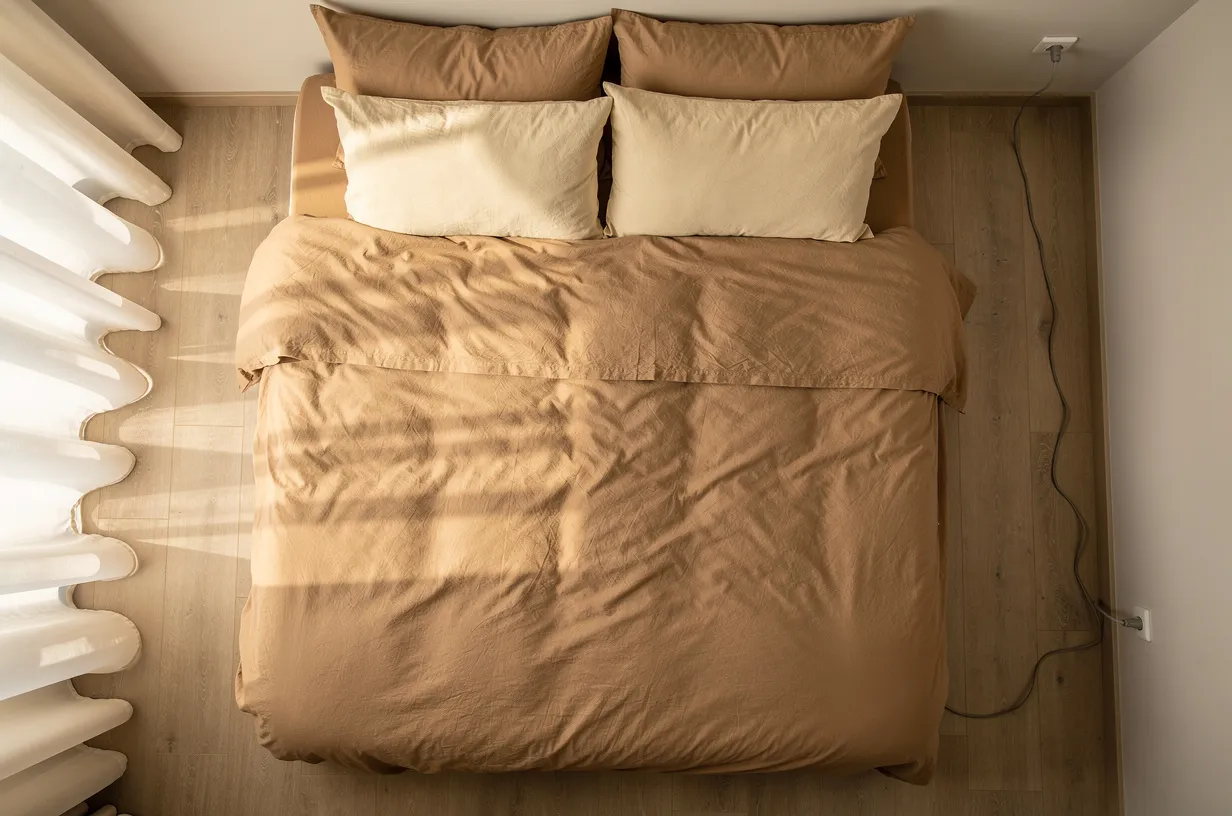
If you and your partner share a bed, you don’t need two grounded outlets to ground it. A full-size fitted grounding sheet is one continuous conductive layer, so a single cord to a single outlet earths the whole surface, both sides included. The question usually comes up because people picture two separate sheets, not because the setup actually requires two circuits.
One properly grounded outlet is enough for two people sharing a bed on a single fitted sheet. You only need a second connection if you and your partner are running two separate half-sheets or mats.
Why one outlet covers the whole bed
A grounding sheet works by weaving conductive thread, usually stainless steel or silver, through the fabric edge to edge. That mesh is electrically one piece, not two zones stitched together. One snap or clip connects it to one cord, and that cord runs to the wall.
Because the fabric itself carries the connection across the whole surface, whoever is touching it, on either side of the mattress, is resting on the same grounded layer. When I tested a queen-size sheet with my partner for two weeks, we never needed a second cord. One outlet did the job for both of us the entire time.
This is also why a full-size sheet under a fitted sheet, rather than two narrow mats, tends to be the simpler setup for couples. We cover the full walkthrough in How to Set Up a Grounding Sheet: Outlet vs Ground Rod and How to Use Grounding Sheets: Setup, Care and Daily Practice if you’re starting from scratch.
What if you and your partner use two separate sheets or mats
Some couples prefer two independent mats instead of one shared sheet, often because only one person wants to try grounding. That’s the scenario where you actually need to think about outlet capacity.
The fix is straightforward. Plug a basic power strip into the single grounded outlet near the bed, then run both grounding cords into the strip. As long as the strip passes the ground pin through cleanly and the wall outlet behind it is genuinely grounded, both mats connect to earth just fine. A surge-protected strip works the same way for this purpose, and we go into more detail on that in Can You Use a Grounding Sheet With a Surge Protector?.
The part worth checking first is whether the outlet is actually grounded at all. A cheap three-prong outlet tester from a hardware store tells you in seconds, and it’s worth the few dollars before you trust any setup, shared or not.
Is it safe to run two grounding cords off one power strip?
Yes, and this trips people up because they’re thinking about it like a power draw problem. It isn’t. The ground pin is a passive safety path back to the building’s earth connection, not a live circuit that gets divided among devices plugged into it.
Two, three, or more grounding cords sharing that pin doesn’t dilute anything the way running several space heaters off one outlet would strain the hot wire. What actually matters is whether the strip and outlet are wired correctly in the first place. If you’re also curious how this interacts with GFCI-protected outlets specifically, that’s covered in Grounding Sheets and GFCI Outlets Explained.
What if only one nightstand has an outlet nearby
This is the more common real-world snag. Most grounding sheet cords run six to ten feet, which reaches one nightstand easily but sometimes falls short of the far side of a king bed. Check the cord length on the specific product before you buy if your bed is wide or your outlet sits behind furniture.
A short, well-rated extension cord can bridge the gap safely, but it needs its own working ground pin, and daisy-chaining multiple cheap extensions is where things get sketchy. Renters dealing with awkward outlet placement, especially in older buildings, will find more on this in Grounding Sheet Cords and Connectors Explained.
One sheet vs two: what actually changes
| Setup | Outlets needed | Best for |
|---|---|---|
| Single full-size grounding sheet | One | Couples who both want to be grounded, simplest wiring, one cord to manage |
| Two separate sheets or mats | One, via a shared power strip | Only one partner wants to try it, or you each prefer your own zone |
Neither option is more or less “grounded” than the other. The difference is really about convenience and whether you want to share a connection point or keep things separate.
The honest bottom line
The electrical side of this is simple: one outlet, one cord, one continuous fabric layer covers two people. The health claims tied to grounding, mostly around sleep and relaxation, come from small early studies and haven’t been tested at the scale that would let anyone promise results. Treat it as low-risk to try, not as anything close to medical treatment, and talk to your doctor first if you have a pacemaker or another implanted device.
If you’re setting up for two and want the least fuss, a single full/queen/king fitted sheet with one cord is usually the easier buy over two separate mats and a power strip.
Premium Grounding Sheet
30% stainless-steel fibers instead of silver, so it will not oxidize and lasts about five times longer. Fits under your fitted sheet, ships worldwide, and comes with a 90-night trial and a 3-year warranty.
Check price on Premium GroundingWhatever you land on, verify the outlet before you trust it, and keep the cord and connectors in good shape so the setup stays doing what it’s supposed to.
Frequently asked questions
Do both people need their own grounding cord?
No. If you share one fitted grounding sheet, it’s a single conductive panel, so one cord and one outlet connects the whole surface, both sides included.
Can I plug a grounding sheet into a power strip?
Yes, as long as the strip itself is plugged into a properly grounded, three-prong outlet with an intact ground pin. Sharing that outlet with a lamp or a phone charger doesn’t weaken the earth connection.
What if my partner doesn’t want to be grounded?
Use a half-size sheet or mat that only covers your side of the mattress, or look for a design with two independent zones so only your side connects to the outlet.
Is an extension cord a problem for a two-outlet setup?
An extension cord isn’t automatically unsafe, but the cord and any adapters need an intact ground pin. See our guide on grounding sheets and extension cords for what to check before you use one.
Does sharing an outlet overload the grounding connection?
No. The ground pin is a passive safety path, not a shared power circuit, so it doesn’t get overloaded the way the hot and neutral wires can under heavy load.
- How to Wash Grounding Sheets Without Killing Conductivity
- How to Set Up a Grounding Sheet: Outlet vs Ground Rod
- How Do I Ground Myself? 7 Ways, From Free to Effortless
- Grounding Outside: Best (and Worst) Surfaces for Earthing
- Grounding in the City: How to Earth Yourself in an Apartment
- DIY Grounding Sheets: Can You Make Your Own? (And Should You?)
- Grounding While Traveling: How to Earth Yourself Away From Home
- 7 Grounding Sheet Setup Mistakes That Kill the Connection
- No Grounded Outlet? How to Use a Grounding Sheet
- Using a Ground Rod for Your Grounding Sheet
- Grounding Sheets and GFCI Outlets Explained
- Grounding in an Apartment: What Works
← How to Use Grounding Sheets: Setup, Care and Daily Practice