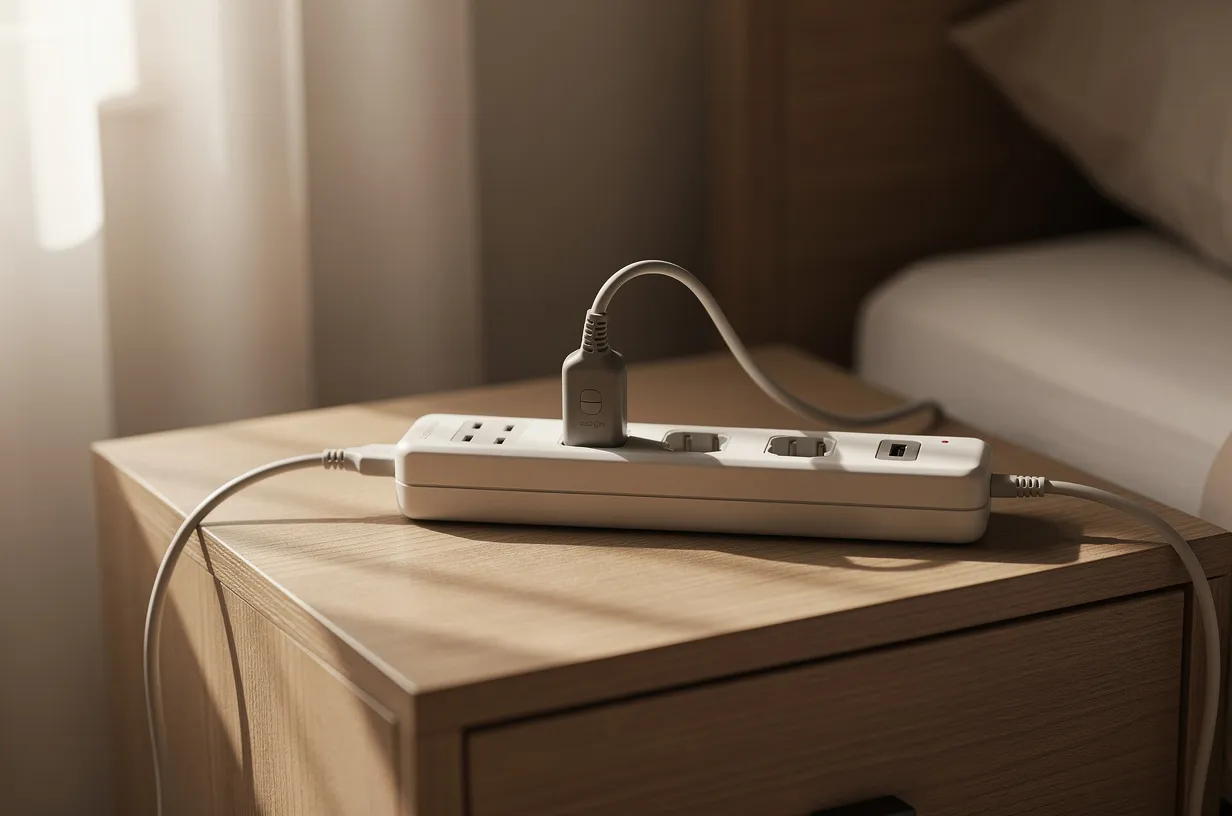
Yes, you can plug a grounding sheet into a surge protector. For most bedrooms it is actually the more practical setup than fighting for a bare wall outlet behind the nightstand. The part that actually matters isn’t the strip itself, it’s what that strip is plugged into: your sheet only grounds properly if the surge protector’s own outlet has a real, working ground.
Here’s the short version, then the reasoning behind it.
A grounding sheet works fine through a surge protector, as long as the strip is plugged into a genuinely grounded three-prong outlet and you’re not using a two-prong “cheater” adapter anywhere in the chain.
Does a surge protector block or weaken the ground connection?
No, not on a normal three-prong strip. A surge protector’s job is to catch voltage spikes on the hot line, usually with a small component called a metal oxide varistor. The ground pin on the strip is just wired straight through to every outlet on it, the same ground pin that’s already in your wall.
Your grounding sheet’s cord has a built-in resistor and pulls almost no current. It isn’t competing with your lamp or your phone charger for anything. It just needs a continuous, low-resistance path back to earth, and a decent surge protector gives you that exact same path the wall outlet would.
What’s actually happening in that outlet chain
The path runs: your skin, the sheet’s conductive threads, the grounding cord, the strip’s ground pin, the wall outlet’s ground terminal, and finally the building’s grounding system, which ties back to earth. Every link in that chain has to actually be connected for the sheet to do anything.
Most people never check the middle links. The strip usually isn’t the weak point, an old or miswired wall outlet is. If you want the full setup walk-through, we cover the outlet-versus-ground-rod question in How to Set Up a Grounding Sheet: Outlet vs Ground Rod.
When you should skip the surge protector
A few situations are genuinely worth avoiding, and they’re not about the surge protector feature at all, they’re about the ground pin getting lost somewhere in the setup.
- Never use a two-prong “cheater” adapter to force a three-prong strip into an old two-slot outlet. That adapter often has no real ground path at all, it just lets the plug fit.
- Be careful with battery-backup units (UPS). Some of their outlets are filtered differently than a plain surge strip, and while most still pass a real ground through, it’s worth confirming rather than assuming.
- Skip unbranded strips with no safety listing (UL or ETL, usually printed right on the label). Cheap, unlisted strips are the ones most likely to have a ground pin that looks connected but isn’t.
| Setup | Safe for a grounding sheet? | Why |
|---|---|---|
| Name-brand surge protector, plugged into a grounded outlet | Yes | Ground pin passes straight through |
| Battery-backup / UPS unit | Usually, confirm first | Most pass ground through, but test the outlet to be sure |
| Strip plugged in via a 2-prong cheater adapter | No | Ground pin is often not actually connected |
| Unbranded strip, no UL/ETL listing | Skip it | Ground continuity isn’t guaranteed |
How to check your setup is actually safe
A cheap outlet tester, the kind with three little lights, is the fastest way to know for sure. Plug it into the wall outlet first, then into the surge protector itself, and check both read “correctly wired.” It costs less than a dollar-store impulse buy and takes about ten seconds.
If the wall reading looks off, that’s a wiring issue behind the outlet, not something a better sheet or a different strip will fix. We walk through what to do if you land in that spot in No Grounded Outlet? How to Use a Grounding Sheet. If your bedroom outlet is a GFCI type, that’s a separate question we answer in Grounding Sheets and GFCI Outlets Explained.
Sharing the strip with other devices
You can run a lamp, a phone charger and your grounding sheet off the same strip without any of them interfering with each other. They’re each drawing power through separate hot and neutral paths, and they all share the same ground pin without conflict. If your outlet situation involves a long run to reach the bed, our guide to Grounding Sheets and Extension Cords: Is It Safe? covers the added variable a cord run introduces.
If you’re shopping for a sheet at the same time, look for one with a cord long enough to reach whichever outlet you’re actually using, strip or not. That sounds obvious until you’ve bought one with a six-foot cord for a bed that sits ten feet from the nearest plug.
Premium Grounding Sheet
30% stainless-steel fibers instead of silver, so it will not oxidize and lasts about five times longer. Fits under your fitted sheet, ships worldwide, and comes with a 90-night trial and a 3-year warranty.
Check price on Premium GroundingThe one habit worth keeping
Test the outlet once when you set up, then leave it alone. You don’t need to retest every week. If you ever get a faint tingling sensation or your sheet suddenly feels “off,” that’s your cue to pull out the tester again rather than assume the strip is the problem. For more troubleshooting steps, see How to Test a Grounding Sheet With a Multimeter and our full guide to How to Use Grounding Sheets: Setup, Care and Daily Practice.
Frequently asked questions
Will a surge protector reduce how well a grounding sheet works?
No. A surge protector’s ground pin is wired straight through to its outlets, the same ground pin already in your wall. As long as that outlet is properly grounded, the strip doesn’t change anything for your sheet.
Can I plug a grounding sheet into a battery backup (UPS)?
Usually, but confirm it first with an outlet tester rather than assuming. Most UPS units pass a real ground through to their outlets, but the internal wiring varies more between brands than a basic surge strip does.
Is it safe to run a grounding sheet and other electronics off the same strip?
Yes. Each device on the strip uses its own hot and neutral connection and just shares the common ground pin. A lamp or charger on the same strip won’t interfere with your sheet’s connection.
What if my surge protector only has two prongs?
Skip it for a grounding sheet. A two-prong strip, or a three-prong strip forced into an outlet with a cheater adapter, often has no real ground path, which means your sheet isn’t actually grounded even though it’s plugged in.
How do I know if my outlet is properly grounded before plugging in?
Use a cheap three-light outlet tester on the wall outlet the strip is plugged into. It takes seconds and tells you immediately if the wiring is correct, rather than leaving you guessing.
- How to Wash Grounding Sheets Without Killing Conductivity
- How to Set Up a Grounding Sheet: Outlet vs Ground Rod
- How Do I Ground Myself? 7 Ways, From Free to Effortless
- Grounding Outside: Best (and Worst) Surfaces for Earthing
- Grounding in the City: How to Earth Yourself in an Apartment
- DIY Grounding Sheets: Can You Make Your Own? (And Should You?)
- Grounding While Traveling: How to Earth Yourself Away From Home
- 7 Grounding Sheet Setup Mistakes That Kill the Connection
- No Grounded Outlet? How to Use a Grounding Sheet
- Using a Ground Rod for Your Grounding Sheet
- Grounding Sheets and GFCI Outlets Explained
- Grounding in an Apartment: What Works
← How to Use Grounding Sheets: Setup, Care and Daily Practice