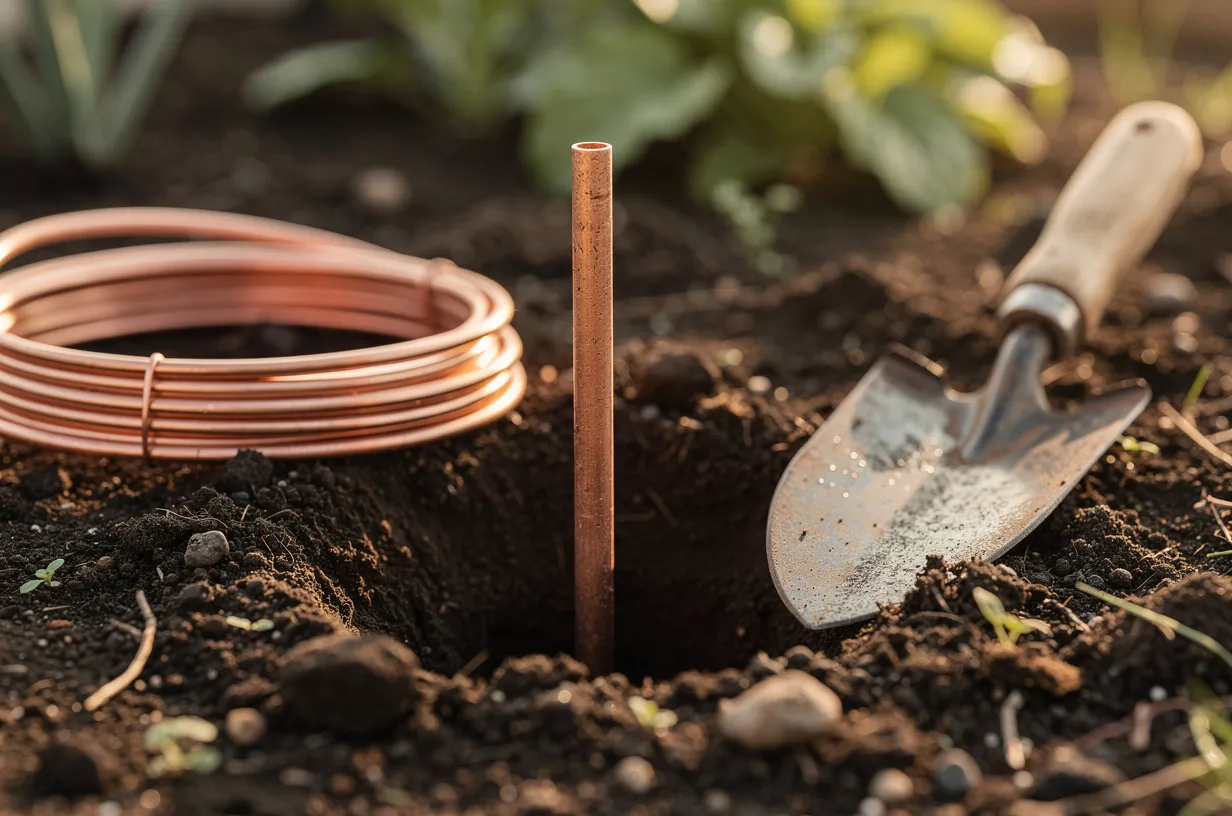
Grounding sheet forums love a DIY ground rod. Hammer a copper rod into the backyard, clamp a wire to it, run the wire to your sheet, and you’re “really” grounded, not just plugged into a wall like everyone else. It sounds more legitimate. Most of the time it isn’t necessary, and done carelessly it can cause more trouble than it solves.
If your bedroom outlet has a working ground pin, that outlet is already wired to a rod, one installed by an electrician and tied into your home’s grounding system. Skip the DIY rod unless you genuinely have no grounded outlet, or you’re setting up somewhere without house wiring at all, like a tent or a detached shed.
Do you actually need a ground rod for your grounding sheet?
For the vast majority of people sleeping in a house or apartment with modern wiring, no. The three-prong outlet by your bed already has a path to earth built in. That’s the whole point of the ground pin. A grounding sheet’s cord clips onto that pin through an outlet adapter, and the electrical connection is complete without you ever touching a shovel.
The idea that a personal rod is “more grounded” comes from earlier earthing experiments, back before pre-made consumer sheets and simple outlet plugs were common. It’s a holdover, not a current requirement.
What’s actually different between an outlet ground and a ground rod?
Your outlet’s ground wire runs back to the ground bus in your breaker panel, which is bonded to a rod already driven near your home’s service entrance, or sometimes to a metal water pipe. Your outlet is already connected to a rod, just one an electrician installed and tested to code, not one you drove yourself under the bedroom window.
A second, separate rod near your bed doesn’t stack on top of that connection the way people assume. Two rods that aren’t properly bonded together can sit at slightly different earth potentials, which electricians flag as an issue, not a bonus. If you’re not sure your outlet is grounded correctly, check that first. Our guide to How to Test a Grounding Sheet With a Multimeter walks through a simple way to confirm the connection is actually working.
When a separate ground rod actually makes sense
There are a few situations where a rod isn’t overkill.
- You have no grounded outlet at all, only old two-prong outlets with no ground pin to use. We cover the outlet-side workarounds in No Grounded Outlet? How to Use a Grounding Sheet.
- You’re grounding somewhere with no house wiring nearby, a detached shed, a converted studio, an RV parked off-grid, or you’re grounding outdoors on purpose. If that’s the case, see Grounding Outside: Best (and Worst) Surfaces for Earthing.
- You want a backup for a location where the wiring is old or unreliable and you’d rather not depend on it.
Outside of those, most people are better off using the wall outlet they already have. It’s simpler, it’s already tested by code when the house was wired, and it doesn’t involve digging.
How to set up a ground rod safely, if you truly need one
If one of the situations above applies to you, the setup itself isn’t complicated, but it’s worth doing right.
- Use a copper or copper-clad steel rod, typically 6 to 8 feet, driven into soil that stays reasonably moist. Dry, sandy soil conducts poorly and can leave you with a rod that looks connected but barely works.
- Attach an insulated ground clamp to the rod, then run insulated wire from the clamp to your sheet’s grounding snap or cord. Don’t leave bare wire exposed where you or a pet will touch it.
- Test the connection with a multimeter before you trust it, the same way you’d test an outlet connection. See How to Test a Grounding Sheet With a Multimeter for the actual steps.
- Never tie your grounding rod into a lightning rod system, a gas line, or any existing plumbing you’re not sure is safe to use. Those are different systems with different jobs.
Outlet ground vs a DIY ground rod
| Setup | Effort | Reliability | Best for |
|---|---|---|---|
| Wall outlet ground pin | Plug in an outlet adapter, done | High, already tested when the house was wired to code | Almost everyone with a modern grounded outlet |
| DIY ground rod | Buy a rod, dig, clamp, test | Depends entirely on soil moisture and installation quality | No grounded outlet available, off-grid or outdoor setups |
What can go wrong with a DIY ground rod
A rod driven too shallow, or into soil that dries out for weeks at a time, can give you a connection that reads as grounded on paper but carries too much resistance to do much. Clamps corrode where they meet the rod, especially through a rainy season, and a corroded connection quietly stops working long before you notice. Mixing a separate rod with your house’s panel ground, without an electrician bonding the two together, is the kind of thing that gets flagged in an inspection, not something to improvise on a Saturday afternoon.
If your outlet situation is unusual, an adjustable base, an old apartment panel, a shared circuit, check whether a GFCI outlet changes anything before you reach for a rod at all. We cover that specifically in Grounding Sheets and GFCI Outlets Explained.
Does any of this change what grounding actually does for you?
No. Whether your sheet’s cord ends at an outlet ground pin or a rod you drove yourself, the mechanism is the same, and so is the evidence behind it. Ghaly and Teplitz’s 2004 pilot, still the most cited study, reported that grounding during sleep shifted cortisol toward a more typical day-night rhythm and improved participants’ own reports of sleep, pain and stress. It was small and unblinded. Sokal and Sokal, and a small blood-viscosity study from Chevalier, reported other physiological changes in similarly small samples. A 2015 review by Oschman, Chevalier and Brown proposes that electrons from the earth act as antioxidants, but that’s a hypothesis from a narrative review, not proof from a large trial.
A rod isn’t a stronger dose of anything. It’s just a different path to the same earth connection, and for most bedrooms, the one already in your wall is the simpler and more reliable choice.
If you’re setting up a grounding sheet for the first time and just want a straightforward outlet connection without any of this,
Premium Grounding Sheet
30% stainless-steel fibers instead of silver, so it will not oxidize and lasts about five times longer. Fits under your fitted sheet, ships worldwide, and comes with a 90-night trial and a 3-year warranty.
Check price on Premium GroundingFrequently asked questions
Is a ground rod safer than using my wall outlet?
Not necessarily. A properly wired outlet is tested to code and connects to a rod an electrician already installed. A DIY rod’s safety depends entirely on how well you install and maintain it.
Can I use a ground rod for camping or outdoor grounding?
Yes, that’s one of the few cases where a rod makes sense, since there’s no house wiring to plug into outdoors.
How deep does a ground rod need to be driven?
Standard practice is 6 to 8 feet in soil that holds some moisture. Shallow or bone-dry soil conducts poorly and can leave you with a weak connection.
Can I connect my grounding sheet to a cold water pipe instead of a rod?
Only if you know for certain it’s an uninterrupted metal pipe tied into your home’s grounding system, and many modern homes use plastic piping that won’t work at all. When in doubt, use the outlet ground pin instead.
Will a ground rod make my grounding sheet work better than an outlet connection?
No. Both connect you to earth potential. A rod doesn’t add strength, it’s just an alternate path, and it’s only necessary when a grounded outlet isn’t available.
- How to Wash Grounding Sheets Without Killing Conductivity
- How to Set Up a Grounding Sheet: Outlet vs Ground Rod
- How Do I Ground Myself? 7 Ways, From Free to Effortless
- Grounding Outside: Best (and Worst) Surfaces for Earthing
- Grounding in the City: How to Earth Yourself in an Apartment
- DIY Grounding Sheets: Can You Make Your Own? (And Should You?)
- Grounding While Traveling: How to Earth Yourself Away From Home
- 7 Grounding Sheet Setup Mistakes That Kill the Connection
- No Grounded Outlet? How to Use a Grounding Sheet
- Grounding Sheets and GFCI Outlets Explained
- Grounding in an Apartment: What Works
- Grounding Sheets on Adjustable Beds
← How to Use Grounding Sheets: Setup, Care and Daily Practice