If you’re a nurse working rotating 12-hour shifts, a grounding sheet won’t fix a schedule that fights your circadian rhythm. But the small pool of research on grounding and sleep, thin as it is, points mostly at one thing: better subjective sleep quality and a calmer nervous system at bedtime. For someone sleeping at 9am after a night shift, that’s not nothing.
Grounding sheets aren’t a fix for shift work sleep problems, but the sleep-and-relaxation research is real enough (and the risk low enough) that many night-shift nurses find it worth adding to a proper daytime sleep setup.
Why do nurses ask about grounding at all?
Shift work messes with the body’s internal clock. Nurses on rotating or night shifts report worse sleep, more fatigue, and higher stress than people on regular daytime hours. Sleep clinicians usually recommend blackout curtains, consistent nap timing, and limiting light exposure before bed as the first line of defense. Grounding sheets come up because they’re marketed as a low-effort add-on to that routine, not a replacement for it.
The honest starting point is this: nothing about grounding is designed to correct a misaligned circadian rhythm. If you’re falling asleep at dawn and waking at dusk, that’s a light and timing problem first.
What does the sleep research actually say?
The most-cited study here is Ghaly and Teplitz (2004), a small, unblinded pilot published in the Journal of Alternative and Complementary Medicine. It found that sleeping grounded shifted participants’ cortisol rhythm closer to a normal day-night pattern and improved self-reported sleep, pain and stress. That’s the study behind most “grounding helps sleep” claims, and it’s worth knowing it was small and relied on people’s own reports rather than objective sleep tracking.
A broader hypothesis paper by Oschman, Chevalier and Brown (2015) proposes that contact with the earth’s electrons may have an antioxidant-like effect on inflammation. That’s a proposed mechanism, not a proven one. Sleep is genuinely the best-supported outcome in this body of research, and even that comes from a handful of small studies, several run by the same research group. Nothing here suggests grounding resets a circadian clock or treats shift work sleep disorder, and no reputable source claims it does.
Does it actually help with daytime sleep after a night shift?
There’s no study specific to shift workers or daytime sleeping. What you’re borrowing from is the general sleep-and-relaxation research, applied to a harder sleep window. Daytime sleep is already fighting your body’s natural wake signal, so anything that nudges you toward feeling calmer at lights-out is worth trying, as long as you’re not expecting it to do the heavy lifting.
Nurses who’ve told us it helped usually describe it the same way: it’s part of a wind-down routine, not a standalone fix. Blackout shades, a fan or white noise, and a fixed sleep window still matter more.
| What actually moves the needle for shift-work sleep | How much evidence backs it |
|---|---|
| Blackout curtains / eye mask | Strong, well-established |
| Consistent sleep and wake times, even on days off | Strong, sleep-medicine consensus |
| Limiting bright light exposure on the drive home | Strong, circadian research |
| Grounding sheet as an add-on for relaxation | Small, early-stage, self-reported |
How do you actually use one on a rotating schedule?
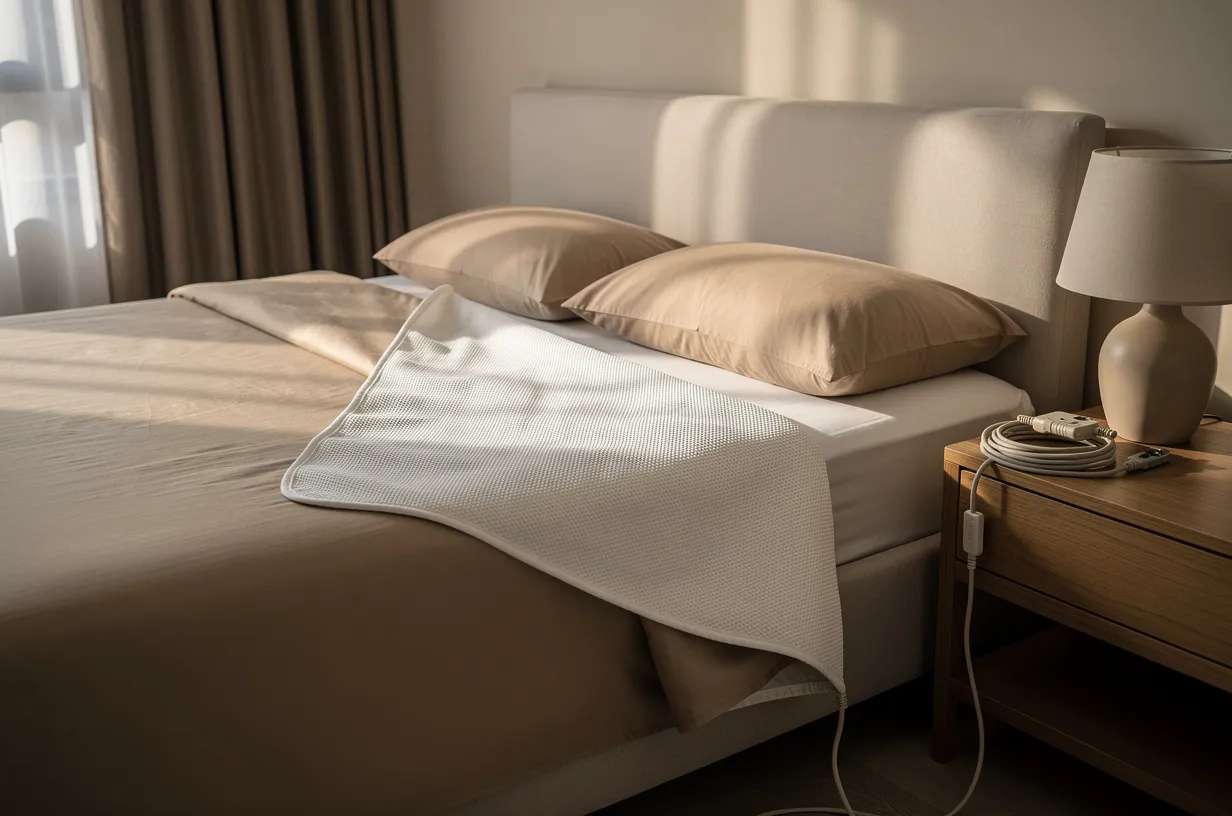
Setup doesn’t change because you sleep odd hours. You still need a three-prong grounded outlet within reach of the bed and a snap connection between the sheet and the cord. What does change is convenience: you’re plugging and unplugging around a schedule that shifts week to week, so it helps to leave the outlet tester and cord in a fixed spot near the bed rather than packing it away between shifts.
If you split time between a bedroom for night sleep and a different room or a partner’s schedule, you may want a second cord rather than moving the sheet itself. We cover the full outlet-versus-ground-rod setup in our How to Set Up a Grounding Sheet: Outlet vs Ground Rod guide, and if you’re renting or living in an apartment with older wiring, our Grounding in an Apartment: What Works guide walks through what to check first.
What if the schedule itself is the real problem?
Be honest with yourself about what’s driving the fatigue. If you’re waking up gasping, snoring loudly, or dragging through entire shifts despite a decent sleep window, that’s a conversation for a doctor, not a bedding upgrade. Grounding sheets are not a treatment for shift work sleep disorder, insomnia, or any diagnosed sleep condition, and nothing in the research supports using one that way. Talk to your doctor if fatigue is affecting your safety at work.
For the specific mechanics of night-shift sleep hygiene, our Grounding Sheets for Night Shift Workers guide goes deeper into scheduling and light management, and How Often Should You Use a Grounding Sheet? covers how consistent your grounding use actually needs to be to notice anything.
Is a grounding sheet worth buying for this?
If your daytime sleep setup is already solid, blackout, consistent timing, quiet room, and you want a low-risk add-on that’s backed by at least some sleep-specific research, it’s a reasonable one to try. If you’re hoping it will undo a rough rotating schedule on its own, it won’t.
Premium Grounding Sheet
30% stainless-steel fibers instead of silver, so it will not oxidize and lasts about five times longer. Fits under your fitted sheet, ships worldwide, and comes with a 90-night trial and a 3-year warranty.
Check price on Premium GroundingFrequently asked questions
Can a grounding sheet fix shift work sleep disorder?
No. Shift work sleep disorder is a diagnosed condition and should be discussed with a doctor. Grounding sheets aren’t a treatment for it; the research only points to modest, self-reported sleep and relaxation benefits in small studies.
Do I need a different grounding setup for daytime sleep?
No. The setup is identical to nighttime use, a grounded three-prong outlet and a properly connected cord. What changes is your light and noise control, which matters more for daytime sleep than the grounding itself.
Is it safe to use a grounding sheet if I only sleep four to six hours between shifts?
Yes, from an electrical standpoint duration doesn’t matter, the sheet connects to the outlet’s ground pin, not live power. The bigger question is whether four to six hours is enough sleep at all, which is worth raising with a doctor if it’s chronic.
Will it help me fall asleep faster after a night shift?
Possibly, based on the small relaxation and cortisol research, but there’s no study on shift workers specifically. Most nurses who like it treat it as one part of a wind-down routine alongside blackout curtains and a fixed schedule.
Should I bring a grounding sheet if I nap at the hospital or in my car?
Only if there’s a safe, grounded outlet available, which is rare in a break room or car. For on-the-go naps, focus on light-blocking and comfort first; grounding is realistically a home-bed tool.
- How to Wash Grounding Sheets Without Killing Conductivity
- How to Set Up a Grounding Sheet: Outlet vs Ground Rod
- How Do I Ground Myself? 7 Ways, From Free to Effortless
- Grounding Outside: Best (and Worst) Surfaces for Earthing
- Grounding in the City: How to Earth Yourself in an Apartment
- DIY Grounding Sheets: Can You Make Your Own? (And Should You?)
- Grounding While Traveling: How to Earth Yourself Away From Home
- 7 Grounding Sheet Setup Mistakes That Kill the Connection
- No Grounded Outlet? How to Use a Grounding Sheet
- Using a Ground Rod for Your Grounding Sheet
- Grounding Sheets and GFCI Outlets Explained
- Grounding in an Apartment: What Works
← How to Use Grounding Sheets: Setup, Care and Daily Practice