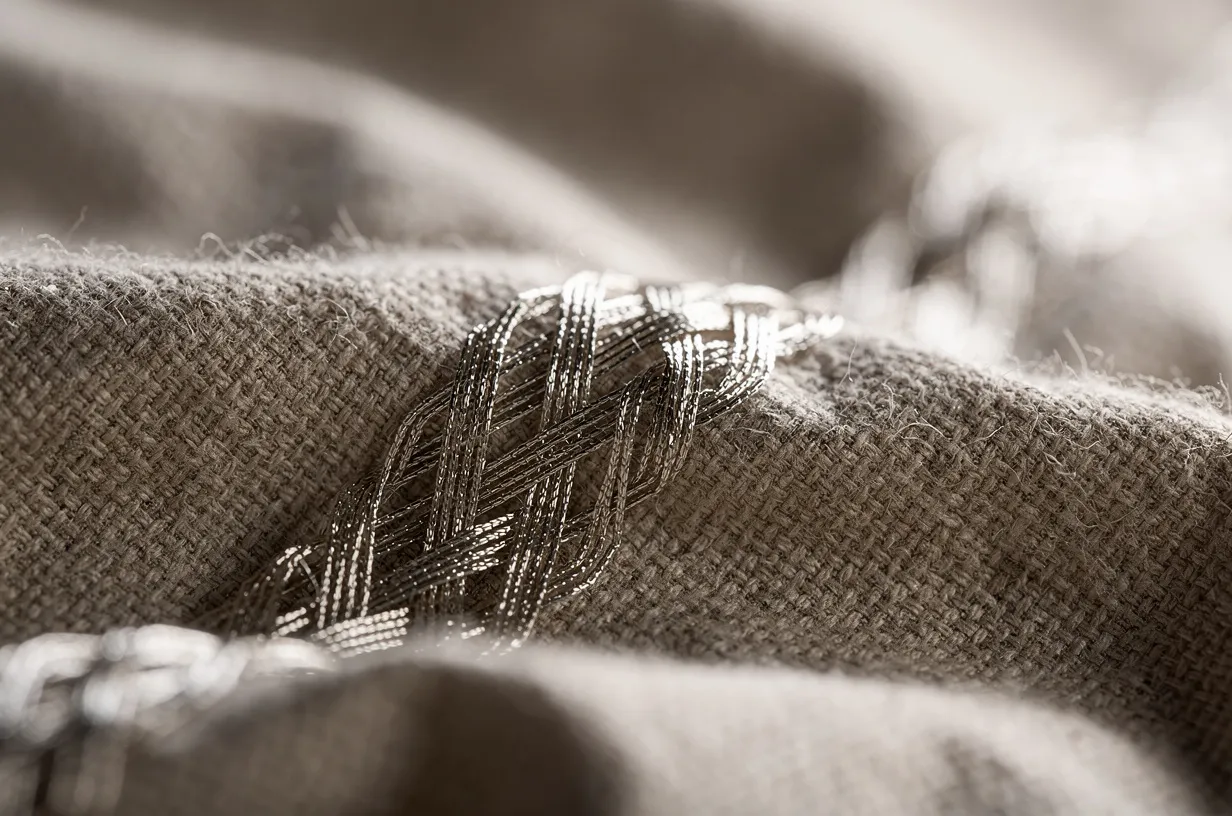
Conductive grounding fabric is the material doing the actual work inside every earthing sheet, blanket or mat: threads woven through cotton that carry electrons from your skin to a cord, then to your wall outlet’s ground pin. Not all conductive fabric is the same, and the type used in a product tells you more about how long it’ll actually work than the marketing copy does.
What is conductive grounding fabric made of?
Three materials show up again and again. Silver-coated nylon or cotton thread is the oldest and most common, usually woven in a grid pattern with a faint sheen. Stainless-steel fiber thread looks duller and feels a bit stiffer at first, but it’s the material our Grounding Fitted Sheets: How They Differ testing increasingly points to for longevity. Carbon-infused fabric or rubber shows up mostly in mats and desk pads rather than bedding, because it’s thicker and less soft against skin.
All three carry electrons across the fabric to a snap or grommet, which connects to a grounding cord, which plugs into the ground pin of a standard outlet. That electrical path is well understood and not controversial. What’s less settled is what, if anything, that electron flow does for your body once you’re grounded, which we get into further down.
Does silver or stainless steel conduct better?
Fresh out of the packaging, silver-thread fabric usually tests as slightly more conductive than stainless steel, since silver is simply a better conductor. The catch is oxidation. Silver tarnishes with repeated washing, sweat and air exposure, and as it oxidizes, its ability to carry a current drops. Some silver-thread sheets that felt snappy-conductive new measure noticeably weaker after a year of regular laundering.
Stainless steel doesn’t oxidize the same way. It starts a touch less conductive, but that number stays close to flat over years of washing. If you actually launder your bedding weekly, that durability gap matters more than silver’s small initial edge. That’s the honest reason stainless-steel sheets tend to outlast silver-thread ones in real use.
| Fabric type | Initial conductivity | Durability over time | Feel | Best for |
|---|---|---|---|---|
| Silver-coated thread | Very good | Drops with washing/oxidation | Soft, slight sheen | Short-term testers, lighter use |
| Stainless-steel fiber | Good | Holds steady for years | Slightly firmer, breaks in | Daily sleepers who wash often |
| Carbon-infused fabric/rubber | Good, steady | Very durable, doesn’t oxidize | Stiffer, not bedding-soft | Mats, desk pads, not sheets |
Do you need bare skin touching the fabric to be grounded?
Yes, mostly. Conductive fabric works through direct skin contact, or damp skin through a single thin layer at most. That’s why grounding sheets sit as the layer closest to you, either fitted or a half-sheet you lie directly on. Slip a thick regular sheet between you and the conductive fabric and you’ve broken the circuit. More coverage doesn’t help without skin contact, which is also why grounding pillowcases and socks exist separately, putting conductive fabric where a sheet’s contact area might miss.
How long does conductive fabric actually last?
With normal weekly washing on gentle and air-drying (heat is hard on both silver coating and stitched-in threads), stainless-steel fabric commonly holds usable conductivity for several years. Silver-thread fabric’s practical lifespan is shorter, often noticeably reduced within a year or two of regular washing, though it varies by brand and habits. Either way, conductive fabric is a wear item, not a lifetime one. If a sheet stops registering on a continuity tester, the fabric has likely degraded rather than failed outright.
Is grounding fabric safe to wash and dry normally?
Machine wash cold or warm on gentle, skip fabric softener (it coats the conductive threads and insulates them, which defeats the point), and air-dry or use low heat. That’s the standard care instruction across nearly every brand we’ve checked, and skipping it is the fastest way to shorten the fabric’s working life regardless of material.
Does conductive fabric actually do anything for your health?
Be honest about this part. The electrical connection through conductive fabric to your outlet’s ground pin is real and measurable. What that connection does inside your body is a much thinner body of evidence. Ghaly and Teplitz’s 2004 pilot found grounding during sleep shifted cortisol rhythm and improved self-reported sleep, pain and stress in a small, unblinded group. Sokal and Sokal’s 2011 work reported changes in a handful of blood markers, again in small samples, and Chevalier’s 2013 blood-viscosity study was tiny. The 2015 Oschman, Chevalier and Brown paper proposing an “electron antioxidant” mechanism is a hypothesis, not proof.
None of that means grounding fabric treats or cures anything, and no reputable source says it does. The most defensible claim is that grounding may support sleep and relaxation for some people. If you have a pacemaker, another implanted device, or you’re pregnant, talk to your doctor before adding any grounding product, and verify your outlet is properly grounded with a cheap tester first.
Which fabric should you actually buy?
If you want a sheet you’ll wash weekly for years without the conductivity fading, stainless-steel fiber fabric is the more honest long-term choice, even though silver tests marginally better on day one. That’s the reasoning behind our top pick, which uses 30% stainless-steel fibers specifically to avoid the oxidation problem silver-thread sheets run into.
Premium Grounding Sheet
30% stainless-steel fibers instead of silver, so it will not oxidize and lasts about five times longer. Fits under your fitted sheet, ships worldwide, and comes with a 90-night trial and a 3-year warranty.
Check price on Premium GroundingFor other formats built on similar conductive fabric, our guides to Grounding Blankets: How They Work and When to Pick One Over Sheets and Grounding Mattress Pads: Full-Coverage Earthing Under Your Sheet cover how the same silver-versus-steel tradeoff plays out in blankets and full-bed pads. If you want a smaller way to try the fabric on a specific spot, Grounding Patches: Targeted Earthing Explained covers adhesive options.
Frequently asked questions
Is stainless-steel grounding fabric better than silver?
For durability, generally yes. Silver conducts slightly better when new but oxidizes with washing and loses conductivity over time. Stainless steel starts a touch lower but stays consistent for years, which matters more if you wash your sheets regularly.
Can I tell what fabric a grounding sheet uses just by looking?
Not reliably. Silver-thread fabric often has a faint metallic sheen and feels a bit softer; stainless steel looks duller and feels slightly firmer. Check the product listing or care label for the actual material rather than guessing from a photo.
Does washing ruin conductive fabric?
Normal gentle washing won’t ruin it, but fabric softener, high heat drying and harsh detergents degrade it faster. Wash cold or warm on gentle, skip softener, and air-dry or tumble low.
Do carbon-fiber mats work the same way as fabric sheets?
The principle is the same, electrons moving from skin to a grounded cord, but carbon-infused material is usually built into stiffer mats and pads rather than soft bedding fabric. It’s common in Grounding Yoga Mats: Earthing While You Practice and Grounding Desk Mats: Earthing While You Work products, where durability under repeated contact matters more than softness.
Will conductive fabric shock me?
No. The fabric connects to your outlet’s ground pin, not the live current, so there’s no meaningful shock risk with a properly wired outlet. The real precaution is checking the outlet is actually grounded correctly, which a cheap plug-in tester confirms in seconds.
- Grounding Blankets: How They Work and When to Pick One Over Sheets
- Earthing Blanket Guide: Conductive Throws Compared
- Grounding Pillow Cases: Small Upgrade, Real Contact Hours
- Grounding Socks: Do Conductive Socks Actually Ground You?
- Grounding Mattress Pads: Full-Coverage Earthing Under Your Sheet
- Grounding Shoes and Footwear: Earthing While You Walk
- Grounding Fitted Sheets: How They Differ
- Grounding Flat Sheets: Pros and Cons
- Grounding Half Sheets: A Simpler Option
- Grounding Mattress Covers: Full Coverage Earthing
- Grounding Throw Blankets: Earthing on the Couch
- Grounding Patches: Targeted Earthing Explained
← Grounding Products Beyond Sheets: Blankets, Socks, Pillowcases & More