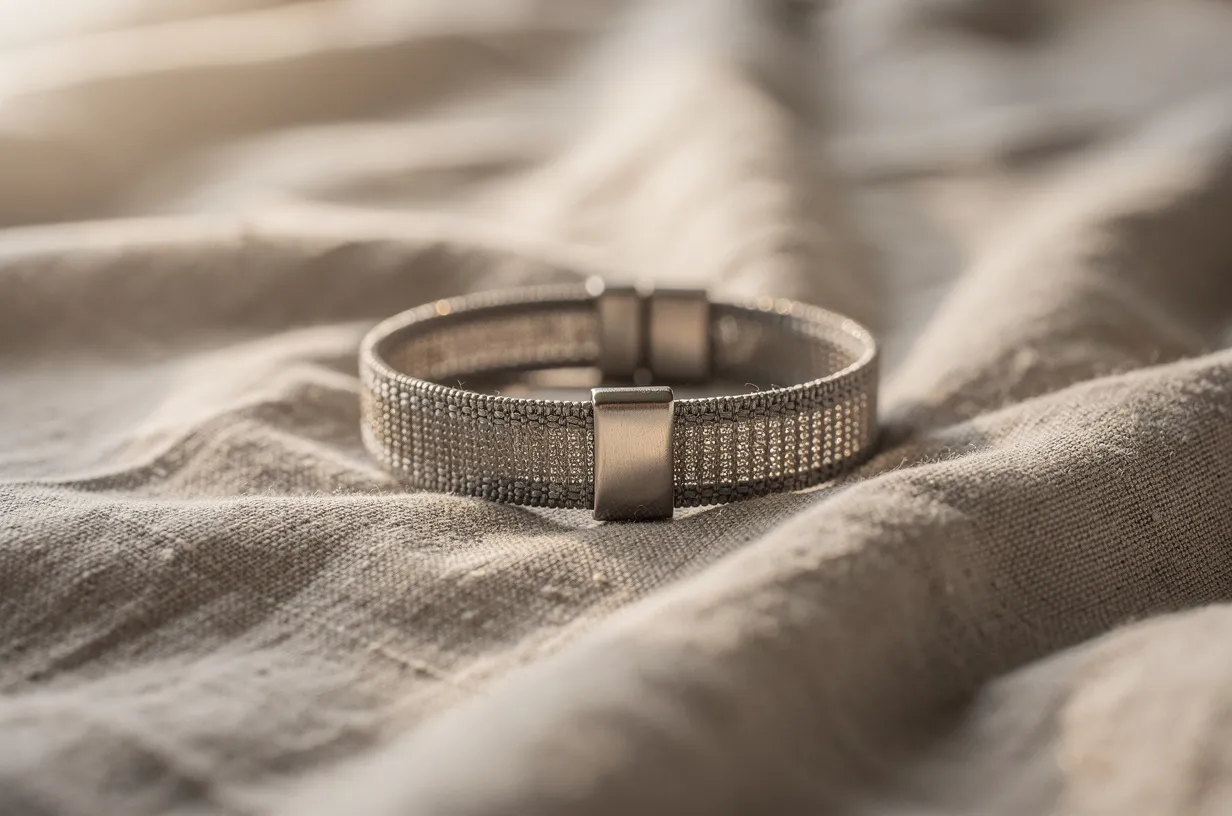
A grounding body band is a conductive strap, usually with a snap connector, that you wrap around a wrist, ankle, knee or waist and plug into a grounding cord. It’s for people who want earthing contact on one specific area rather than a full sheet across the whole bed.
Skip it as your main grounding method. A body band is a fine add-on for a sore joint or for grounding at a desk when a sheet isn’t practical, but skin contact area is tiny compared to a sheet, so don’t expect sheet-level results from a band alone.
What is a grounding body band, exactly?
Picture a wide elastic or fabric strap, similar to a knee brace, woven or coated with conductive thread. A metal snap on the strap connects to a grounding cord, the same style used for sheets and mats, which plugs into the ground pin of a wall outlet.
You wrap it around whatever body part you want direct contact with: a wrist for typing at a desk, an ankle or knee for a joint that’s been bothering you, sometimes a waist band for torso contact while you read or watch TV. It’s grounding jewelry more than grounding bedding.
How does a body band actually connect you to the earth?
The mechanism is identical to a sheet. Your skin touches the conductive fibers, the fibers run to the snap, the snap runs through the cord to the ground terminal in your outlet, and that terminal is bonded to the earth outside your home. No current flows into you from the wall; you’re simply matched to the same electrical potential as the ground itself.
What changes with a band is contact area and duration. A fitted sheet touches a large share of your skin for seven or eight hours while you sleep. A band touches one small patch of skin for however long you keep it strapped on, which for most people is closer to an hour or two at a desk.
Do grounding body bands work as well as a full sheet?
Nobody has run a study that isolates a body band specifically, so this is inference from the broader research, not a direct finding. The studies behind grounding, small pilots like Ghaly and Teplitz (2004) on sleep and cortisol, and the Sokal and Sokal (2011) work on blood markers, all used overnight, whole-body or large-area contact. A band gives you a fraction of that surface area.
Here’s how the main contact options stack up on paper:
| Product | Skin contact area | Typical use | Best for |
|---|---|---|---|
| Grounding sheet | Large, most of the back and legs | Overnight, hours at a time | Sleep, whole-night grounding |
| Grounding body band | Small, one wrist/ankle/knee | While seated, an hour or more | Desk work, a specific sore joint |
| Grounding patch | Very small, a few square inches | Targeted, hours to overnight | One localized spot |
| Grounding socks | Moderate, both feet | Daytime or sleep | People who dislike sheets touching bare skin |
If your goal is better sleep, the outcome the research actually supports, a band around your ankle while you’re awake at a desk isn’t doing the same job as a sheet under you at night. If your goal is contact on a specific sore spot while you work, a band is a reasonable, low-cost way to try it.
Who actually benefits from a body band?
Three groups tend to reach for one. Desk workers who want some grounding contact during the day but can’t run a sheet or mat setup at the office. People who already sleep on a grounding sheet and want extra contact on one joint that bothers them during waking hours. And travelers who want something small and packable rather than a full mat.
If you’re new to grounding and trying to decide whether it does anything for you, a band is one of the cheapest ways to test the waters, but I’d still steer you toward a sheet first if sleep is what you’re chasing. That’s where the studies, thin as they are, actually point.
Is a grounding body band safe to use?
The safety profile is the same as any grounding product: you’re connecting to the ground wire, not live power, so the real risk is a poorly wired outlet rather than the band itself. A cheap outlet tester from a hardware store checks that the ground pin is doing its job before you plug anything in.
Check the fit isn’t cutting off circulation, since some bands use elastic that can be snug. If you have a pacemaker or other implanted device, are pregnant, or manage a condition with medication, talk to your doctor before adding any grounding product, band included. And if the strap ever feels warm, tingly in a bad way, or the cord looks frayed, stop using it.
For most people, though, a body band is low-stakes. It’s not a medical device and it’s not going to hurt you if the outlet behind it is properly grounded.
Band, patch, or sheet: which should you actually buy?
If you’re deciding between accessories, our full breakdown of Grounding Bands and Wristbands: Do They Work? and our guide to Grounding Patches: Targeted Earthing Explained both cover the smaller, targeted-contact category a band sits in. If you want feet-first contact instead, Grounding Socks: Do Conductive Socks Actually Ground You? is the closer comparison. But if sleep is the actual goal, start with the product the evidence is built around.
Premium Grounding Sheet
30% stainless-steel fibers instead of silver, so it will not oxidize and lasts about five times longer. Fits under your fitted sheet, ships worldwide, and comes with a 90-night trial and a 3-year warranty.
Check price on Premium GroundingA band can live alongside a sheet as a daytime add-on, it just shouldn’t replace one if better sleep is what sent you looking for grounding gear in the first place. For the full lineup of accessories beyond the bed, see Grounding Products Beyond Sheets: Blankets, Socks, Pillowcases & More.
Frequently asked questions
- Grounding Blankets: How They Work and When to Pick One Over Sheets
- Earthing Blanket Guide: Conductive Throws Compared
- Grounding Pillow Cases: Small Upgrade, Real Contact Hours
- Grounding Socks: Do Conductive Socks Actually Ground You?
- Grounding Mattress Pads: Full-Coverage Earthing Under Your Sheet
- Grounding Shoes and Footwear: Earthing While You Walk
- Grounding Fitted Sheets: How They Differ
- Grounding Flat Sheets: Pros and Cons
- Grounding Half Sheets: A Simpler Option
- Grounding Mattress Covers: Full Coverage Earthing
- Grounding Throw Blankets: Earthing on the Couch
- Grounding Patches: Targeted Earthing Explained
← Grounding Products Beyond Sheets: Blankets, Socks, Pillowcases & More