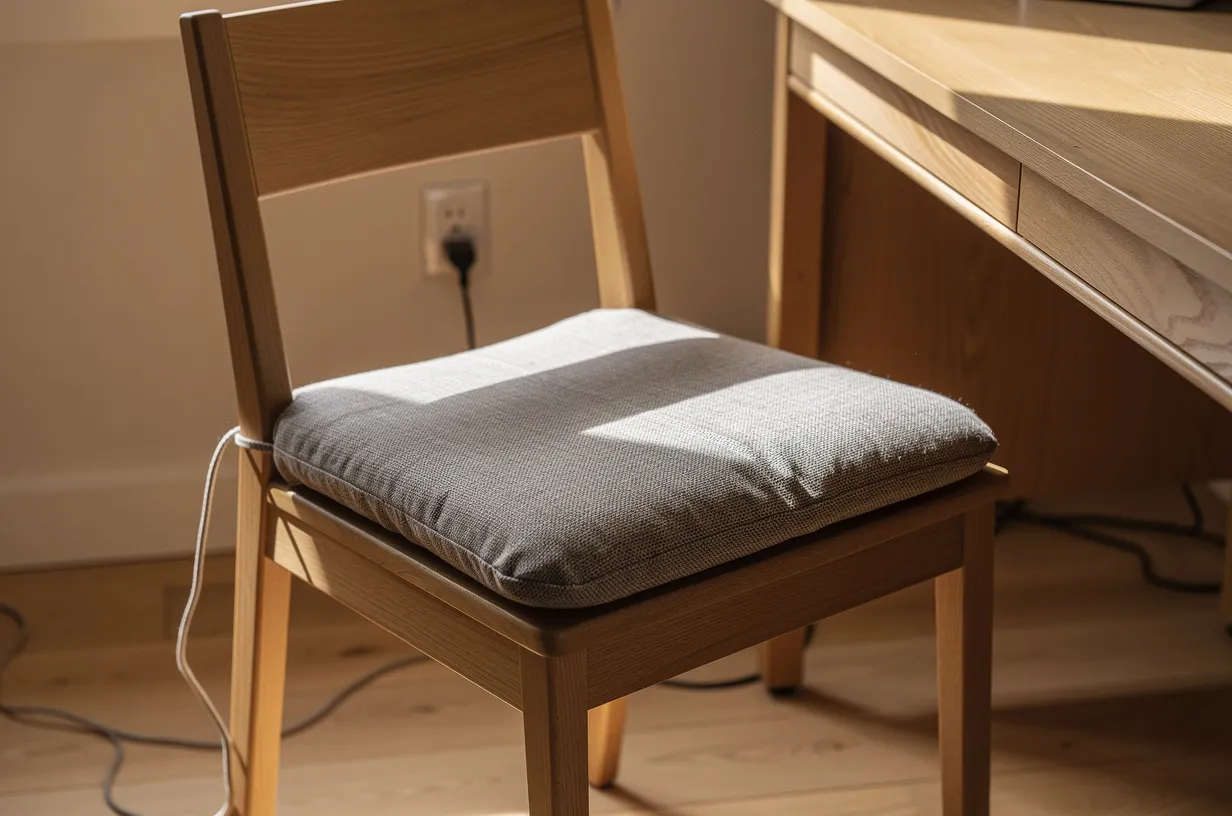
A grounding chair pad is a conductive cushion or seat cover you sit on during the day, wired to the ground pin of a wall outlet so your skin stays in contact with earth potential while you work. The honest short version: it’s a reasonable add-on if you already sleep on a grounding sheet, but it’s not where the evidence is strongest, and it won’t do much if you’re sitting on it through jeans and a cardigan.
Worth adding once you’re already grounded at night; skip it as your first or only purchase, since sitting is shorter and less skin contact than a full night in bed.
What is a grounding chair pad and how does it work?
Most chair pads use a layer of carbon-loaded fabric or fine conductive thread built into a cushion or a thin seat cover. A snap on one corner connects to a cord, and that cord plugs into the ground port of a standard outlet, the same pin an outlet tester checks. When bare skin, or skin under a thin single layer, touches the pad, you’re electrically continuous with the earth ground your house wiring is bonded to.
That’s the whole mechanism. There’s no current flowing into you from the wall; the pad only ties your body to the same reference potential as the earth, which is the part of grounding that’s genuinely uncontroversial physics, whatever you think of the health claims layered on top.
Does sitting on one actually do anything?
Here’s where I want to be careful, because most of the research this niche leans on wasn’t built around a chair pad specifically. Ghaly and Teplitz (2004), the most-cited study for “grounding helps sleep,” had people grounded overnight in bed, not seated at a desk for an hour. Sokal and Sokal (2011) looked at broader physiological markers over grounded sessions, and Chevalier’s blood viscosity work (2013) also used longer, supervised grounded periods. None of it isolates “thirty minutes in a desk chair” as its own variable.
So the fair read is: the mechanism is the same as a grounding sheet, but the dose is smaller. A workday of intermittent contact through a chair pad is a weaker version of what the sleep studies tested, not a separately proven benefit. If you notice you feel calmer with your feet or forearms on a grounded pad, that’s plausible and low-risk to enjoy, but I’m not going to tell you it’s backed the way overnight grounding is.
What should you check before buying one?
A few things separate a pad that actually works from one that’s just a nice cushion with a snap on it.
- Conductive material that runs through the actual contact surface, not just a hidden strip you might not sit on.
- A cord that plugs into the ground port itself, not an adapter that defeats the third prong to fit an old two-prong outlet.
- A snap and cord that feel like they’ll survive months of you shifting in your chair, since a frayed cord is the first thing to fail.
- Some kind of trial period or return window, because whether it’s comfortable under you all day is honestly the bigger factor for most buyers.
Chair pad vs. other seated grounding options
| Option | Main contact point | Best for | Portability |
|---|---|---|---|
| Chair pad | Thighs, lower back | Desk chairs, dining chairs | Moves easily between chairs |
| Grounding Desk Mats: Earthing While You Work | Bare feet | People who sit barefoot or in socks at a desk | Stays under the desk |
| Grounding for a Recliner or Sofa | Back, legs, forearms | Recliners and sofas for evening downtime | Fitted to one piece of furniture |
| Grounding Pads for an Office Chair | Full seated area | Dedicated office chairs | Semi-permanent setup |
How do you set one up safely?
Same electrical caution I give for every grounding product on this site: the whole thing depends on your outlet actually having a working ground, and you can’t tell that by looking at it. A cheap plug-in outlet tester, the kind with three little lights, checks this in about two seconds and it’s worth doing before you plug in any grounding product for the first time.
Beyond that, keep it simple. Sit with skin, or a single thin layer like leggings, touching the pad rather than through a heavy cushion or blanket on top of it. Don’t run the ground cord through an adapter that bypasses the third prong. And if you have a pacemaker, an ICD, or another implanted electrical device, talk to your doctor before adding any grounding product, chair pad included; this isn’t a case where I’d guess on your behalf.
Chair pad or grounding sheet: which comes first?
If you’re choosing where to start, start in bed. You spend more consecutive hours in contact with a grounding sheet than you ever will in a chair pad, and it’s overnight sleep that the strongest of the small studies actually measured. A chair pad is a genuinely nice way to add more grounded hours to your day once you’re already sleeping on one, not a substitute for it.
Premium Grounding Sheet
30% stainless-steel fibers instead of silver, so it will not oxidize and lasts about five times longer. Fits under your fitted sheet, ships worldwide, and comes with a 90-night trial and a 3-year warranty.
Check price on Premium GroundingFor the bedroom side of this, our Grounding Products Beyond Sheets: Blankets, Socks, Pillowcases & More guide covers the full range of blankets, socks and pillowcases if a chair pad turns out not to be the piece you need first.
Frequently asked questions
Do grounding chair pads work through clothing?
Thick fabric, multiple layers, or anything with a rubberized backing will block the contact. A single thin layer like cotton leggings usually still conducts fine; a padded office chair cover on top of the pad generally does not.
Can I use a grounding chair pad without a grounded outlet?
Not effectively. Some pads can connect to an outdoor ground rod instead, but that’s a bigger project than most desk setups call for. If your outlet doesn’t test as properly grounded, the pad has nothing to connect you to.
How long do I need to sit on it for it to matter?
There’s no studied dose for seated grounding specifically, so I can’t give you a real number. Most people just leave it under them for however long they’re at the desk, which is a reasonable, low-effort way to use it.
Are grounding chair pads safe if I’m pregnant?
The electrical exposure is the same low-risk earth-ground connection as any grounding product, but as with sheets and mats, it’s worth a quick check with your doctor, especially in the first trimester, more as general caution than because of specific documented risk.
Will a chair pad help my back pain?
Some of the small early studies on grounding and pain and inflammation are interesting, but they’re not chair-pad-specific and they’re far from conclusive. Treat any comfort improvement as a possible bonus, not a reason to skip an actual ergonomic chair or a conversation with a doctor about ongoing pain.
- Grounding Blankets: How They Work and When to Pick One Over Sheets
- Earthing Blanket Guide: Conductive Throws Compared
- Grounding Pillow Cases: Small Upgrade, Real Contact Hours
- Grounding Socks: Do Conductive Socks Actually Ground You?
- Grounding Mattress Pads: Full-Coverage Earthing Under Your Sheet
- Grounding Shoes and Footwear: Earthing While You Walk
- Grounding Fitted Sheets: How They Differ
- Grounding Flat Sheets: Pros and Cons
- Grounding Half Sheets: A Simpler Option
- Grounding Mattress Covers: Full Coverage Earthing
- Grounding Throw Blankets: Earthing on the Couch
- Grounding Patches: Targeted Earthing Explained
← Grounding Products Beyond Sheets: Blankets, Socks, Pillowcases & More