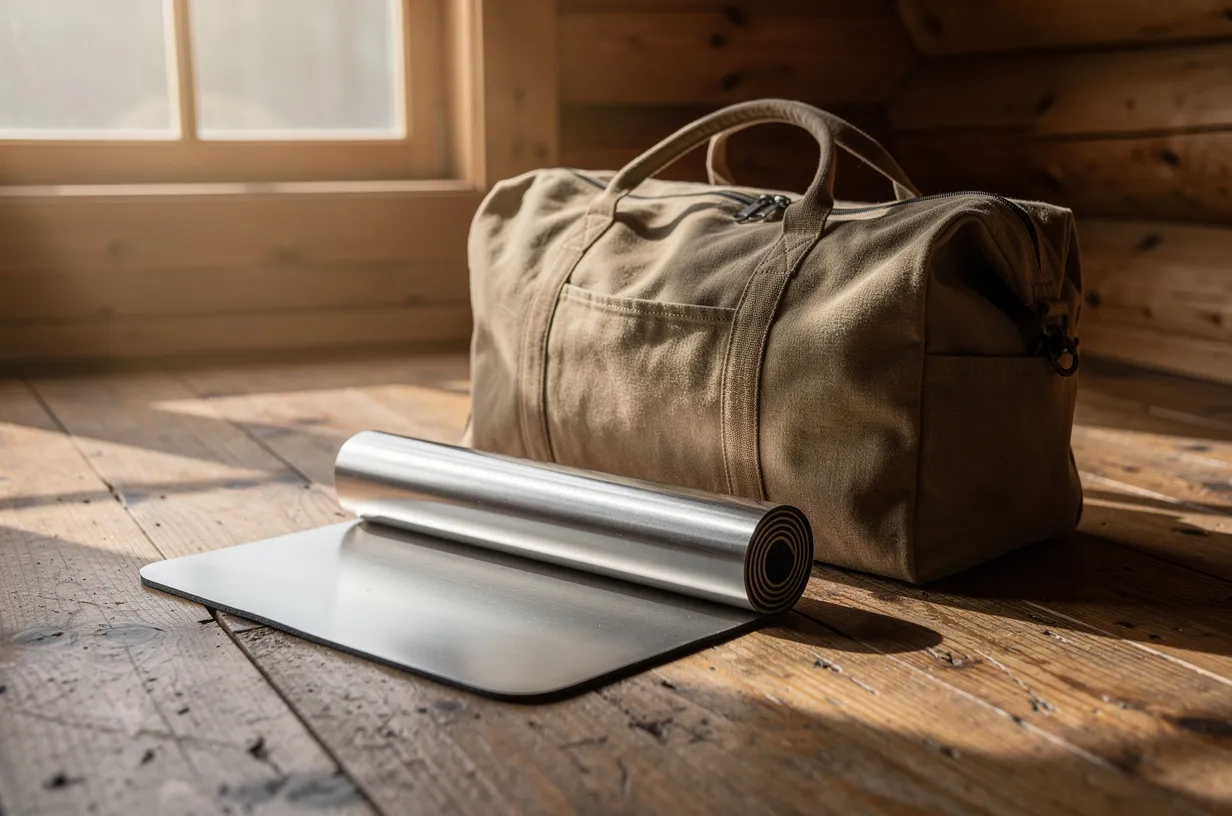
A grounding travel mat is a small conductive pad, usually stainless-steel or silver-threaded fabric with a grounding cord attached, built so you can bring an earthing habit into a hotel room, RV or rental instead of leaving it behind with your bed at home. It works the same way a grounding sheet does, just on a smaller patch of skin.
A grounding travel mat is a reasonable way to keep the habit going on the road, if the outlet is actually grounded. It gives you less contact than a full sheet, so treat it as a convenience swap, not an upgrade.
How does a grounding travel mat work?
The mechanics are identical to a grounding sheet. A conductive layer, usually stainless-steel or silver thread woven into fabric or bonded to leatherette, sits under your feet, forearms or calves. A cord runs from the mat to the ground pin of a wall outlet, which connects back to the earth through the building’s wiring. Your skin touches the mat, the mat touches the outlet’s ground, and you’re electrically tied to the earth for as long as the connection holds.
Conductive Grounding Fabric Explained covers the material side in more depth if you want to compare stainless-steel and silver options before you buy.
Is a travel mat different from a regular grounding mat?
Not really. Most “travel” mats are just standard grounding mats, smaller, foldable and sold with a shorter cord so they fit in a bag. A handful of brands market a dedicated travel version, but the fabric, the snap connector and the science behind it are the same as a Grounding Desk Mats: Earthing While You Work you’d use at home. If you already own a small mat, you don’t need to buy a separate “travel” one just for the label.
Do grounding travel mats actually do anything?
Here’s where I have to be honest with you. Every study behind grounding, including the small pilot from Ghaly and Teplitz on sleep and cortisol, Sokal and Sokal’s work on blood markers, and the 2015 Oschman, Chevalier and Brown review in the Journal of Inflammation Research, was done with people grounded through sheets or full-body mats at home. None of it tested a small travel pad specifically, and none of it was a large, independently replicated trial.
So if a sheet’s evidence is already thin, a travel mat’s is thinner still, since it’s borrowing conclusions from a different setup with more skin contact and more hours per night. The best-supported outcome across the research is still subjective sleep quality, and even that comes from small samples. If a travel mat helps you sleep better in an unfamiliar bed, that’s worth something to you, but don’t expect it to do more than a full sheet would.
What should you check before plugging one in?
The real risk with any grounding product isn’t the low current involved, it’s an outlet that isn’t actually wired to earth. Hotels, older rentals and RV park pedestals are exactly where that shows up. A three-prong outlet can look fine and still have a floating or reversed ground.
- Pack a cheap outlet tester and check the outlet before you plug in, the same habit worth building at home.
- Skip outlets with two-prong adapters or visibly damaged faceplates.
- On an RV or camper, ground quality depends on the park’s pedestal and your rig’s own wiring, so test at each new site rather than assuming last week’s hookup was representative.
- Airplanes have no earth ground available at your seat, so a grounding mat has nothing to connect to in flight. Leave it packed until you land.
Travel mat vs a grounding sheet: what changes
| Feature | Grounding travel mat | Grounding sheet |
|---|---|---|
| Skin contact | Feet, calves or forearms only | Most of your body for a full night |
| Portability | Folds small, fits a bag | Stays on the bed at home |
| Setup time | Under a minute, plug and place | Fits under a fitted sheet, set once |
| Best use | Hotel rooms, desks, RVs, short sessions | Nightly sleep, the setup most studies actually used |
Less skin contact isn’t a dealbreaker, it just means a travel mat is a lighter version of the habit, not a replacement for a full night on a Grounding Fitted Sheets: How They Differ.
How do you actually use one on the road?
Test the outlet first. Unroll the mat on a hard floor or desk, not carpet, since the conductive layer needs to sit flat against your skin, not fabric. Rest your bare feet or forearms on it while you work, read or wind down before bed. If you’re staying somewhere for more than a night or two, you can also loop it around a chair leg or set it on the mattress under your calves while you sleep, though a full sheet will always give you more contact hours if that’s the setup you’re used to at home.
If most of your grounding happens in your own bed and travel is occasional, the mat is really there to bridge the gap, not replace the main setup. For the bulk of your contact hours at home, we still point people toward a stainless-steel sheet for the reasons we get into in Grounding Products Beyond Sheets: Blankets, Socks, Pillowcases & More.
Premium Grounding Sheet
30% stainless-steel fibers instead of silver, so it will not oxidize and lasts about five times longer. Fits under your fitted sheet, ships worldwide, and comes with a 90-night trial and a 3-year warranty.
Check price on Premium GroundingFrequently asked questions
Can you use a grounding mat on an airplane?
No. Airplane seats don’t have an earth-grounded outlet to plug into, even where a USB or standard power port exists, so there’s nothing for the mat’s ground pin to connect to. Save it for the hotel.
Do hotel outlets count as grounded?
Not automatically. Many are, but wiring quality varies by building age and country, and a working three-prong socket doesn’t guarantee a properly bonded ground. A pocket outlet tester takes the guesswork out in seconds.
Can I ground myself while traveling without a mat at all?
Yes. Bare feet on natural ground, grass, sand, bare soil, gives you the same earth connection without any cord or outlet. It’s the original version of the practice and works anywhere you can find real ground outdoors.
Is a travel mat worth buying if I already have a grounding sheet at home?
Only if you travel often enough to miss the habit. If a few nights away a month don’t bother you, skip it and save the money. If you’re on the road weekly, a folding mat is a low-cost way to keep the routine without hauling a sheet.
How long does a travel mat’s conductive layer last with frequent packing?
Folding and unfolding wears conductive fabric faster than a sheet that stays flat on a bed, especially at silver-thread seams. Stainless-steel weaves tend to hold up better under that kind of repeated handling, which is worth factoring in if you’ll be packing it weekly.
- Grounding Blankets: How They Work and When to Pick One Over Sheets
- Earthing Blanket Guide: Conductive Throws Compared
- Grounding Pillow Cases: Small Upgrade, Real Contact Hours
- Grounding Socks: Do Conductive Socks Actually Ground You?
- Grounding Mattress Pads: Full-Coverage Earthing Under Your Sheet
- Grounding Shoes and Footwear: Earthing While You Walk
- Grounding Fitted Sheets: How They Differ
- Grounding Flat Sheets: Pros and Cons
- Grounding Half Sheets: A Simpler Option
- Grounding Mattress Covers: Full Coverage Earthing
- Grounding Throw Blankets: Earthing on the Couch
- Grounding Patches: Targeted Earthing Explained
← Grounding Products Beyond Sheets: Blankets, Socks, Pillowcases & More