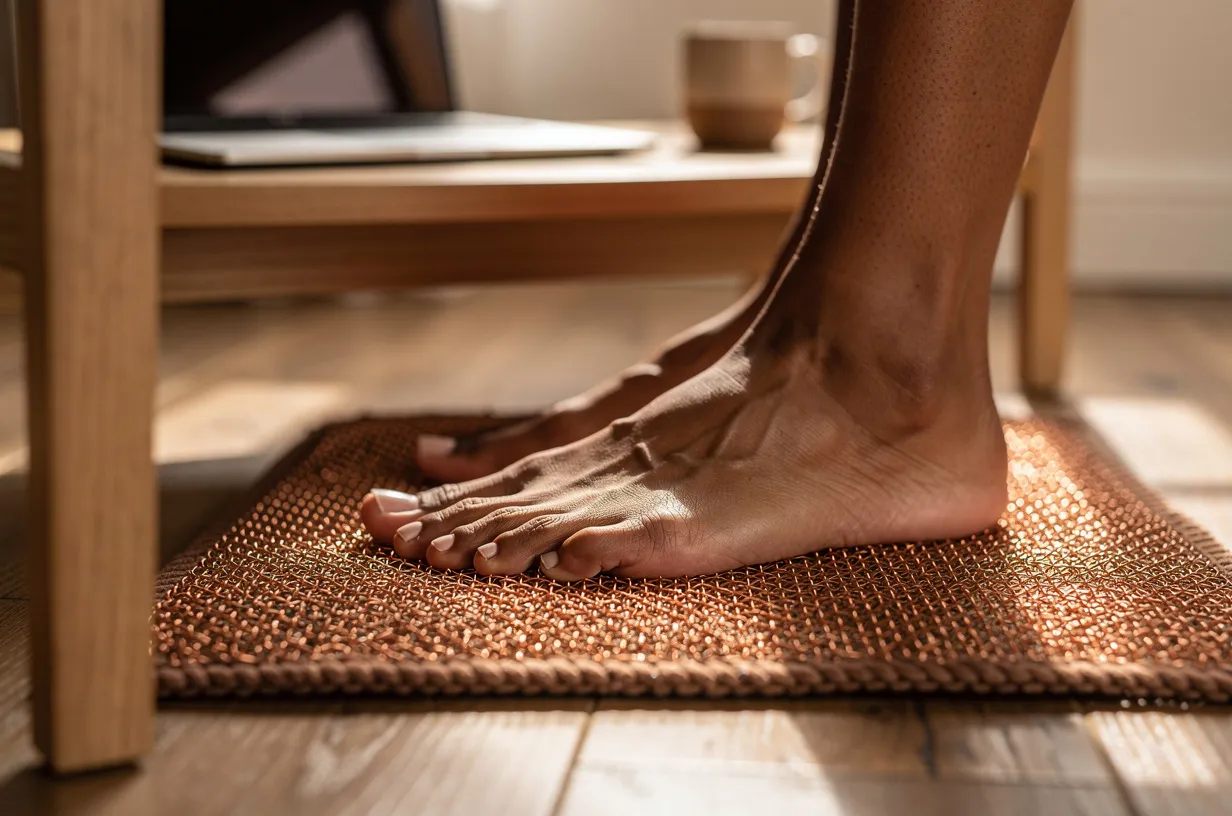
Yes, grounding works the same way whether you’re lying in bed or sitting at your desk. The mechanism doesn’t care about posture. Your skin touches conductive fabric, the fabric runs through a cord with a built-in resistor to a wall outlet’s ground pin, and that pin ties back to the earth. What changes for office and work-from-home use isn’t the physics, it’s the gear and the outlet you’re stuck with.
A grounding mat under your feet or forearms at a desk does the same job electrically as a bed sheet. The setup is cheap and low-risk to try. The catch: almost every study behind grounding tested people asleep or recovering from exercise, not sitting at a keyboard, so daytime focus claims are extrapolation, not proven outcomes.
Does grounding actually work if you’re sitting, not sleeping?
Electrically, yes. Conductive fibers against your skin, connected to a true earth ground, do the same thing at 2pm as they do at 2am. What’s different is the research base. How to Use Grounding Sheets: Setup, Care and Daily Practice covers overnight setup in detail, and that’s where the science actually points, sleep and subjective stress are the best-supported outcomes, and even those come from small studies.
Nobody has run a proper trial on office workers grounded at a desk for eight hours. If someone tells you grounding will sharpen your focus by 2pm, that’s a guess dressed up as a fact. A reasonable one, maybe, but still a guess.
What you need to try it at your desk
- A grounding mat sized for your feet, or a smaller wrist/forearm pad if you type most of the day
- A nearby outlet with a working ground pin, ideally one you’ve checked with a cheap outlet tester
- A cord long enough that it doesn’t cross a walkway
If your building is older, don’t assume the third prong does anything. No Grounded Outlet? How to Use a Grounding Sheet walks through what to do when the outlet you’ve got isn’t actually grounded.
Grounding mat vs grounding sheet for office use
A full sheet is built for a mattress. It’s not meant to travel between your bed and a desk chair every morning, though a fitted-style sheet is removable enough that some people do exactly that. A mat is purpose-built for daytime use and it’s what most desk setups actually need.
| Option | Best for | Trade-off |
|---|---|---|
| Grounding mat under feet | Shared or office desks, easy to store in a bag | Small contact area, you need bare feet or thin socks |
| Half sheet draped over a chair | A dedicated home office chair, long sessions | Bulkier, has to stay put on the seat |
| Wrist or forearm pad | Heavy typing days | Cable sits close to your keyboard, some people find that annoying |
What does the research actually say about daytime, working-hours grounding?
None of the anchor studies were run on people sitting at a desk during work. Ghaly and Teplitz (2004) looked at sleep and cortisol rhythm overnight. Sokal and Sokal (2011) tested a handful of blood markers across a series of small experiments. Chevalier’s 2013 work on blood viscosity used a tiny sample and hasn’t been widely replicated. Brown, Chevalier and Hill’s soreness studies looked at recovery after exercise, not sitting still.
The 2015 Oschman, Chevalier and Brown paper in the Journal of Inflammation Research is a narrative review, not a trial, it proposes that the earth’s electrons act as antioxidants. That’s a hypothesis about a mechanism, not evidence that grounding at your desk changes how you feel by lunchtime. Talk to your doctor before relying on grounding for any medical condition, and treat “more focus at work” as an unproven, plausible-sounding idea rather than a documented result.
What if your office outlet has no ground pin?
This is the most common blocker for people who want to try it at work. Two-prong outlets, adapters, and shared power strips are everywhere in older office buildings. Plugging a grounding product into a fake or missing ground doesn’t just fail to work, in a badly wired outlet it can be genuinely unsafe. A five-dollar outlet tester tells you in seconds whether the ground pin is live.
Newer offices often run GFCI-protected outlets, which is a separate layer of protection from grounding and generally plays fine with a grounding product, but it’s worth understanding the difference. Grounding Sheets and GFCI Outlets Explained breaks that down if you’re not sure what’s on your circuit.
Mistakes people make grounding while working
The cord across the walkway is the obvious one, it’s a trip hazard and it’s the fastest way to get a grounding mat banned from a shared office. Running the cord through a power strip that strips the ground, which some surge protectors do, is a quieter mistake, since it looks connected but isn’t doing anything.
Skipping a conductivity check is another. If you’re not sure your mat is actually passing current to ground, How to Test a Grounding Sheet With a Multimeter shows you how to check with a cheap multimeter instead of guessing. And treating it as all-or-nothing doesn’t help either, twenty or thirty minutes with bare feet on a mat during a call is a realistic habit; wearing shoes over it all day isn’t doing anything.
If you’re already looking at getting a grounding sheet for your bed, our tested top pick, the Premium Grounding sheet, is removable enough to double as a daytime option draped over a chair, since it’s designed to sit loose under a fitted sheet rather than being sewn in.
Premium Grounding Sheet
30% stainless-steel fibers instead of silver, so it will not oxidize and lasts about five times longer. Fits under your fitted sheet, ships worldwide, and comes with a 90-night trial and a 3-year warranty.
Check price on Premium GroundingFrequently asked questions
- How to Wash Grounding Sheets Without Killing Conductivity
- How to Set Up a Grounding Sheet: Outlet vs Ground Rod
- How Do I Ground Myself? 7 Ways, From Free to Effortless
- Grounding Outside: Best (and Worst) Surfaces for Earthing
- Grounding in the City: How to Earth Yourself in an Apartment
- DIY Grounding Sheets: Can You Make Your Own? (And Should You?)
- Grounding While Traveling: How to Earth Yourself Away From Home
- 7 Grounding Sheet Setup Mistakes That Kill the Connection
- No Grounded Outlet? How to Use a Grounding Sheet
- Using a Ground Rod for Your Grounding Sheet
- Grounding Sheets and GFCI Outlets Explained
- Grounding in an Apartment: What Works
← How to Use Grounding Sheets: Setup, Care and Daily Practice