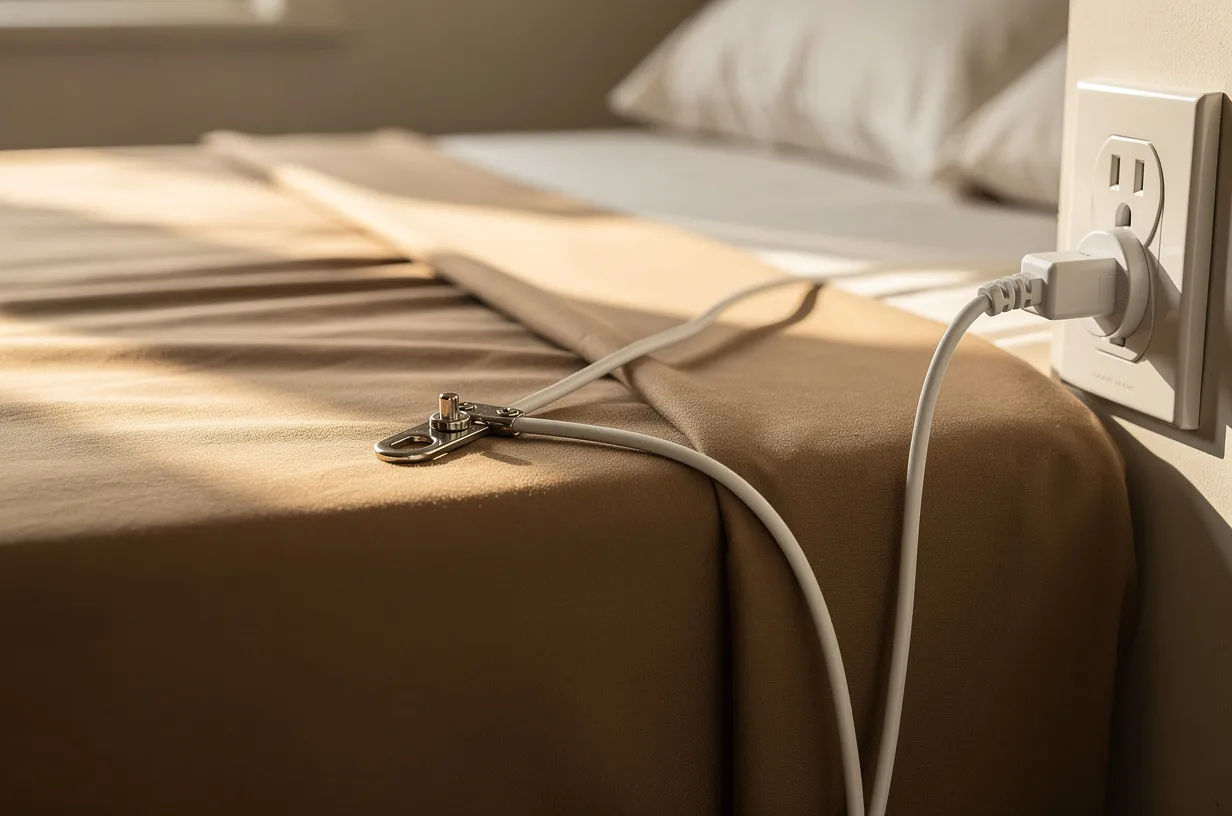
A grounding cord is the wire that links your sheet’s conductive fibers to something actually connected to the earth, usually the ground pin on a wall outlet. It doesn’t carry power. It just gives your body a path to the same electrical reference point your home’s wiring already uses for safety.
A grounding cord connects your sheet to the ground hole of an outlet (or a rod in soil). No voltage runs through it in normal use, and it’s low-risk as long as the outlet is actually grounded.
What does a grounding cord actually do?
Inside a grounding sheet, thin conductive threads (usually silver-coated or, on better sheets, stainless steel) run through the fabric and meet at a small metal snap. The cord clips onto that snap on one end. On the other end it terminates in a plug shaped to fit the round third hole on a US outlet, or a two-pin ground plug for other regions.
That third hole isn’t live power. It’s the protective earth conductor, the same one that keeps your washing machine or laptop charger from turning into a hazard if something inside shorts out. Clipping into it puts your body at roughly the same electrical potential as the earth itself, which is the whole premise behind grounding. We break the full chain down in How Do Grounding Sheets Work? The Mechanism Step by Step.
How does it connect to the wall outlet?
Most cords plug in one of two ways: a full three-prong plug that occupies the whole outlet, or a small ground-pin-only plug that leaves the outlet free for other devices. Either way, the cord should only ever touch the ground pin, never the hot or neutral slots.
Some brands add a built-in resistor inside the cord, usually rated around 100 kilo-ohms, as an extra safeguard that limits any theoretical current to a trickle even in a fault scenario. Not every brand does this, and it’s worth checking the spec sheet before you buy if it matters to you.
What are the different types of grounding cords?
| Cord type | Connects to | Best for | Watch out for |
|---|---|---|---|
| Standard outlet plug cord | Ground pin of a wall outlet | Everyday bedroom use | Requires a properly grounded outlet |
| Ground-pin-only adapter cord | Just the round pin, outlet stays free | Rooms with one outlet in use | Cheap versions can fit loosely over time |
| Earth rod cord | A metal stake pushed into damp soil | Outdoor use, camping, or homes with unreliable wiring | Impractical for nightly bedroom use |
Snap sizes aren’t standardized either. A 10mm snap is common but not universal, so a replacement cord from one brand won’t always click into a sheet from another. If you lose or damage a cord, buy the matching one from the sheet’s maker rather than a generic option.
Is a grounding cord safe to use?
Yes, with one real caveat: the outlet has to actually be grounded. If a house has miswired outlets, meaning the ground and hot terminals got crossed somewhere in the wiring, then anything plugged into that ground pin could carry a small live current instead of a safe earth reference. This is rare, but it’s the one scenario worth taking seriously.
The fix is cheap. A plug-in outlet tester costs about the same as a couple of coffees and tells you whether an outlet is wired correctly in under ten seconds. Test it before you use a grounding sheet, not after. A GFCI-protected circuit is a good sign, not a conflict, since GFCI outlets still ground normally.
Skip the cheap two-prong-to-three-prong “cheater” adapters if you’re not sure the outlet behind them is actually earthed. They’ll let a cord plug in, but they don’t create a ground connection that wasn’t there.
Who should check with a doctor first?
If you have a pacemaker or another implanted electrical device, or you’re pregnant or on medication that affects your heart rhythm, talk to your doctor before adding a grounding sheet and cord to your routine. It’s a low-current, earth-referenced connection, not a treatment, and your doctor is better placed than any product page to weigh your specific situation.
Do I need to replace a grounding cord over time?
Cords themselves hold up well since they’re just wire and a plug, but the snap connection and the sheet’s conductive threads are where wear shows up first. Silver-coated threads tend to oxidize with repeated washing, which quietly weakens the connection even though the cord itself still works fine (Do Grounding Sheets Oxidize? Silver vs Steel goes into why). Stainless-steel threads, like the ones on our top pick, resist that breakdown for longer, which is one reason we point people there when a sheet’s mesh starts to fail.
Premium Grounding Sheet
30% stainless-steel fibers instead of silver, so it will not oxidize and lasts about five times longer. Fits under your fitted sheet, ships worldwide, and comes with a 90-night trial and a 3-year warranty.
Check price on Premium GroundingEither way, a quick continuity check every few months tells you whether the whole chain, cord included, is still doing its job. We walk through exactly how in How to Test if Your Grounding Sheet Is Actually Working.
What if my outlet isn’t grounded at all?
Some older homes still have two-prong outlets with no ground pin anywhere in the room. In that case, an earth rod cord run out a window to a stake in the soil is the honest workaround, though most people find it too fussy for nightly use. The more practical fix is having an electrician add a grounded outlet near the bed, which also benefits every other device you plug in there. For the underlying physics of why the earth connection matters at all, see Earth Potential and Grounding, Explained Simply.
Frequently asked questions
Can a grounding cord give me an electric shock?
Not if the outlet is correctly grounded. The cord connects only to the protective earth pin, not to live power. The real risk is a miswired outlet, which is why testing it first with a cheap outlet tester matters more than anything about the cord itself.
How do I know if my grounding cord is actually working?
A multimeter continuity check between the sheet’s conductive surface and a known ground point is the most reliable way. We cover the step-by-step version of this test separately.
Can I use any grounding cord with any sheet?
Not reliably. Snap sizes and cord lengths vary by brand, so a cord from one manufacturer may not fit another’s sheet. Stick with the cord that came with your sheet or order a matching replacement from the same brand.
Do grounding cords wear out?
The cord and plug are simple and durable, but the snap contact point can loosen with repeated use, and the fabric threads it connects to can degrade faster than the cord does, especially silver ones. Check the connection periodically rather than assuming it’s fine forever.
Is an earth rod cord better than a standard outlet cord?
An earth rod gives a more direct connection to soil, but it’s not practical for most bedrooms. A standard outlet cord works just as well in daily use as long as the outlet has been verified as properly grounded.
- What Is Earthing? The Practice Behind Grounding, Explained
- How Do Grounding Sheets Work? The Mechanism Step by Step
- Grounding Sheets vs Earthing Sheets: Same Thing, Different Name?
- What Are Grounding Sheets Made Of? Silver vs Stainless Steel Fibers
- The History of Grounding: How Cultures Slept Connected to the Earth
- How to Test if Your Grounding Sheet Is Actually Working
- Grounding Sheet Conductivity and Ohms Explained
- Silver vs Stainless Steel Grounding Fiber
- Do Grounding Sheets Oxidize? Silver vs Steel
- How Long Do Grounding Sheets Last?
- Grounding vs Earthing: Is There a Difference?
- Earth Potential and Grounding, Explained Simply
← What Are Grounding Sheets? How Earthing Bedding Actually Works