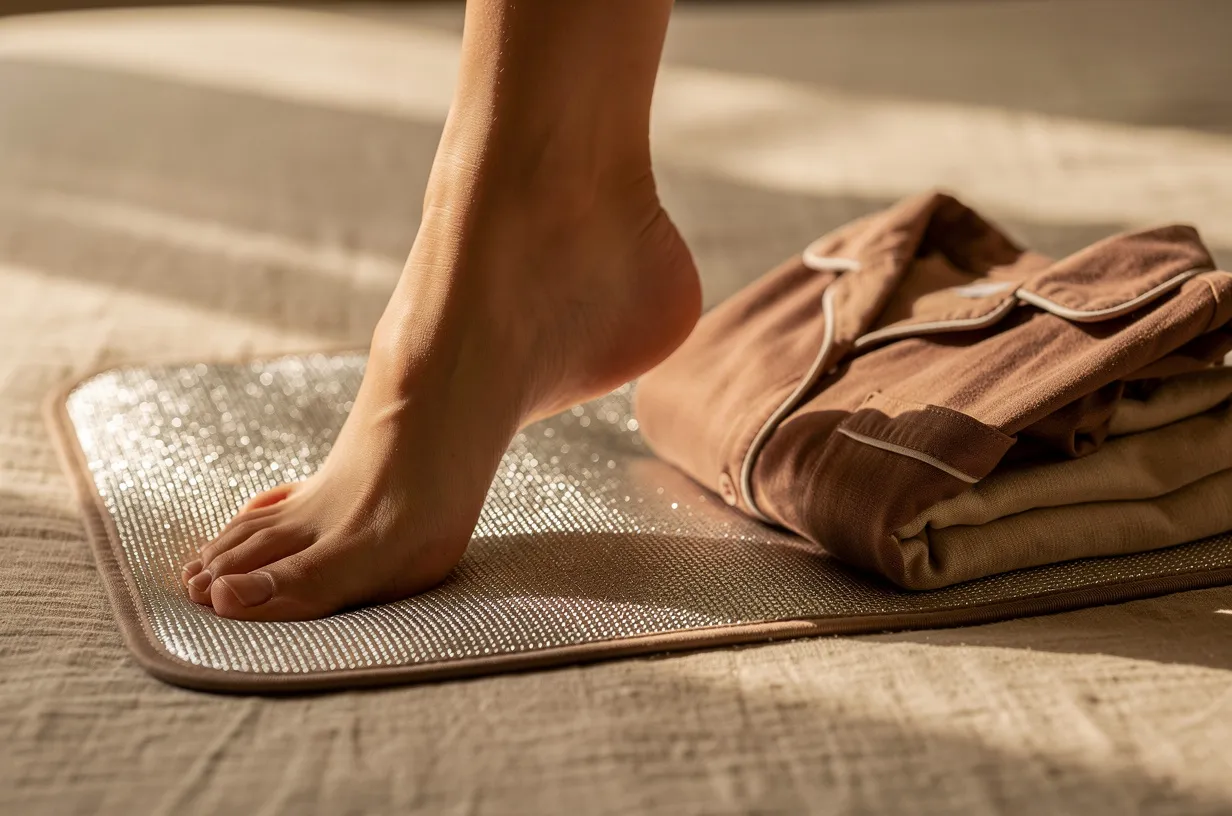
No, not reliably. A grounding sheet works by putting the conductive threads in direct contact with your skin, and clothing, especially anything synthetic, gets in the way of that. A little sweat-dampened cotton might let a trace of current through, but you are not getting the same connection you would with bare skin against the fabric.
Grounding sheets need skin contact to conduct well. Thick or synthetic clothing blocks it almost entirely, thin damp cotton lets a little through, and bare skin, even just feet or hands, is the only setup that works consistently.
Why does skin contact matter for a grounding sheet?
The whole mechanism is electrical. The sheet has fine stainless-steel or silver threads woven into it, connected by a cord to your wall outlet ground pin. Skin is a decent conductor because it is slightly damp and salty. Most fabric is not. When fabric sits between you and the threads, it acts like a layer of insulation, and the circuit that grounding depends on gets weaker or stops working entirely.
This is the same reason we tell people to check their setup carefully when they first How to Set Up a Grounding Sheet: Outlet vs Ground Rod. A correct outlet connection does nothing if your skin never actually touches the sheet.
What happens if you sleep in pajamas?
Full-coverage pajamas, especially anything polyester or fleece, are the worst case. If your arms, legs and torso are all covered, you may end up with close to zero contact, unless your feet, hands or a bit of exposed skin at the wrists or ankles happens to rest on the sheet. A lot of people do not think about this until they wonder why they are not noticing the effect they expected.
If you want to check whether your setup is even making contact in the first place, a cheap multimeter test settles the question fast. We walk through it in our guide to How to Test a Grounding Sheet With a Multimeter.
Does fabric type change the answer?
Yes, and it is not a small difference. Here is roughly how different materials behave against a conductive sheet.
| What is between you and the sheet | How well it conducts | Practical takeaway |
|---|---|---|
| Bare skin | Good, consistent | The setup grounding sheets are designed for |
| Thin cotton, slightly damp (sweat) | Weak, inconsistent | Some connection some nights, none on dry ones |
| Thick cotton, dry (t-shirt, sweatpants) | Very weak to none | Treat as basically no contact |
| Wool or flannel | Poor | Thick and usually dry, blocks most current |
| Polyester, fleece, synthetic blends | Essentially none | These materials do not conduct meaningfully |
How much bare skin do you actually need?
Less than people assume. A hand, a foot, or the back of a calf resting on the sheet is enough for the circuit to close. Full nudity is not required for a grounding sheet to do its job. This is part of why people sleeping in shorts or a light t-shirt, with feet and lower legs exposed, tend to get a workable connection without changing much about how they normally sleep.
Where this gets messy is partial coverage that shifts through the night. You might start with your foot on the sheet and end up curled up with everything covered by 3 a.m. That is normal, and it is also one of the small, avoidable 7 Grounding Sheet Setup Mistakes That Kill the Connection that quietly reduces how much benefit people get from an otherwise good sheet.
What about socks, gloves, or hair?
Socks are the most common complaint we hear. Thin cotton socks sometimes let a small amount of current through if they get damp, but it is not something to count on. If your feet are meant to be your contact point and you sleep in socks, you are probably not grounding much at all. Hair does not conduct the way skin does, so resting your head on the sheet is not a substitute for skin contact elsewhere. Gloves behave like socks: thin and damp, maybe a little; thick and dry, basically nothing.
So what should you actually do about it?
If full skin contact matters to you, sleep in something that leaves feet, hands, or lower legs bare, and check periodically that you are not migrating off the sheet conductive panel overnight. If you would rather not think about it, some people use a small grounded patch or band on an ankle or wrist under clothing, which solves the coverage problem without changing what you wear to bed. None of this needs to be complicated, and it is one of the few genuinely mechanical questions in this space with a clear, checkable answer instead of a debate.
Fabric quality also affects how long a sheet conducting well lasts in the first place. Sheets with stainless-steel thread hold their conductivity longer than silver-thread sheets, which tend to oxidize with repeated washing and lose effectiveness over time.
Premium Grounding Sheet
30% stainless-steel fibers instead of silver, so it will not oxidize and lasts about five times longer. Fits under your fitted sheet, ships worldwide, and comes with a 90-night trial and a 3-year warranty.
Check price on Premium GroundingFor the full rundown on getting a grounding sheet set up correctly the first time, including outlet checks and common wiring questions, see our main guide to How to Use Grounding Sheets: Setup, Care and Daily Practice. And if you are not sure how often you should even be doing this, we cover that separately in How Often Should You Use a Grounding Sheet?.
Frequently asked questions
Can I wear pajamas with a grounding sheet?
You can, but the parts of your body covered by fabric will not be conducting. Most people who sleep in pajamas still get some contact through bare feet, hands, or a lower back gap, which is enough for the electrical connection to work, just not as much of it.
Do socks block a grounding sheet completely?
Cotton socks are thin enough that a small amount of sweat can sometimes bridge the gap, but it is not reliable. If your feet are your main point of contact, take the socks off, or plan for skin contact somewhere else.
Does a top sheet or blanket over the grounding sheet stop it from working?
No, because the grounding sheet is the layer touching you, not covering you. A blanket on top changes nothing. The problem is only ever what sits between your skin and the conductive threads underneath you.
Will a thin cotton undershirt still let some grounding through?
Sometimes, a little, especially if the fabric is damp with sweat. Treat it as a maybe, not a plan. If you want a dependable connection, bare skin against the sheet is the only version that is not a guess.
- How to Wash Grounding Sheets Without Killing Conductivity
- How to Set Up a Grounding Sheet: Outlet vs Ground Rod
- How Do I Ground Myself? 7 Ways, From Free to Effortless
- Grounding Outside: Best (and Worst) Surfaces for Earthing
- Grounding in the City: How to Earth Yourself in an Apartment
- DIY Grounding Sheets: Can You Make Your Own? (And Should You?)
- Grounding While Traveling: How to Earth Yourself Away From Home
- 7 Grounding Sheet Setup Mistakes That Kill the Connection
- No Grounded Outlet? How to Use a Grounding Sheet
- Using a Ground Rod for Your Grounding Sheet
- Grounding Sheets and GFCI Outlets Explained
- Grounding in an Apartment: What Works
← How to Use Grounding Sheets: Setup, Care and Daily Practice