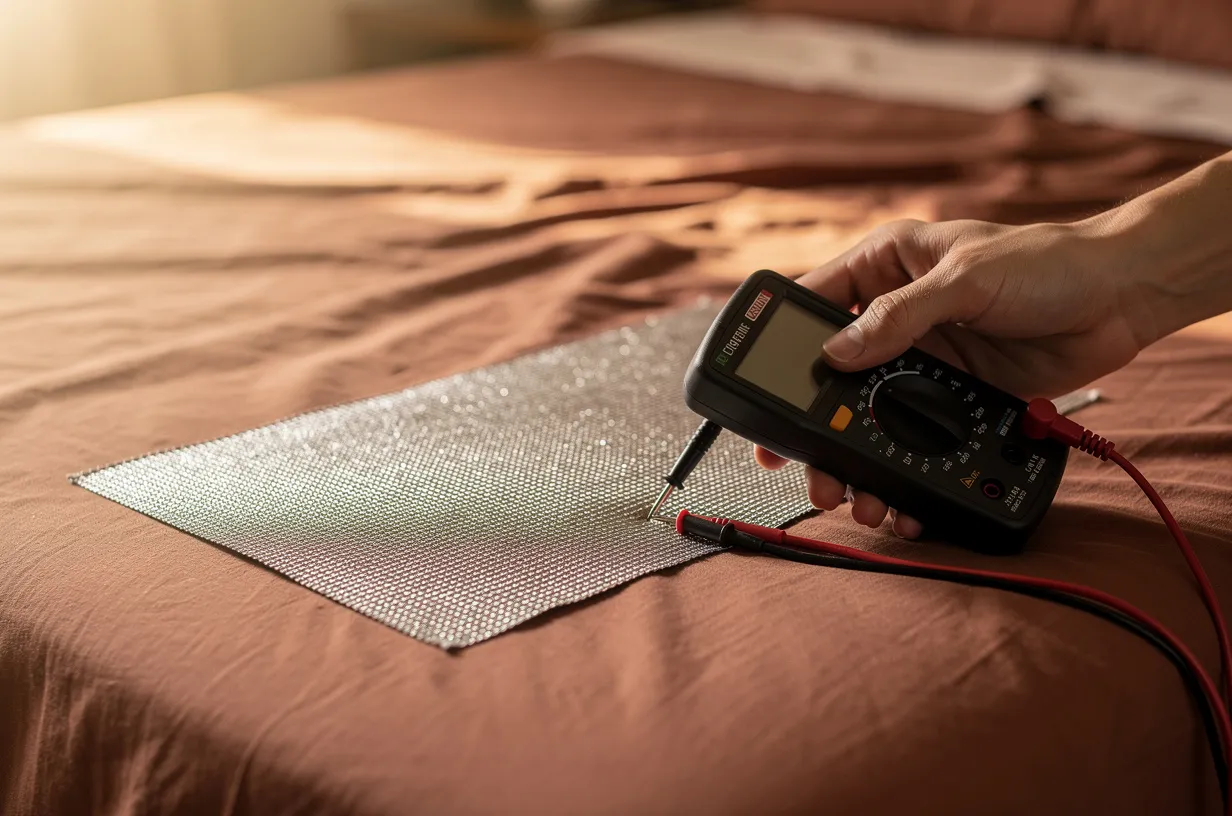
Short answer: set your multimeter to continuity or resistance, touch one probe to the sheet’s conductive
panel and the other to a known ground point, like the ground pin on the plug or a bare metal screw on an outlet
cover. A beep or a low, stable ohm reading means the sheet is making a real connection. Silence or “OL” on the
display means it isn’t, and no amount of squinting at the cord will fix that for you.
A basic multimeter is the fastest, cheapest way to confirm a grounding sheet is actually conductive.
Continuity mode beeps for pass, resistance mode gives you a low ohm number for pass. Takes about two minutes.
Why bother testing with a multimeter at all?
Because a grounding sheet can look completely normal, sit under your fitted sheet every night, and still not
be doing anything. Conductive thread frays with washing, cords fatigue at the connector, and silver-coated fibers
oxidize over time in a way you can’t always see or feel. A multimeter takes the guesswork out. It’s the same logic
as testing a smoke detector instead of just assuming the battery’s still good.
I keep a cheap meter in the nightstand drawer specifically for this. When I’m reviewing a new sheet, the first
thing I do after setup, described in our guide to How to Set Up a Grounding Sheet: Outlet vs Ground Rod, is confirm continuity
before I ever sleep on it. It takes less time than making the bed.
What multimeter do you actually need?
Nothing fancy. Any basic digital multimeter with a continuity or resistance function works, and most hardware
store models under twenty dollars have both. Look for the diode-and-sound-wave symbol for continuity, or the
Omega (Ω) symbol for resistance. If your meter has an auto-ranging resistance mode, that’s even easier since you
don’t have to guess the right range ahead of time.
| Mode | Symbol to look for | What it tells you | Pass result |
|---|---|---|---|
| Continuity | Diode / sound-wave icon | Whether a complete electrical path exists | Audible beep |
| Resistance (ohms) | Ω | How much resistance is in that path | Low, stable number, not “OL” |
How do you actually run the test, step by step?
The process is the same whether you’re testing a full sheet, a mat, or a pillowcase. Here’s the walkthrough
I use on every product I review.
First, unplug the sheet’s grounding cord from the wall outlet, but leave it connected to the sheet itself.
Set your multimeter to continuity mode. Touch one probe to the conductive fabric panel, usually a small metallic
snap or patch sewn into a corner of the sheet, that’s where the cord attaches. Touch the second probe to the metal
prong at the far end of the cord, the one that plugs into the outlet’s ground hole.
If the meter beeps, or shows a low ohm reading in resistance mode, the fabric-to-cord path is intact. If you
get nothing, silence in continuity mode or “OL” in resistance mode, the connection is broken somewhere between
the fabric and the plug, and no outlet in the world will fix that.
Second test: with the sheet still plugged into a live outlet, touch one probe to the conductive fabric and
the other to a known-grounded point elsewhere in the room, an unpainted screw on a light switch cover plate
works well for this. A pass here confirms the entire chain, fabric to cord to outlet to the building’s earth
wire, all in one reading.
What should the reading actually look like?
Don’t expect a dead-zero reading the way you’d see testing a piece of bare copper wire. Conductive fabric,
whether it’s silver-coated thread or stainless-steel fiber, has more resistance than solid metal by design, it’s
still cloth. A reading anywhere from a few ohms up to a few hundred ohms is normal and counts as a pass. What
you’re really watching for is the difference between “some resistance” and “no path at all.” Silence or “OL” is
the number that actually matters here, not the exact ohm value.
If you’re seeing a reading climb noticeably higher every few months on the same sheet, that’s usually oxidation
creeping into silver thread, which is the main reason we point people toward stainless-steel fiber sheets for
anyone who wants the connection to hold up over years of regular washing rather than months.
Premium Grounding Sheet
30% stainless-steel fibers instead of silver, so it will not oxidize and lasts about five times longer. Fits under your fitted sheet, ships worldwide, and comes with a 90-night trial and a 3-year warranty.
Check price on Premium GroundingWhat if the sheet fails the test?
A failed continuity test means the fabric-to-cord connection is broken, and that’s almost always one of three
things: a snap connector that’s come loose or corroded, conductive thread that’s frayed or broken from repeated
washing, or a cord that’s damaged internally even though it looks fine on the outside. None of these are fixed
by moving to a different outlet. If the sheet itself checks out but the second test at the wall fails, the problem
has shifted to the outlet or wiring, and that’s a different conversation covered in
Grounding Sheet Not Working? Troubleshooting.
Washing habits matter here too. We go through the specific do’s and don’ts in
How to Wash Grounding Sheets Without Killing Conductivity, since harsh detergent, high heat, and the dryer are the fastest ways to
degrade the conductive thread you just tested.
Should you test the outlet itself too?
Yes, and it’s worth doing separately from the sheet test. A grounding sheet can pass every continuity check
you throw at it and still do nothing useful if the outlet it’s plugged into isn’t actually grounded. A cheap
plug-in outlet tester, the kind with three small indicator lights, answers that question in seconds without
needing a multimeter at all. If you’re dealing with an older building or a two-prong setup, our guide to
No Grounded Outlet? How to Use a Grounding Sheet covers what your real options are.
Bottom line: a multimeter won’t tell you how you’ll feel sleeping on a grounding sheet, that’s still subjective
and the research behind it is early. But it will tell you, in about two minutes, whether the product is even
capable of doing its one electrical job. That’s worth knowing before you spend another month wondering why
nothing feels different.
Frequently asked questions
What multimeter setting should I use to test a grounding sheet?
Use the continuity setting if your meter has one, it’s the mode with the diode or sound-wave symbol that beeps when a circuit is complete. If your meter doesn’t have continuity, resistance (ohms, the Omega symbol) works too, you’re just reading a number instead of hearing a beep. Either mode tells you the same thing here.
What reading means my grounding sheet is working?
For continuity mode, a beep means the path is complete, that’s a pass. For resistance mode, you want a low reading, generally under a few hundred ohms between the conductive panel and a known ground point. Silver and stainless-steel conductive fabric aren’t as low-resistance as bare copper wire, so don’t expect zero, just expect a low, stable number, not an open circuit (OL or blank display).
Can I test the sheet without unplugging it from the outlet?
You can leave the cord plugged in and just touch one probe to the conductive fabric and the other to the metal ground pin on the plug or a known-grounded metal surface, like an unpainted screw on an outlet cover plate. Testing at the wall this way confirms the whole chain, sheet to cord to outlet, in one step.
Do I need an expensive multimeter for this?
No. A basic ten-to-twenty-dollar digital multimeter from a hardware store does this job fine. You’re not measuring anything delicate, just checking whether a path exists and roughly how resistive it is. Save the higher-end meters for people who need precision on other projects.
My multimeter shows a reading but the sheet still feels like it’s not working. What’s going on?
A passing continuity or resistance test only confirms the electrical path exists, it doesn’t confirm your outlet itself is properly grounded to earth, and it doesn’t measure anything about how you feel using it. If the meter says the sheet is fine, the next thing to check is the outlet itself, which we cover in our troubleshooting guide.
- How to Wash Grounding Sheets Without Killing Conductivity
- How to Set Up a Grounding Sheet: Outlet vs Ground Rod
- How Do I Ground Myself? 7 Ways, From Free to Effortless
- Grounding Outside: Best (and Worst) Surfaces for Earthing
- Grounding in the City: How to Earth Yourself in an Apartment
- DIY Grounding Sheets: Can You Make Your Own? (And Should You?)
- Grounding While Traveling: How to Earth Yourself Away From Home
- 7 Grounding Sheet Setup Mistakes That Kill the Connection
- No Grounded Outlet? How to Use a Grounding Sheet
- Using a Ground Rod for Your Grounding Sheet
- Grounding Sheets and GFCI Outlets Explained
- Grounding in an Apartment: What Works
← How to Use Grounding Sheets: Setup, Care and Daily Practice