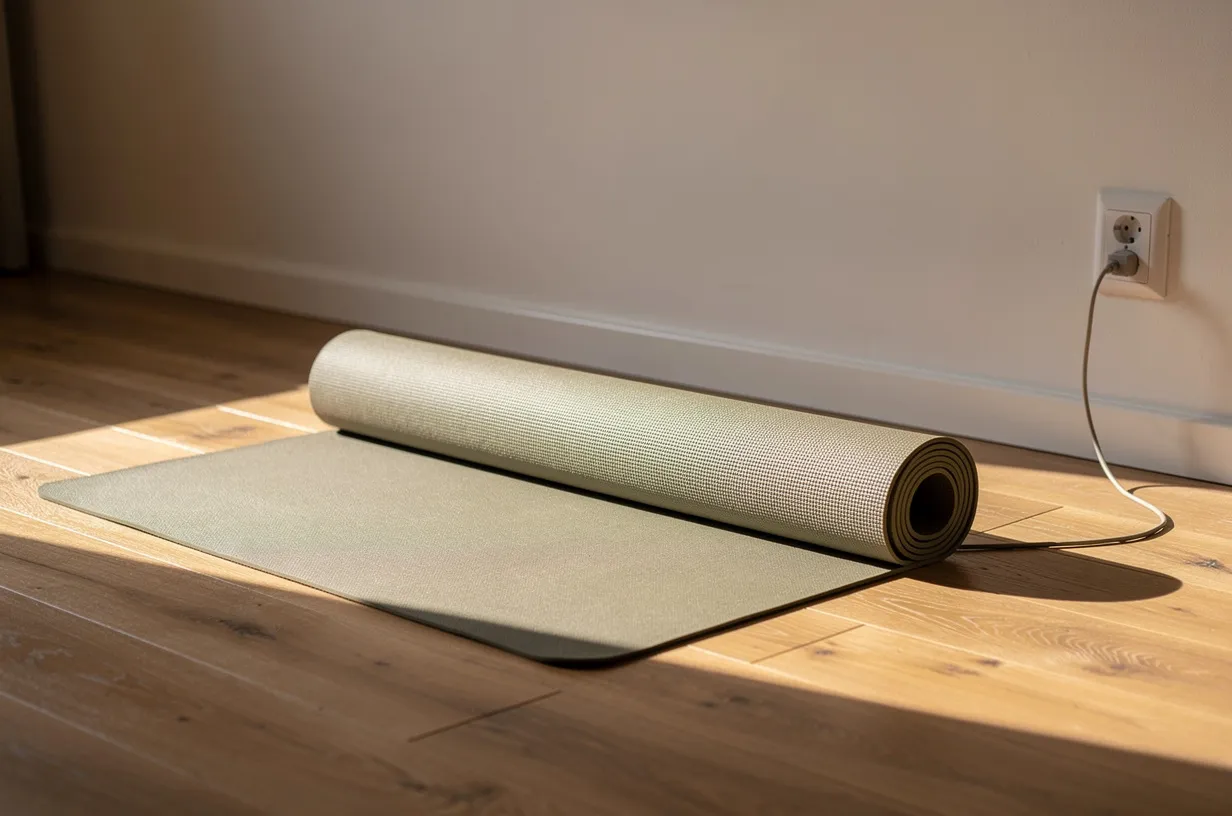
A grounding yoga mat is a conductive mat that plugs into the ground pin of a wall outlet, so your hands and feet pick up the same earth connection you would get standing barefoot on grass. It works, in the narrow electrical sense that the cord genuinely completes a circuit to earth. Whether that changes anything in your body during a 30 to 60 minute practice is a much smaller claim than the marketing usually makes.
A grounding yoga mat is a reasonable low-risk way to try earthing while you stretch, but the evidence behind grounding is strongest for overnight sleep contact, not a short daytime session. If your real goal is the studied benefit, a grounding sheet does more of the work.
What is a grounding yoga mat, exactly?
It looks like an ordinary yoga mat, usually a bit thinner, with fine conductive fibers, carbon-loaded rubber, or a metallic mesh woven through the surface. A cord runs from the mat to a wall outlet, where a small prong plugs into the round ground hole, not the two flat slots that carry live current.
Some versions ship with an alternative ground rod stake for outdoor use, so you can drive it into damp soil instead of relying on your home’s wiring. Either way, the goal is the same: put your skin in contact with a surface that is electrically tied to the earth.
How does a grounding yoga mat actually work?
The mechanism is straightforward and not really in dispute. A grounded outlet’s third pin connects, through your home’s wiring, back to a rod driven into the earth outside. When you touch a conductive surface wired to that pin, your body’s electrical potential settles toward the earth’s, instead of floating at whatever static charge it picked up from shoes, synthetic fabric, or dry indoor air.
The mat itself is usually built from the same handful of materials used across the category, carbon-loaded rubber, woven silver thread, or stainless fibers. Conductive Grounding Fabric Explained breaks down how each one conducts and holds up, which is worth a look before you compare mats by price alone.
What is genuinely uncertain is what, if anything, that potential shift does inside your body. Grounding Products Beyond Sheets: Blankets, Socks, Pillowcases & More covers the mechanism question across every product type, and it is worth reading before you decide a mat, sock, or sheet is the right fit for you.
Does grounding during yoga do anything measurable?
Here is where I have to be honest with you rather than upsell the idea. The research most often cited for grounding, Ghaly and Teplitz’s 2004 sleep and cortisol pilot, Sokal and Sokal’s work on calcium and thyroid markers, and Chevalier’s small blood viscosity study, all involved hours of skin contact, usually overnight. A yoga session gives you a fraction of that exposure.
The closest fit for a mat is the exercise-recovery research from Brown, Chevalier and Hill, which looked at markers of muscle damage after grounded versus ungrounded workouts in small samples. It is suggestive, not conclusive, and it has not been independently replicated at scale. The Oschman, Chevalier and Brown 2015 paper proposes that earth’s electrons act as antioxidants, neutralizing free radicals, but that is a hypothesis paper, not a clinical trial. Treat any claim that a yoga mat will speed your recovery or lower inflammation as unproven, even if the idea itself is plausible.
Grounding yoga mat vs a grounding sheet: where does your time actually go?
Contact duration is the variable that matters most here, and it is the one most product pages skip over.
| Factor | Grounding yoga mat | Grounding sheet |
|---|---|---|
| Typical daily contact time | 20 to 60 minutes | 6 to 8 hours, most nights |
| Best-supported outcome | Unproven for a single session | Sleep quality, still small studies |
| Setup | Roll out, plug into outlet or rod | Fits under a fitted sheet, plug in nightly |
| Good for | Curious yoga or stretching practitioners | Anyone testing grounding for sleep, the strongest studied use case |
If you already do a daily practice and want to add grounding without changing your routine, a mat is a low-effort way to try it. If you are mainly curious whether earthing does anything for how you sleep, a mat during a 45-minute practice is not going to answer that question, and a full-coverage option like Grounding Mattress Pads: Full-Coverage Earthing Under Your Sheet gets you closer to the contact time the sleep studies actually used.
Who should try one, and who should skip it?
It is a reasonable pick if you already practice yoga most days, want a passive way to test grounding without buying bedding, or you travel with a mat and like the idea of using it as your main earthing surface. If your day is mostly spent at a desk instead, Grounding Desk Mats: Earthing While You Work is the more natural fit for the same idea.
It is a weaker pick if you are chasing a specific health outcome, since the research base simply is not built around short daytime sessions. Talk to your doctor before using any grounding product, mat included, if you have a pacemaker or implanted device, are pregnant, or are managing a condition tied to your medication.
How to set one up without wasting your money
Check that the outlet you plan to use actually tests as grounded. A five-dollar outlet tester from a hardware store will tell you in seconds, and it matters more than any spec on the mat’s packaging. A grounding product plugged into a miswired outlet is not doing anything useful, no matter how conductive the fabric is.
Unplug it during thunderstorms, keep it away from standing water, and replace the cord if the insulation cracks. Those basics apply to every conductive product in the lineup, from mats to sheets to socks.
Premium Grounding Sheet
30% stainless-steel fibers instead of silver, so it will not oxidize and lasts about five times longer. Fits under your fitted sheet, ships worldwide, and comes with a 90-night trial and a 3-year warranty.
Check price on Premium GroundingA yoga mat only grounds you while you are on it. If the sleep and relaxation research is what actually drew you to earthing in the first place, that happens overnight, not during a single practice, which is the honest reason a sheet tends to be the better starting point.
Frequently asked questions
Is a grounding yoga mat the same as a regular grounding mat?
Mostly, yes. It is a conductive mat built around a yoga-mat shape and thickness, wired to a wall outlet’s ground pin the same way a desk or bed grounding mat is. The main difference is the surface texture and size, not the underlying technology.
Can I feel anything when I use one?
Most people feel nothing at all, and that is expected. A properly grounded outlet carries essentially no current into you. If you feel tingling or a mild shock, stop and have the outlet checked rather than assuming it is the grounding working.
Will a grounding yoga mat help my recovery or inflammation?
Small pilot studies, including work by Brown, Chevalier and Hill, have looked at grounding and exercise recovery markers, and the Oschman, Chevalier and Brown 2015 review proposes an antioxidant mechanism. None of this is proof, and a 45-minute practice gives you far less contact time than a full night on a grounding sheet.
Do I need a special yoga mat, or can I ground a normal one?
A standard yoga mat is not conductive, so grounding it yourself is not really practical. Grounding yoga mats use conductive threads or a carbon layer built into the mat itself, which is not something you can add to a regular foam mat.
Is it safe to use during a thunderstorm?
No. Unplug any grounding product, mat or sheet, during a thunderstorm, the same way you would unplug other electronics connected to your home’s wiring.
- Grounding Blankets: How They Work and When to Pick One Over Sheets
- Earthing Blanket Guide: Conductive Throws Compared
- Grounding Pillow Cases: Small Upgrade, Real Contact Hours
- Grounding Socks: Do Conductive Socks Actually Ground You?
- Grounding Mattress Pads: Full-Coverage Earthing Under Your Sheet
- Grounding Shoes and Footwear: Earthing While You Walk
- Grounding Fitted Sheets: How They Differ
- Grounding Flat Sheets: Pros and Cons
- Grounding Half Sheets: A Simpler Option
- Grounding Mattress Covers: Full Coverage Earthing
- Grounding Throw Blankets: Earthing on the Couch
- Grounding Patches: Targeted Earthing Explained
← Grounding Products Beyond Sheets: Blankets, Socks, Pillowcases & More