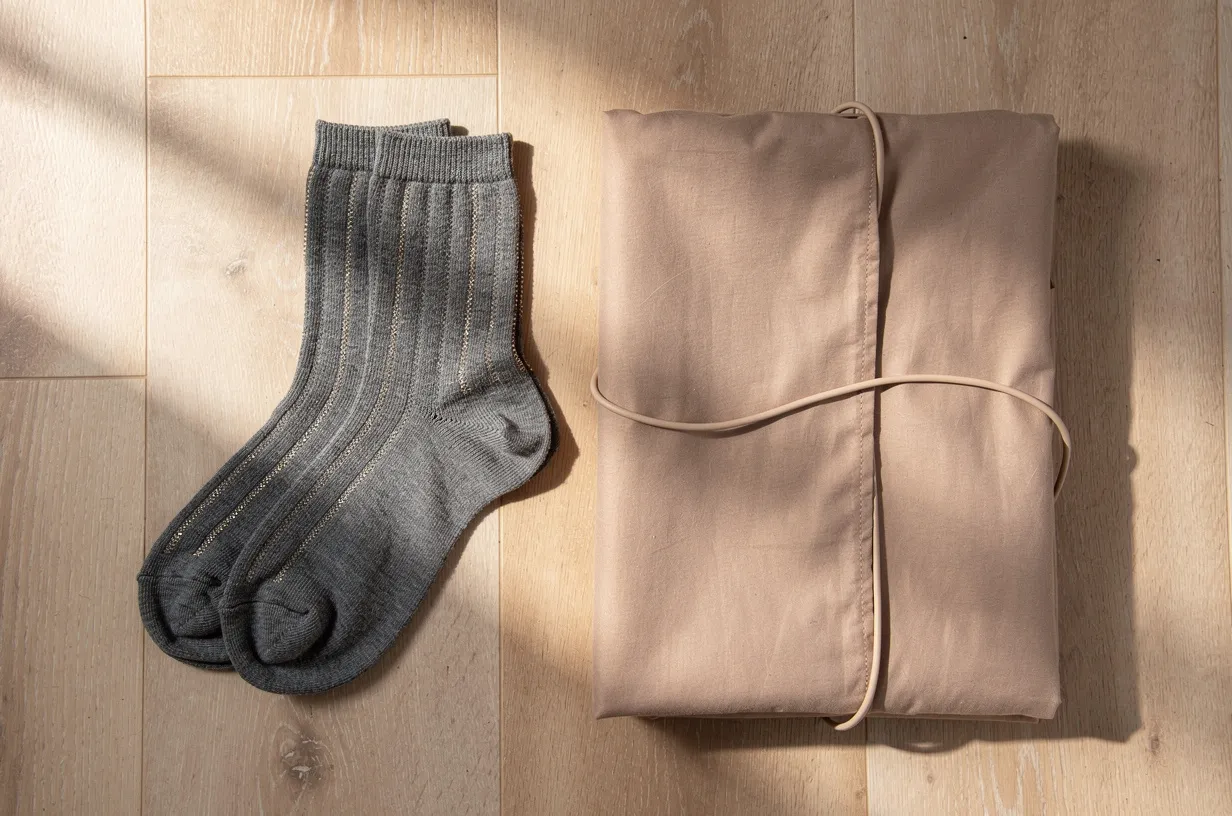
Grounding sheets win for most people, mainly because they work while you sleep and cover far more skin than a pair of socks ever will. Grounding socks earn a place if you want to stay grounded during the day, at a desk or on the couch, without dragging a cord to your bed.
For overnight use, a grounding sheet beats grounding socks on contact area and consistency. Socks are the better pick for daytime grounding at a desk or on a mat, not as a sleep replacement.
What’s the actual difference between the two?
A grounding sheet is a flat or fitted sheet woven with conductive thread, usually silver or, in the case of our top pick, stainless steel. It sits under your regular fitted sheet, plugs into the ground pin of a wall outlet, and touches your skin for six to eight hours while you sleep.
Grounding socks are a pair of cotton socks with a thin conductive sole, often silver-coated. On their own they don’t do much. Most brands pair them with a grounding mat you stand or sit on, or with a snap-and-cord setup that clips to the sock and plugs into the same outlet ground pin your sheet would use.
Both rely on the same underlying idea: skin contact with a conductive surface that’s wired to the earth pin of your outlet, not to live power. See our Grounding Products Beyond Sheets: Blankets, Socks, Pillowcases & More guide if you want the full lineup, sheets, blankets, mats and everything in between.
Do grounding socks work as well as a sheet?
Not for sleep, no. The soles of your feet are a fraction of the skin a full grounding sheet touches when you’re lying on your back or side for hours. Most of the research on grounding and sleep, thin as it is, involved participants lying on conductive sheets or mats overnight, not wearing socks.
Ghaly and Teplitz (2004) ran a small, unblinded pilot where sleeping grounded shifted cortisol toward a more normal day-night pattern and improved participants’ own reports of sleep, pain and stress. It’s the study most often cited for “grounding helps you sleep,” and it’s worth repeating: small sample, self-reported outcomes, no large follow-up trial since. Socks weren’t part of that setup.
Where socks make more sense is daytime grounding, standing at a desk on a grounding mat while you work, or sitting with your feet on one while you read. If your real goal is skin contact through the night, a Grounding Fitted Sheets: How They Differ or a Grounding Half Sheets: A Simpler Option does that job with zero effort on your part once it’s plugged in.
Which one is easier to actually use every night?
Sheets win here too, and it’s not close. You make the bed once, plug the cord into a tested outlet, and forget about it. Socks have to go on before bed and, in our experience testing conductive footwear, they tend to slip or bunch after an hour of tossing and turning, which breaks the connection without you noticing.
There’s also a durability angle. Silver-thread socks see friction at the heel and ball of the foot every time you walk in them, and that wear shows up faster than it does on a sheet you’re mostly lying still on. Stainless-steel sheets, like our top pick, hold their conductivity longer than silver because steel doesn’t oxidize the way silver does with repeated washing.
| Grounding socks | Grounding sheets |
|---|---|
| Best for: daytime use at a desk or with a mat | Best for: full nights of sleep |
| Skin contact: soles of the feet only | Skin contact: back, legs, arms, most of the body |
| Setup: socks plus a mat or cord clip | Setup: sheet plus outlet cord, made once |
| Durability: heel and sole wear faster | Durability: less friction, steel threads last longer |
| Portability: easy to pack for travel | Portability: fixed to one bed |
| Evidence base: mostly borrowed from mat/sheet studies | Evidence base: the actual setup used in most sleep studies |
Who should pick grounding socks instead of a sheet?
If you sit at a desk most of the day and want to stay grounded without buying a mat for the floor, socks paired with a grounding mat are a reasonable, low-cost way in. Travelers who don’t want to bring a fitted sheet to a hotel also lean toward socks or a Grounding Socks: Do Conductive Socks Actually Ground You? and mat combo they can pack flat.
But if the reason you’re here is sleep, pain, or general relaxation, which is where the strongest evidence sits even though it’s still thin, a sheet does more with less effort. Pair it with a Grounding Blankets: How They Work and When to Pick One Over Sheets if you run cold and want grounding on top as well as underneath.
Either product only does what it claims through the outlet’s ground pin, not live power, so the real safety question is whether your outlet is actually wired correctly. A cheap outlet tester answers that in seconds. If you have a pacemaker, are pregnant, or take medication that affects your heart rhythm, talk to your doctor before adding either product to your routine.
Premium Grounding Sheet
30% stainless-steel fibers instead of silver, so it will not oxidize and lasts about five times longer. Fits under your fitted sheet, ships worldwide, and comes with a 90-night trial and a 3-year warranty.
Check price on Premium GroundingFrequently asked questions
Can I use grounding socks and a grounding sheet together?
Yes, and plenty of people do, socks or a mat during the day, a sheet at night. Just don’t plug both into the same outlet without checking the cord and outlet can handle it, and keep both connections to a properly grounded outlet.
Do grounding socks actually conduct electricity through regular flooring?
No. Standing on carpet, vinyl, or a sealed wood floor in grounding socks does nothing on its own. You need either a grounding mat under your feet or a cord that clips to the sock and plugs into the wall outlet’s ground pin.
Will grounding socks wear out faster than a sheet?
Usually, yes. Feet flex and rub against the sole with every step, which stresses the conductive thread more than the gentler contact of lying on a sheet. Washing frequency matters for both, but socks tend to lose conductivity sooner.
Is one option safer than the other?
Neither is inherently safer than the other. Both connect to the same outlet ground pin rather than live power, so the real variable is whether your outlet is wired correctly, not which product you choose.
Which one should a beginner start with?
Start with a sheet if better sleep is the goal, since that’s the setup behind most of the existing research. Start with socks and a mat if you mainly want grounding while working or traveling.
- Grounding Blankets: How They Work and When to Pick One Over Sheets
- Earthing Blanket Guide: Conductive Throws Compared
- Grounding Pillow Cases: Small Upgrade, Real Contact Hours
- Grounding Socks: Do Conductive Socks Actually Ground You?
- Grounding Mattress Pads: Full-Coverage Earthing Under Your Sheet
- Grounding Shoes and Footwear: Earthing While You Walk
- Grounding Fitted Sheets: How They Differ
- Grounding Flat Sheets: Pros and Cons
- Grounding Half Sheets: A Simpler Option
- Grounding Mattress Covers: Full Coverage Earthing
- Grounding Throw Blankets: Earthing on the Couch
- Grounding Patches: Targeted Earthing Explained
← Grounding Products Beyond Sheets: Blankets, Socks, Pillowcases & More