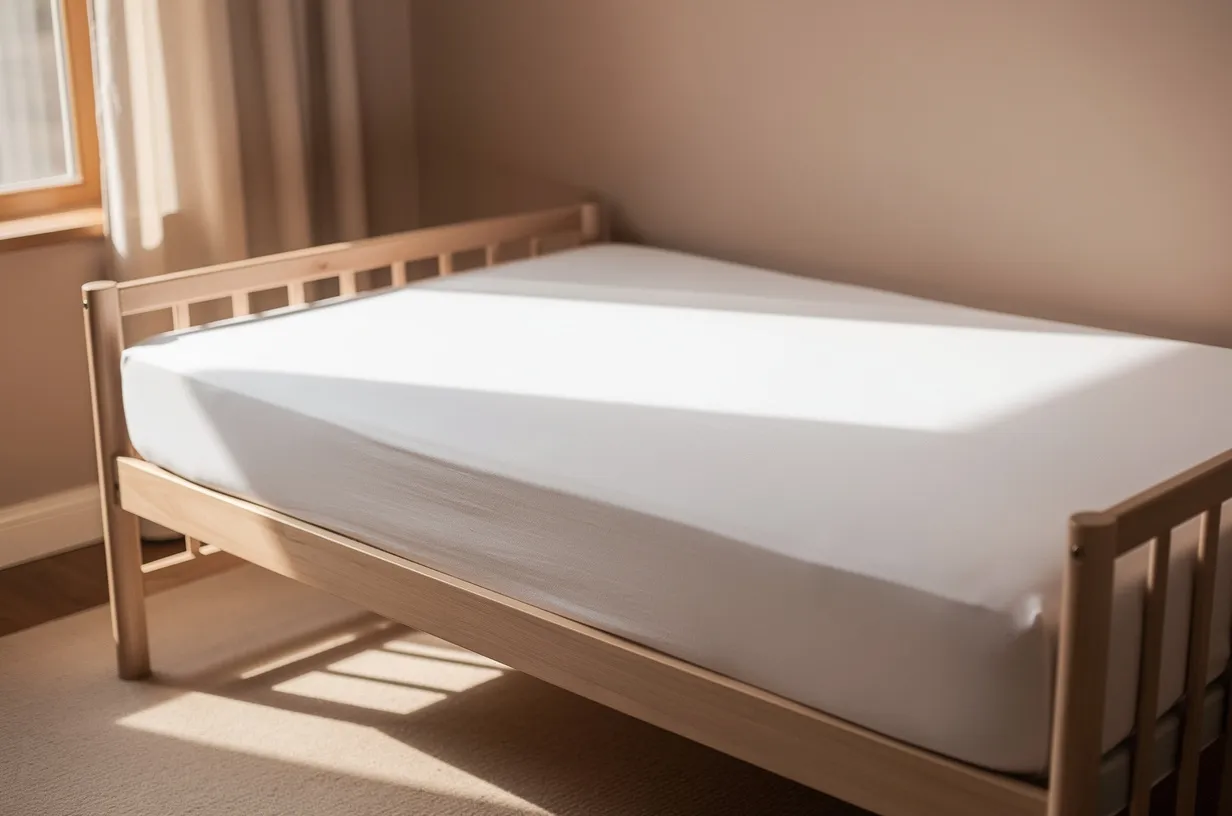
Short answer: skip the grounding sheet in a baby’s crib. There’s no research on grounding and infants, the American Academy of Pediatrics already asks parents to keep cribs bare, and any electrical product in a baby’s sleep space adds a variable you don’t need. If you’re curious about grounding, try it on your own bed first.
A grounding sheet isn’t recommended for a baby’s crib. No study has tested grounding on infants, and safe-sleep guidance already calls for an empty crib with no loose fabric, cords, or extra layers.
Is a grounding sheet safe for a baby’s crib?
The honest answer is that nobody has studied it, which is a different problem than “it’s dangerous.” The studies behind grounding (Ghaly and Teplitz 2004 on sleep and cortisol, Sokal and Sokal 2011, Chevalier’s blood-viscosity work) were all done on adults, mostly small groups of them. There’s no pediatric trial to point to, positive or negative.
That gap matters more here than it would for, say, a grounding sock on a grown adult. Safe-sleep guidelines from the American Academy of Pediatrics are specific: a crib should have a firm mattress, a fitted sheet, and nothing else. No blankets, no bumpers, no pillows, no extra layers between baby and mattress. A grounding sheet is an extra layer with a cord attached, and that alone puts it outside the guidance most pediatricians will give you.
What actually happens when a sheet plugs into the wall?
Grounding sheets connect through a cord to the ground pin of a wall outlet, the same pin that protects any grounded appliance in your house. They’re not wired into live power, and the current involved is tiny. The real-world risk with any grounding product isn’t the sheet itself, it’s a miswired outlet, which is why we always recommend a cheap outlet tester before plugging one in anywhere, nursery included.
Even with a correctly grounded outlet, a crib is a different environment than an adult bed. Cords, however thin, are a strangulation and entanglement risk near an infant who can roll, grab, and kick. That’s a separate issue from whether grounding “works,” and it’s the one that should decide this for most parents.
Why babies are treated differently than adults here
Infants regulate body temperature, skin contact, and sleep cycles differently than adults do, and their skin is thinner and more reactive to fabric and moisture. None of the grounding studies measured any of that. So a claim like “grounding sheets improve sleep” (already a stretch, since it rests on small, mostly self-reported adult data) simply doesn’t transfer to a crib.
We’d say the same about a lot of adult wellness products. A weighted blanket, a heating pad, an essential-oil diffuser plugged in overnight, all of these have adult use cases that don’t carry over to a baby’s crib, usually for the same two reasons: unstudied on infants, and safe-sleep guidance already tells you to keep the space empty.
What the research does and doesn’t cover
To be fair to the topic, the case for grounding in adults isn’t nothing. Ghaly and Teplitz found shifts in cortisol rhythm and better self-reported sleep in a small, unblinded pilot. Oschman, Chevalier and Brown (2015) proposed a mechanism, Earth’s surface electrons acting as antioxidants, but that paper is a review and hypothesis piece, not a clinical trial. None of it has been replicated in large, independent studies, and several of the researchers involved have ties to grounding-product companies. That’s the honest state of the adult evidence: promising for sleep and relaxation, thin everywhere else.
Now subtract the infant piece entirely, because it hasn’t been tested at all, and you’re left with zero data either way. Calling it unproven for babies isn’t a scare tactic, it’s just accurate.
| Question | What we’d tell a friend |
|---|---|
| Grounding sheet in the crib, under the fitted sheet? | Skip it. Extra layer, extra cord, no infant research. |
| Grounding sheet on the parents’ bed for a room-sharing setup? | Fine on your side, keep the baby’s own sleep surface bare per AAP guidance. |
| Grounding mat under the crib mattress, no cord near baby? | Still unstudied for infants. We wouldn’t recommend it either. |
| Waiting until baby is older, or a toddler bed? | Still no pediatric research exists as of 2026. Ask your pediatrician before trying anything electrical near a child’s sleep space. |
If a family member on medication, with a pacemaker, or with any other medical device is involved in caring for the baby, or you’re weighing this for yourself during pregnancy, that’s a conversation for a doctor, not a product review. We’re not medical professionals, and the safest move for a question this specific is a five-minute call to your pediatrician.
Safer ways to explore grounding without touching the crib
If the appeal of grounding is really about your own sleep, there’s a straightforward way to test it without any of the infant-safety questions: put a grounding sheet on your bed, not the crib. We’ve reviewed the category in our Best Grounding Mattress Pads 2026 roundup, and if you want the lighter, layer-on-top option rather than a full fitted sheet, our Grounding Blankets: How They Work and When to Pick One Over Sheets guide covers how that compares. Neither belongs anywhere near a baby’s sleep space, but both are reasonable for an adult who wants to try grounding without changing anything about how the nursery is set up.
Premium Grounding Sheet
30% stainless-steel fibers instead of silver, so it will not oxidize and lasts about five times longer. Fits under your fitted sheet, ships worldwide, and comes with a 90-night trial and a 3-year warranty.
Check price on Premium GroundingFor parents who specifically want something small and low-commitment to test on themselves, our Grounding Socks: Do Conductive Socks Actually Ground You? guide and the Grounding Patches: Targeted Earthing Explained page cover the lowest-cost ways to try grounding on an adult body before deciding whether it’s worth a full sheet. Whatever you land on, keep it out of the crib and stick to what your pediatrician and the AAP’s bare-crib guidance already recommend for baby.
Frequently asked questions
Can I put a grounding sheet under my baby’s fitted crib sheet?
We wouldn’t. It adds a layer and a cord to a sleep space that safe-sleep guidelines want kept empty, and there’s no research on grounding in infants either way.
Are grounding products dangerous for babies specifically?
Not in the sense of live electricity, since they connect to a wall outlet’s ground pin rather than power. The concern is the extra fabric layer and cord in a crib, which goes against standard safe-sleep advice, plus the total absence of infant research.
Is it fine to use a grounding sheet on my own bed if the baby sleeps in the same room?
Room-sharing without the baby on the grounded sheet is a different situation than the baby sleeping directly on one. Keep the baby’s own mattress and fitted sheet as the AAP recommends, and if you have questions about your specific setup, ask your pediatrician.
Has anyone studied grounding on children at all?
Not that we could find. The existing studies (Ghaly and Teplitz, Sokal and Sokal, Chevalier and colleagues) were all done on adults, and mostly small groups of them.
What should I do instead if I want my baby to sleep better?
That’s really a pediatric sleep question rather than a grounding one. A pediatrician or a certified pediatric sleep resource is a better starting point than any product, grounding included.
- Grounding Blankets: How They Work and When to Pick One Over Sheets
- Earthing Blanket Guide: Conductive Throws Compared
- Grounding Pillow Cases: Small Upgrade, Real Contact Hours
- Grounding Socks: Do Conductive Socks Actually Ground You?
- Grounding Mattress Pads: Full-Coverage Earthing Under Your Sheet
- Grounding Shoes and Footwear: Earthing While You Walk
- Grounding Fitted Sheets: How They Differ
- Grounding Flat Sheets: Pros and Cons
- Grounding Half Sheets: A Simpler Option
- Grounding Mattress Covers: Full Coverage Earthing
- Grounding Throw Blankets: Earthing on the Couch
- Grounding Patches: Targeted Earthing Explained
← Grounding Products Beyond Sheets: Blankets, Socks, Pillowcases & More