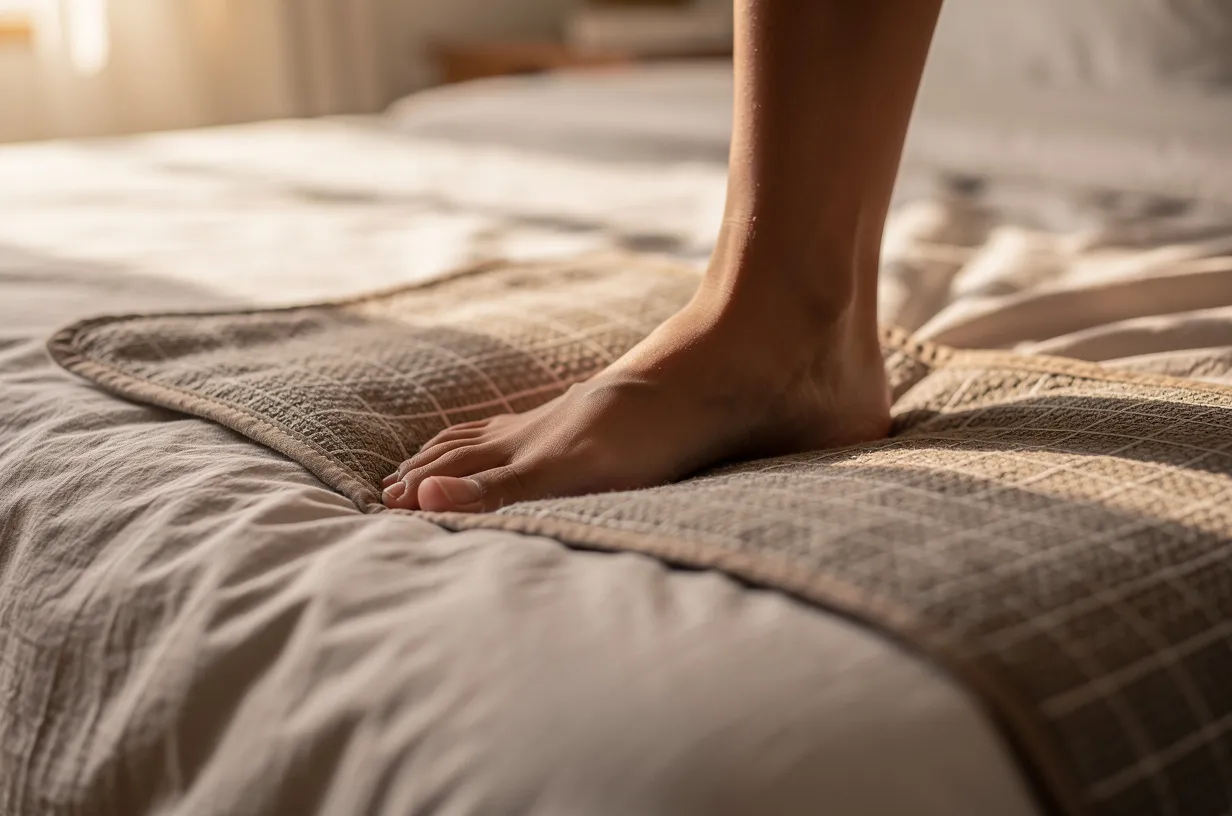
Short answer: grounding sheets aren’t a tendonitis treatment, and no honest source will tell you otherwise. What the small studies actually point to is calmer inflammation markers and better subjective sleep, which can support recovery around the edges while your tendon does the slow work of healing.
If you’re dealing with tennis elbow, Achilles pain, or a cranky rotator cuff, the fastest relief still comes from load management and a good physical therapy plan. Grounding is something you layer on top of that, not instead of it.
Grounding sheets don’t treat tendonitis. Small studies suggest they may support sleep and calm some inflammation markers, so they’re a reasonable, low-risk add-on to rest and physical therapy, not a replacement for either.
Can grounding sheets help tendonitis?
Not directly, and nobody has actually studied grounding on tendon injuries specifically. What exists is a small body of research on grounding, inflammation, and muscle recovery, plus the sleep studies that started this whole niche. You have to connect the dots yourself, and I’ll be upfront about how thin that bridge is.
Tendonitis is mechanical damage from repeated stress on a tendon. It responds to reduced load, targeted strengthening, and time. A conductive sheet on your mattress isn’t going to change that biomechanics problem. What it might do is help you sleep better while your body handles the repair work, and sleep is when a lot of tissue repair happens anyway.
What does the research actually say about grounding and inflammation?
The most cited paper here is Oschman, Chevalier and Brown (2015) in the Journal of Inflammation Research. It’s a narrative review, not a controlled trial, and it proposes that electrons from the earth might act as antioxidants that neutralize reactive oxygen species involved in inflammation. That’s a hypothesis about a mechanism, not proof it reduces swelling in your elbow.
Separately, Brown, Chevalier and Hill ran small pilots on delayed-onset muscle soreness after exercise, and reported some markers of muscle damage trending down in grounded participants. Muscle soreness after a workout and a degraded tendon from months of overuse are not the same injury, so I’d treat this as suggestive at best, not a green light.
Do the muscle recovery studies apply to tendon pain?
Partially, and only in the sense that both involve inflammation and repair. Tendons have far less blood flow than muscle, which is exactly why tendonitis heals slowly and why doctors often call it tendinopathy once it becomes chronic. Whatever grounding does for muscle recovery markers in a small pilot study doesn’t automatically transfer to a structure that’s built and behaves so differently.
We go deeper into what those recovery studies actually measured in our guide to Grounding for Muscle Recovery: What Research Says, and how athletes use grounding as one piece of a routine in Grounding Sheets for Athletes: Recovery, Claims and Reality. Worth reading if you’re weighing this as part of a broader recovery stack rather than a standalone fix.
What actually works for tendonitis
This is the part that matters more than any sheet. Standard, evidence-backed tendonitis care looks like this, and it’s what your doctor or physical therapist will likely recommend regardless of what you add on top.
| Approach | What it does | Evidence level |
|---|---|---|
| Load management / rest from the aggravating movement | Stops re-injuring the tendon so it can repair | Well established, first-line |
| Eccentric strengthening (physical therapy) | Rebuilds tendon capacity gradually | Well established for chronic cases |
| Ice / short-term NSAIDs | Manages acute pain and swelling | Established for short-term symptom control |
| Better sleep quality | Supports the body’s general repair processes | Reasonably established, non-specific |
| Grounding sheets | May support sleep; proposed anti-inflammatory mechanism unproven for tendons | Small, early-stage studies only |
Notice where grounding sits on that list. It’s the last thing to add, not the first thing to try, and it should never replace a proper diagnosis if the pain is sharp, sudden, or doesn’t improve after a couple of weeks of rest.
Is it safe to try alongside standard treatment?
For most people, yes. The sheet connects to your outlet’s ground pin, not live power, so the real-world risk is a miswired outlet rather than the sheet itself. A cheap outlet tester from a hardware store settles that question in about thirty seconds.
If you have a pacemaker or another implanted electrical device, or you’re pregnant, talk to your doctor before adding a grounding sheet to your routine. That’s standard caution with any conductive bedding product, not a tendonitis-specific concern. We cover the mechanism and the electron-antioxidant hypothesis in more detail in our guide to Grounding and Inflammation: What the Research Actually Measures, and if your pain is more foot-specific, our piece on Grounding for Plantar Fasciitis: Does It Help? walks through a closely related question.
So is it worth trying?
If your tendonitis care is already dialed in, rest, PT, load management, and you’re curious about a low-risk sleep add-on, grounding is reasonable to try for a few weeks. Just don’t expect it to move the needle on the tendon itself, and don’t let it become an excuse to skip the boring stuff that actually works.
Premium Grounding Sheet
30% stainless-steel fibers instead of silver, so it will not oxidize and lasts about five times longer. Fits under your fitted sheet, ships worldwide, and comes with a 90-night trial and a 3-year warranty.
Check price on Premium GroundingFor the wider picture on what grounding is genuinely good for versus what’s marketing, our Grounding Sheets Benefits: What’s Proven, Promising, and Hype guide breaks down the full evidence by outcome, sleep, inflammation, blood pressure, and more, so you can set realistic expectations before you buy anything.
Frequently asked questions
Can grounding sheets cure tendonitis?
No. Tendonitis needs reduced load and time to heal, usually with physical therapy. No study has tested grounding on tendon injuries directly, and no honest source claims it treats or cures the condition.
What does the research on grounding and inflammation actually show?
The main paper, Oschman, Chevalier and Brown (2015), is a narrative review proposing that grounding may act as an antioxidant against inflammatory free radicals. It’s a hypothesis about a mechanism, not a controlled trial proving it reduces swelling in an injury like tendonitis.
Will a grounding sheet help with post-workout soreness that led to tendonitis?
Small pilot studies by Brown, Chevalier and Hill suggest grounding may lower some markers of muscle damage after exercise. That’s about general muscle soreness, not chronic tendon injury, so treat it as a minor supporting factor at most.
Is grounding safe to use while recovering from tendonitis?
Generally yes for most people. The sheet uses your outlet’s ground pin, not live power, so the main real-world risk is a miswired outlet, which a cheap tester can rule out. Anyone with a pacemaker, another implanted device, or who is pregnant should check with their doctor first.
What should I do instead of relying on grounding for tendonitis?
Start with rest from the aggravating movement, see a physical therapist about eccentric strengthening, and use ice or short-term anti-inflammatories for acute flare-ups. Grounding can sit on top of that plan for its possible sleep benefit, but it shouldn’t replace any of it.
- Grounding Sheets for Sleep: Can Earthing Improve Your Nights?
- Grounding and Inflammation: What the Research Actually Measures
- Grounding Sheets for Restless Leg Syndrome: Does Earthing Help?
- Benefits of Grounding: The Full List, Ranked by Evidence
- How Long Should You Ground Yourself Each Day?
- Grounding Sheets and EMF: Protection or Misconception?
- Grounding Sheets for Athletes: Recovery, Claims and Reality
- Grounding Sheets for Seniors: What to Know Before Buying
- Grounding Sheets for Anxiety: What the Evidence Actually Says
- Grounding Sheets and Jet Lag: Can Earthing Help You Reset?
- Grounding Sheets for Back Pain: What Evidence Shows
- Grounding Sheets for Inflammation: The Research
← Grounding Sheets Benefits: What’s Proven, Promising, and Hype