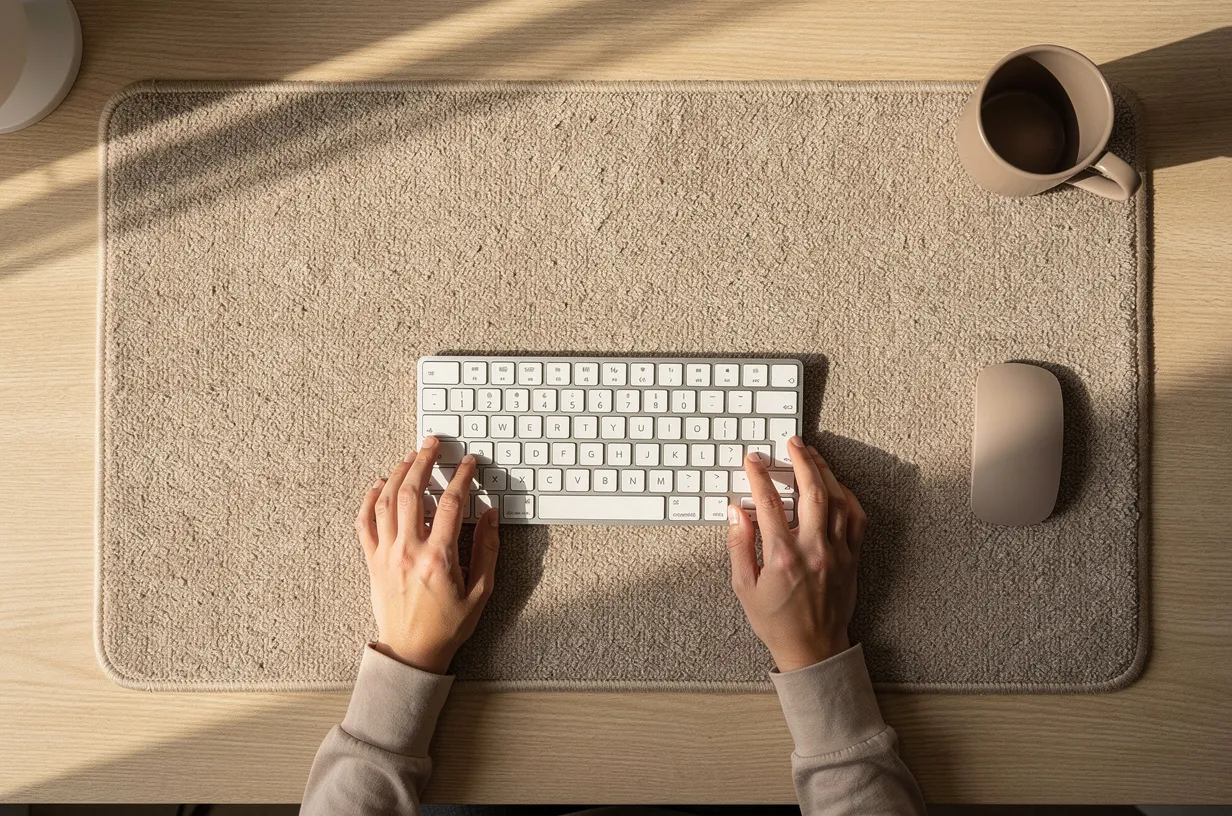
A grounding mat under your desk connects your hands, forearms, or bare feet to your home’s earth ground while you work, the same wiring idea behind a grounding sheet, just running during the day instead of overnight.
A desk mat is a cheap, low-risk way to stay grounded during work hours, but the sleep-focused studies this niche leans on don’t cover sitting at a desk, so treat it as a comfort experiment rather than a proven fix.
Does a grounding mat under your desk actually do anything?
The electrical part is simple and verifiable. A conductive mat, whether it’s carbon-filled leatherette or a silver-thread fabric, runs a cord to a plug that ties into your outlet’s ground pin. That puts your body at roughly the same electrical potential as the earth outside, the same mechanism used in a Grounding Mat for Bed: How to Choose and Set One Up setup.
What’s less settled is what that connection does for you physically during the day. The small studies most often cited in this space, Ghaly and Teplitz (2004), Sokal and Sokal (2011), and Chevalier et al. (2013) on blood viscosity, all looked at sleep or short grounding sessions, not eight hours at a keyboard. Nobody has run a solid trial on desk-mat use specifically. If resting your wrists on a mat makes you feel calmer or a little less tense by mid-afternoon, that’s worth paying attention to, but it isn’t something the research has measured yet.
How do you set up a grounding mat at your desk?
Most desk mats plug straight into the ground hole of a standard outlet, either directly with a grounded plug or through an adapter cord with a built-in resistor for safety. You place the mat wherever skin will actually touch it: under your forearms and wrists, or on the floor under bare feet if you’d rather ground through your soles.
- Test the outlet first with a cheap three-light outlet tester. A miswired outlet, not the mat itself, is the real safety issue in this whole category.
- Keep skin contact direct. Grounding through a mouse pad, sleeve, or thick fabric layer defeats the point of the mat.
- Wipe the surface down occasionally. Skin oils and dust build up on conductive fabric and can dull the connection over months of daily use.
If you have a pacemaker, another implanted electrical device, or you’re pregnant, talk to your doctor before adding any grounding product to your routine. The current involved is tiny, but a professional opinion costs nothing and this niche doesn’t have enough research to override that caution.
What should you check before buying one?
Size and cord length matter more than most buying guides mention. A mat that’s too small to fit both forearms, or a cord too short to reach a nearby outlet without an extension, ends up in a drawer within a month. Beyond that, the mat’s surface material is the real fork in the road.
| Mat type | Feel | Durability | Typical price |
|---|---|---|---|
| Carbon or leatherette (Hooga-style) | Firm, slightly rubbery | Holds up well, nothing to oxidize | Budget-friendly |
| Silver-thread fabric | Soft, closer to a placemat | Conducts great new, but silver tarnishes with washing and wear | Mid-range |
| Stainless-steel thread fabric | Soft, close to cotton | Resists oxidation, longer functional life | Check current price |
You’ll find more detail on the differences between mat styles and where each one fits in Grounding Mat Benefits: What to Expect (and When), and a full rundown of tested options in Best Grounding Mats of 2026: Desk, Floor & Bed Picks.
Do you need a desk mat if you already have a grounding sheet?
Not necessarily. If sleep is your main goal, a bed setup does more for you, since you’re in contact for hours without moving and that’s also where most of the study data actually points. A desk mat is really for people who sit most of the day and want to extend that contact into waking hours, remote workers, students, anyone who noticed a difference from a sheet at night and wants more of it.
The two aren’t competing purchases, they solve different parts of the day. If you’re starting from scratch and have to pick one, the bed is the better first move; the sleep research, thin as it is, is still the strongest evidence this category has. Our tested top pick for that side of things is the Premium Grounding Sheet. Its stainless-steel fiber weave resists the oxidation that eventually dulls silver-thread bedding, and it fits under a regular fitted sheet so your bed doesn’t look or feel any different.
Premium Grounding Sheet
30% stainless-steel fibers instead of silver, so it will not oxidize and lasts about five times longer. Fits under your fitted sheet, ships worldwide, and comes with a 90-night trial and a 3-year warranty.
Check price on Premium GroundingFor a closer side-by-side of the two product categories, see Grounding Mat vs Grounding Sheet: Which One Fits Your Setup?, and for the full picture of how mats fit into a grounding routine, start at Grounding Mats: The Complete Guide (vs Sheets, Setup, Picks).
Is a desk mat worth the money?
For the price of a budget carbon mat, yes, it’s a reasonable low-stakes try. You’re not spending much, the setup takes ten minutes, and the worst case is that you notice nothing and stop using it. Just don’t expect it to outperform sleep grounding, and don’t buy into any claim that it treats a specific condition. The honest read on this whole category is that it’s promising for comfort and relaxation, thin on proof for anything beyond that, and low-risk enough to test for yourself.
Frequently asked questions
Can I use a grounding mat on a wood or laminate desk?
Yes. The desk surface underneath doesn’t matter, since wood and laminate don’t conduct electricity. What matters is that your skin touches the mat directly and the mat’s cord reaches a properly grounded outlet.
Does a grounding mat need to touch bare skin to work?
For the conductive path to function, yes. A shirt sleeve, mouse pad, or thick fabric between your skin and the mat blocks the connection, so most people rest bare forearms or wrists directly on the surface.
Is a desk mat as effective as a grounding sheet for sleep?
No, and that’s expected. The sleep-focused studies, like Ghaly and Teplitz’s cortisol pilot, tested overnight grounding, not daytime desk use, so a sheet is the better choice if better sleep is your actual goal. A desk mat is a separate, daytime addition.
How do I know if my outlet’s ground is actually safe?
A cheap three-prong outlet tester, sold for a few dollars at any hardware store, will tell you in seconds whether an outlet is properly wired. This matters more for safety than anything about the mat itself.
Will a grounding mat interfere with my laptop or wifi signal?
No. Grounding mats work through a low-current connection to your outlet’s ground pin and have no meaningful effect on wifi signals or nearby electronics.
- Grounding Mat for Bed: How to Choose and Set One Up
- Best Grounding Mats of 2026: Desk, Floor & Bed Picks
- Grounding Mat vs Grounding Sheet: Which One Fits Your Setup?
- Grounding Mat Benefits: What to Expect (and When)
- Earthing Mats Explained: Types, Conductivity and Placement
- Grounding Pads for Bed: Are They Better Than Full Sheets?
- Grounding Mats for Your Feet: How to Use
- Universal Grounding Mats Explained
- Grounding Mat vs Grounding Blanket
- Grounding Mat Not Working? Fixes
- Best Grounding Mats 2026: Tested Picks
← Grounding Mats: The Complete Guide (vs Sheets, Setup, Picks)