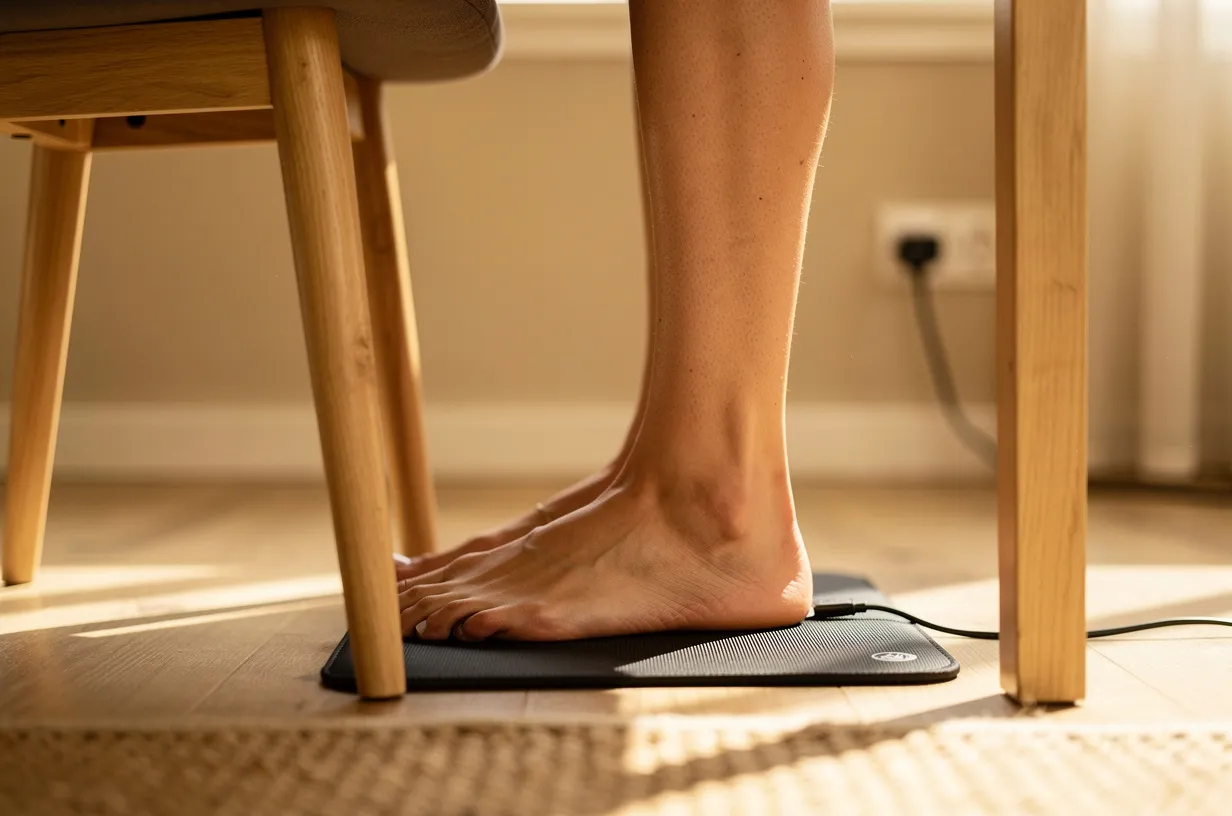
A grounding mat for your feet is a small conductive pad you set on the floor under your desk (or beside a chair) so your bare soles touch it while you work. It plugs into the same electrical ground as a bed sheet does, just on a much smaller patch of skin and for shorter stretches. It’s a reasonable way to try earthing during the day, but it’s not a substitute for the hours of full-body contact most of the sleep research was actually built on.
A foot mat gives you the same real electrical connection as a bed sheet, on a smaller scale. Good for a daytime try, not a replacement for overnight contact.
What exactly is a grounding mat for your feet?
Most are a thin sheet of carbon-loaded rubber or leatherette, sometimes woven with conductive thread, roughly the size of a bath mat or smaller. A snap or wire runs from one corner to a cord, and that cord ends in either a plug shaped to fit the ground pin of a US outlet or an alligator clip for a dedicated ground rod outside.
You set it on the floor, kick your shoes off, and rest your bare soles on it. Some people keep one under the desk for work hours, others put a smaller version by the couch or the bed for reading time before sleep.
How do you actually use one at your desk?
Plug the cord into a properly grounded three-prong outlet, or clip it to a ground rod if you’re using one. Set the mat flat on the floor where your feet naturally land when you sit. Bare skin needs to touch the surface, socks and most slippers block the contact almost entirely.
From there it’s passive. You just sit and work, and the mat does its job in the background. There’s no sensation to chase, if anything feels like a shock or a buzz, unplug it and check the outlet before you use it again.
Does foot-only contact still count as grounding?
Electrically, yes. Your feet sweat more than most skin, which actually makes them decent conductors, and the ground pin doesn’t care how much of your body is touching the mat. The circuit either completes or it doesn’t.
Where it differs from a sheet is exposure time and body coverage. A few hours of feet-only contact during a work day is a different dose than eight hours of your back, legs and arms all touching a sheet overnight. Neither is “wrong,” they’re just not the same experiment.
What does the research actually say about this?
Here’s the honest gap: the small studies people point to for grounding, Ghaly and Teplitz’s 2004 sleep and cortisol pilot, Sokal and Sokal’s work on blood chemistry, Chevalier’s blood viscosity study, were done with participants grounded overnight or for extended sessions, not with a foot mat under a desk for an hour between meetings.
The Oschman, Chevalier and Brown 2015 paper that proposes electrons from the earth might act as antioxidants is a review of a hypothesis, not a trial on desk mats specifically. So daytime foot grounding borrows plausibility from the sheet research, it isn’t separately proven. If you want the full picture of what’s actually been tested, we’ve summarized it in The Science of Grounding Sheets: Every Study, Summarized.
Skeptics also have a fair point here: sample sizes across this whole field are small, blinding a “grounded” mat against a fake one is hard, and some of the researchers have ties to grounding brands. That doesn’t make the electrical part fake, but it should keep your expectations modest.
Foot mat vs full grounding sheet: which one actually fits you?
| Foot mat | Full grounding sheet |
|---|---|
| Soles of the feet only | Full-body skin contact, back and legs and arms |
| Good for desk workers who want a low-effort daytime habit | Closer to how the sleep studies were actually run |
| Sits loose on the floor, easy to move room to room | Fits under your fitted sheet, stays put once it’s set up |
| Cheap way to test if you notice anything at all | Bigger investment, but matches the strongest evidence (still small studies) for sleep and relaxation |
If you’re curious but don’t want to commit, a mat is the lower-cost way in. We compare the two setups in more detail in Grounding Mat vs Grounding Sheet: Which One Fits Your Setup?, and if the bedroom version is what you’re actually after, Grounding Mat for Bed: How to Choose and Set One Up covers that setup directly.
What setup mistakes ruin the connection?
The most common one is an outlet that isn’t actually grounded. Some older buildings have three-prong outlets wired without a real ground path, so the pin is there but doing nothing. A cheap outlet tester from a hardware store checks this in seconds, and it’s worth the few dollars before you assume the mat is broken.
Second most common: socks. Thin dress socks and most slippers stop skin contact cold. Third: the mat facing the wrong side up, some have a conductive top and a plain rubber backing, so check the label if nothing seems to be happening.
Who should ask a doctor before trying this?
If you have a pacemaker or another implanted electrical device, talk to your doctor or the device manufacturer before using any grounding product, mat or sheet. The same goes if you’re pregnant or on medication that affects your heart rhythm or nerve function. None of this is because the current is dangerous, the ground pin connects you to the earth, not to live power, but it’s a reasonable and cheap precaution.
Is a foot mat worth buying on its own?
For a low-cost way to test whether grounding does anything for you, sure, it’s a fair starting point and it’s easy to move between the desk and the sofa. But if you’re chasing the sleep and relaxation effects that the actual studies looked at, more skin contact for more hours is the closer match to what was tested. That’s the case for switching to a full sheet once you know you like the idea.
Premium Grounding Sheet
30% stainless-steel fibers instead of silver, so it will not oxidize and lasts about five times longer. Fits under your fitted sheet, ships worldwide, and comes with a 90-night trial and a 3-year warranty.
Check price on Premium GroundingWhichever you pick, check our full buying breakdown in Best Grounding Mats of 2026: Desk, Floor & Bed Picks or start from the category overview in Grounding Mats: The Complete Guide (vs Sheets, Setup, Picks) if you’re still comparing formats.
Frequently asked questions
Does a grounding mat for your feet actually work the same as a grounding sheet?
Electrically, the connection to the outlet ground works the same way. The difference is dose: a sheet covers far more skin for far more hours overnight, while a foot mat gives you a smaller contact area for however long you sit at your desk.
Can you wear socks on a grounding mat for your feet?
Not really. Socks and most slippers insulate your skin from the conductive surface, so the connection barely registers. Bare feet, or at most very thin damp socks, are what actually make contact.
How long should you sit on a foot grounding mat each day?
There’s no studied ideal number for daytime foot mats specifically. Most people leave it under the desk for however long they’re working, an hour or several, and treat it as a passive background habit rather than a timed session.
Is a grounding mat for feet enough, or should you also get a sheet?
A mat is a fair low-cost way to try grounding out. If you like it and want the exposure closer to what the sleep studies actually tested, moving to a full grounding sheet for overnight use is the more direct comparison.
- Grounding Mat for Bed: How to Choose and Set One Up
- Best Grounding Mats of 2026: Desk, Floor & Bed Picks
- Grounding Mat vs Grounding Sheet: Which One Fits Your Setup?
- Grounding Mat Benefits: What to Expect (and When)
- Earthing Mats Explained: Types, Conductivity and Placement
- Grounding Pads for Bed: Are They Better Than Full Sheets?
- Grounding Mats for Your Desk: Setup and Picks
- Universal Grounding Mats Explained
- Grounding Mat vs Grounding Blanket
- Grounding Mat Not Working? Fixes
- Best Grounding Mats 2026: Tested Picks
← Grounding Mats: The Complete Guide (vs Sheets, Setup, Picks)