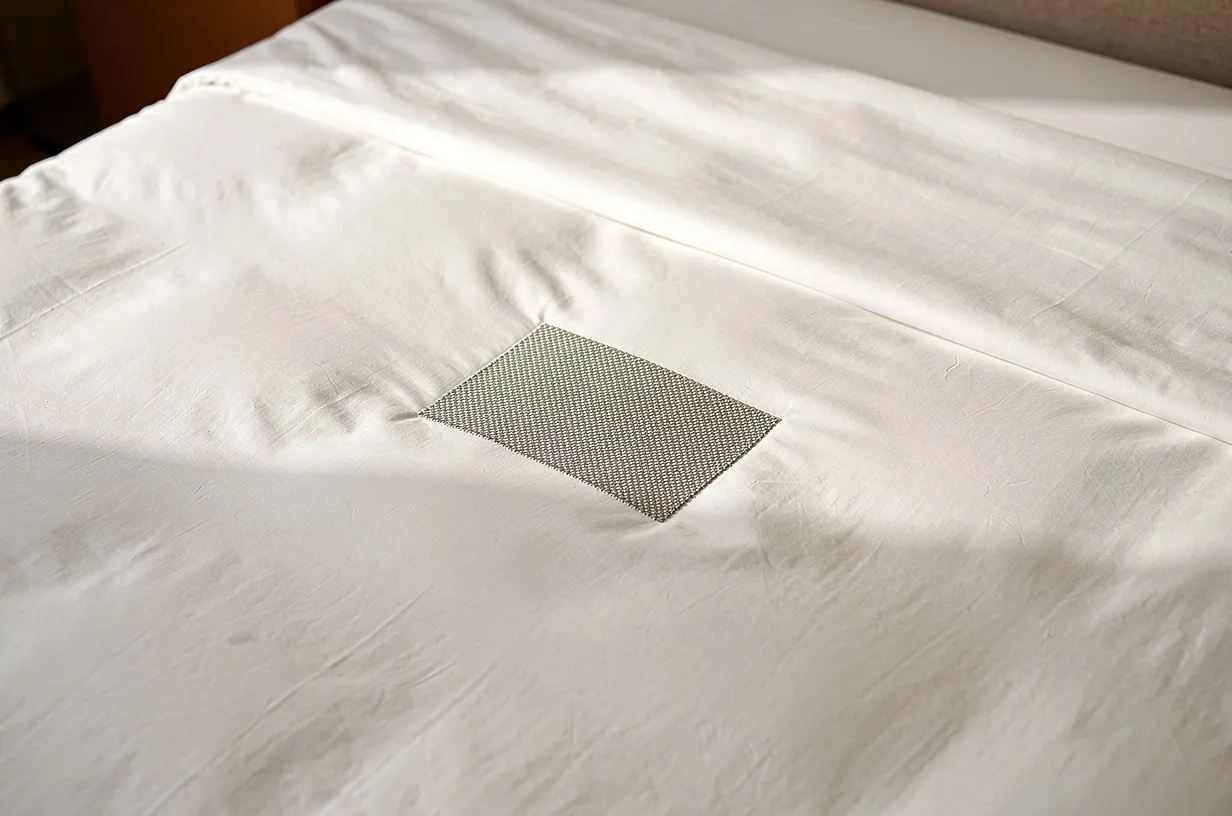
A grounding half sheet is a smaller conductive panel, usually sized to cover just the area under your torso and hips, that you lay on top of your regular fitted sheet and plug into a grounded outlet. It’s a cheaper, simpler way to try earthing without replacing your bedding.
A half sheet is a fair low-cost entry point if you sleep mostly still and mostly on your back. If you toss and turn, a full grounding fitted sheet or mattress pad gives more reliable skin contact.
What exactly is a grounding half sheet?
Think of it as a flat rectangle of conductive fabric, usually cotton woven with a percentage of silver or stainless-steel thread, roughly the size of a large placemat or a small blanket. You place it over your existing sheet, run the grounding cord to a wall outlet, and lie on top of it. There’s no elastic, no fitting to your mattress corners, nothing to wash separately from your regular laundry routine, though you’ll still want to check the manufacturer’s washing instructions.
It’s the low-commitment version of Grounding Products Beyond Sheets: Blankets, Socks, Pillowcases & More. You’re not swapping your whole sleep setup, you’re adding one piece of conductive fabric to it.
How is a half sheet different from a full grounding sheet?
A full Grounding Fitted Sheets: How They Differ covers the entire mattress and stays put with elastic corners, the way a normal fitted sheet does. A half sheet only covers part of the bed, usually the middle third where most people spend most of the night. That means less fabric, less material cost, and typically a lower price.
The tradeoff is coverage. If you roll onto your side or drift toward the edge of the mattress, you can end up off the conductive panel entirely, and the grounding stops working the moment your skin loses contact. A full sheet is more forgiving because there’s conductive fabric under you no matter where you land.
Does a half sheet still work if you move around at night?
It works when you’re touching it, and it does nothing when you’re not. That’s true of any grounding product, but the smaller footprint of a half sheet makes the gap more noticeable. If you’re a back sleeper who mostly stays in one spot, a half sheet positioned under your torso and legs can give you several hours of solid contact. If you’re a restless sleeper who ends up sideways or diagonal by 3am, you’ll likely spend real chunks of the night off the fabric without realizing it.
Some people solve this by pairing a half sheet with a grounding pillowcase or a strip near the feet, so contact is more likely no matter how they’ve shifted. Others just accept the gaps as a fair tradeoff for the lower price.
Is a half sheet worth the lower price?
If your goal is simply to find out whether grounding does anything for your sleep before spending more, yes, a half sheet is a reasonable way to test the waters. It’s less fabric to buy, less to wash, and easier to try in a guest bed or on a mattress you don’t want to fully commit to modifying.
If you already know you’re a restless sleeper, or you’re buying specifically because of the sleep research, small and early-stage as it is, you’re better served putting your money into something with full-mattress coverage, like a fitted sheet or a Grounding Mattress Pads: Full-Coverage Earthing Under Your Sheet. Consistent contact matters more than the marketing copy on any one product suggests.
How do you set up a grounding half sheet?
Lay it flat and centered where your torso and hips will rest, tuck the excess under the mattress edge if there is any, and run the cord to a nearby outlet. Before you plug in anything for the first time, test that outlet with a cheap outlet tester, the kind sold at any hardware store for a few dollars. Grounding products connect to the ground pin of your outlet, not the live power, but that safety feature only works if the outlet is actually wired correctly. A miswired outlet is the real risk here, not the sheet itself.
Half sheet vs full sheet vs mattress pad
| Option | Coverage | Setup | Best for |
|---|---|---|---|
| Grounding half sheet | Partial, usually torso/hip area | Lay flat, no fitting | Testing the concept, back sleepers who stay put |
| Grounding fitted sheet | Full mattress, elastic corners | Fits like a normal fitted sheet | Anyone who moves around at night |
| Grounding mattress pad | Full mattress, sits under your regular sheet | Layer under existing bedding | People who don’t want conductive fabric as their top layer |
Our tested top pick,
Premium Grounding Sheet
30% stainless-steel fibers instead of silver, so it will not oxidize and lasts about five times longer. Fits under your fitted sheet, ships worldwide, and comes with a 90-night trial and a 3-year warranty.
Check price on Premium GroundingWhat’s the honest evidence for any of this?
Worth saying plainly: the research behind grounding is small. The most-cited study, Ghaly and Teplitz (2004), was a small, unblinded pilot that reported grounding during sleep shifted cortisol patterns and improved self-reported sleep, pain and stress. Sokal and Sokal (2011) and Chevalier et al. (2013) reported other physiological changes in small samples. None of this is proof that grounding treats or cures anything, and several of the researchers involved have commercial ties to grounding products. The Sleep Foundation and independent reviewers have flagged the same limitations: tiny sample sizes, self-reported outcomes, and a lack of independent replication.
What that means for a half sheet specifically: if it helps, sleep and relaxation are the most plausible outcomes, not disease treatment of any kind, and even that evidence is thin. It’s a low-risk thing to try as long as your outlet is properly grounded, but go in with realistic expectations. If you’re pregnant, have a pacemaker or another implanted device, or you’re on medication that affects your skin or circulation, talk to your doctor before adding any grounding product to your routine.
Frequently asked questions
Do grounding half sheets actually work?
They provide the same electrical connection as a full sheet whenever your skin is touching the conductive fabric. The open question isn’t whether the connection works, it’s whether grounding itself does anything measurable, and the research on that is small and early. See our Conductive Grounding Fabric Explained guide for how the fabric itself functions.
How much smaller is a half sheet than a full one?
It varies by brand, but most cover roughly the middle third of the bed, enough for your torso, hips and part of your legs when you’re lying flat and centered. It won’t reach the edges or the head of the bed.
Can I use a half sheet on any size mattress?
Yes, since it isn’t fitted to mattress dimensions, a half sheet works on twin through king. You’re just placing a flat panel where you sleep, not stretching elastic corners around anything.
Will a half sheet stay in place overnight?
Most will shift some without elastic corners to anchor them, especially if you move a lot. Tucking the edges under your fitted sheet or mattress helps, but expect some drift compared to a full grounding fitted sheet.
Is a half sheet safe to use every night?
Yes, as long as it’s plugged into a properly grounded outlet. The connection runs to your outlet’s ground pin, not live current. Test the outlet with a cheap outlet tester before your first use, and check the cord periodically for wear.
- Grounding Blankets: How They Work and When to Pick One Over Sheets
- Earthing Blanket Guide: Conductive Throws Compared
- Grounding Pillow Cases: Small Upgrade, Real Contact Hours
- Grounding Socks: Do Conductive Socks Actually Ground You?
- Grounding Mattress Pads: Full-Coverage Earthing Under Your Sheet
- Grounding Shoes and Footwear: Earthing While You Walk
- Grounding Fitted Sheets: How They Differ
- Grounding Flat Sheets: Pros and Cons
- Grounding Mattress Covers: Full Coverage Earthing
- Grounding Throw Blankets: Earthing on the Couch
- Grounding Patches: Targeted Earthing Explained
- Grounding Bands and Wristbands: Do They Work?
← Grounding Products Beyond Sheets: Blankets, Socks, Pillowcases & More