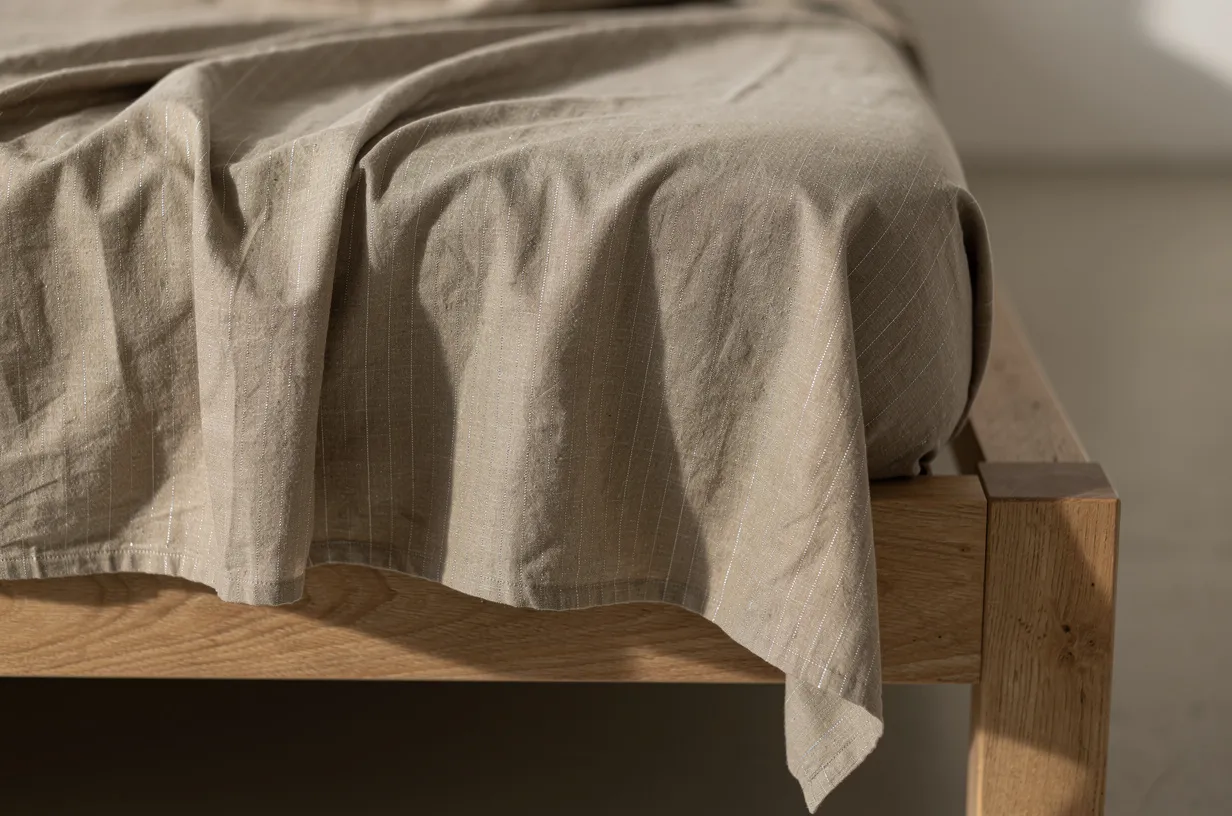
A grounding flat sheet is the loose top layer of an earthing sleep setup, the piece you drape over your regular bedding rather than fit snugly like a pocketed sheet. It’s the cheapest way into grounding, and it works fine if you don’t move much in your sleep. If you’re a restless sleeper, though, it slips away from your skin more often than a fitted one does.
A grounding flat sheet is the budget, no-fuss way to try earthing. It works, and it’s simple to set up, but it keeps contact with your skin less reliably than a fitted sheet if you toss and turn at night.
What is a grounding flat sheet, exactly?
A grounding flat sheet is woven with thin conductive threads, usually silver-coated fibers, run through cotton or a cotton blend. One corner has a snap connector. You clip a grounding cord to that snap and plug the other end into the ground pin of a wall outlet, and the sheet is meant to sit at the same electrical potential as the earth while you sleep on it.
Unlike a fitted grounding sheet, it has no elastic pocket. You lay it flat, either as a top sheet over your existing bedding or straight across the mattress, and let its own weight hold it in place.
How is a flat sheet different from a fitted grounding sheet?
The conductive material is usually the same. What changes is how it stays put. A fitted sheet has elastic edges that wrap the mattress corners, so your skin keeps touching the conductive threads through a whole night of moving. A flat sheet just sits there, though some people tuck the edges under the mattress to cut down on shifting. We cover the fitted version in Grounding Fitted Sheets: How They Differ, worth a read if you sleep restlessly, since fit matters more than fabric for actually staying grounded.
What are the real pros and cons?
Price is the main pro. Flat sheets tend to be the least expensive format in a grounding lineup, since they use less fabric and skip the elastic construction. They’re also flexible: fold one over for a half-sheet-style layer, drape it across a chair during the day, or pack it for travel since it folds flatter than a fitted one.
The main con is contact. If you kick off the top sheet or roll away from it overnight, you’re not grounded anymore, and you won’t necessarily notice. Hot, restless sleepers often end up with the sheet bunched at the foot of the bed by morning. It also washes differently, a loose sheet gets more friction in the wash, which can wear down the conductive threads faster over time.
How do the formats compare?
| Format | Skin contact | Setup effort | Best for |
|---|---|---|---|
| Flat sheet | Inconsistent, depends how you sleep | Low, drape or tuck | Budget testers, still sleepers |
| Fitted sheet | Reliable, elastic holds it against you | Low | Restless or side sleepers |
| Half sheet | Good for feet and legs only | Low | Trying grounding without redoing the whole bed |
| Mattress pad | Most consistent, full body | Medium, sits under your fitted sheet | People who want grounding to just work every night |
If a flat sheet feels like too little coverage, Grounding Half Sheets: A Simpler Option is a middle option, and Grounding Mattress Pads: Full-Coverage Earthing Under Your Sheet goes under your existing sheets for the most consistent contact of the three.
Does the science actually back up sleeping on one?
Partly, and mostly for sleep. Ghaly and Teplitz (2004) ran a small, unblinded pilot where participants slept grounded and reported better sleep, less pain, and a cortisol rhythm that shifted closer to a normal day-night pattern. It’s the most-cited study behind the claim that grounding helps you sleep, and it’s also small and self-reported, so treat it as suggestive rather than proof.
Other work, including Sokal and Sokal’s (2011) experiments on metabolic markers and Chevalier’s (2013) blood-viscosity study, points toward broader effects, but those come from a handful of the same researchers and need independent replication. Oschman, Chevalier and Brown’s 2015 review in the Journal of Inflammation Research proposes that the earth’s electrons might act as antioxidants, but that’s a hypothesis, not a large clinical trial. None of this means a grounding flat sheet treats or prevents any condition. If sleep is your goal, the format doesn’t change the underlying science, a sheet grounds you the same way whenever it’s actually touching your skin. That “whenever” is the whole tradeoff.
Is a flat sheet the right buy, or should you go fitted?
If you sleep still, mostly on your back, and want the cheapest way to test whether grounding does anything for you, a flat sheet is a reasonable start. If you toss and turn, a fitted sheet or a full mattress pad will keep contact more reliably.
We keep coming back to the
Premium Grounding Sheet
30% stainless-steel fibers instead of silver, so it will not oxidize and lasts about five times longer. Fits under your fitted sheet, ships worldwide, and comes with a 90-night trial and a 3-year warranty.
Check price on Premium GroundingWhat about electrical safety?
A grounding flat sheet connects to your wall outlet’s ground pin, not to live power, so the exposure isn’t the same as plugging in an appliance. The real risk is a miswired outlet where the ground pin isn’t actually connected to earth. A cheap outlet tester checks that in under a minute. If you have a pacemaker, another implanted device, or you’re pregnant, talk to your doctor before adding any grounding product to your routine.
Frequently asked questions
Can I use a regular flat sheet over a grounding fitted sheet?
Yes, but not the other way around. Your skin needs to touch the conductive layer directly, so the grounding sheet has to be the layer against you, not covered by a regular one.
Does a grounding flat sheet need special detergent?
Use a mild detergent and skip fabric softener. Softener coats the fibers and can reduce how well the threads carry a charge over time.
How do I know my flat grounding sheet is still working?
Most brands sell a simple continuity tester that lights up when you touch it to the conductive thread and the grounding snap, an easy check before assuming the sheet still works.
Is a grounding flat sheet safe for children?
The electrical exposure is the same low-risk setup as for adults when the outlet is properly grounded, but talk to your pediatrician first, and check our safety guide for the specifics that matter with kids.
- Grounding Blankets: How They Work and When to Pick One Over Sheets
- Earthing Blanket Guide: Conductive Throws Compared
- Grounding Pillow Cases: Small Upgrade, Real Contact Hours
- Grounding Socks: Do Conductive Socks Actually Ground You?
- Grounding Mattress Pads: Full-Coverage Earthing Under Your Sheet
- Grounding Shoes and Footwear: Earthing While You Walk
- Grounding Fitted Sheets: How They Differ
- Grounding Half Sheets: A Simpler Option
- Grounding Mattress Covers: Full Coverage Earthing
- Grounding Throw Blankets: Earthing on the Couch
- Grounding Patches: Targeted Earthing Explained
- Grounding Bands and Wristbands: Do They Work?
← Grounding Products Beyond Sheets: Blankets, Socks, Pillowcases & More