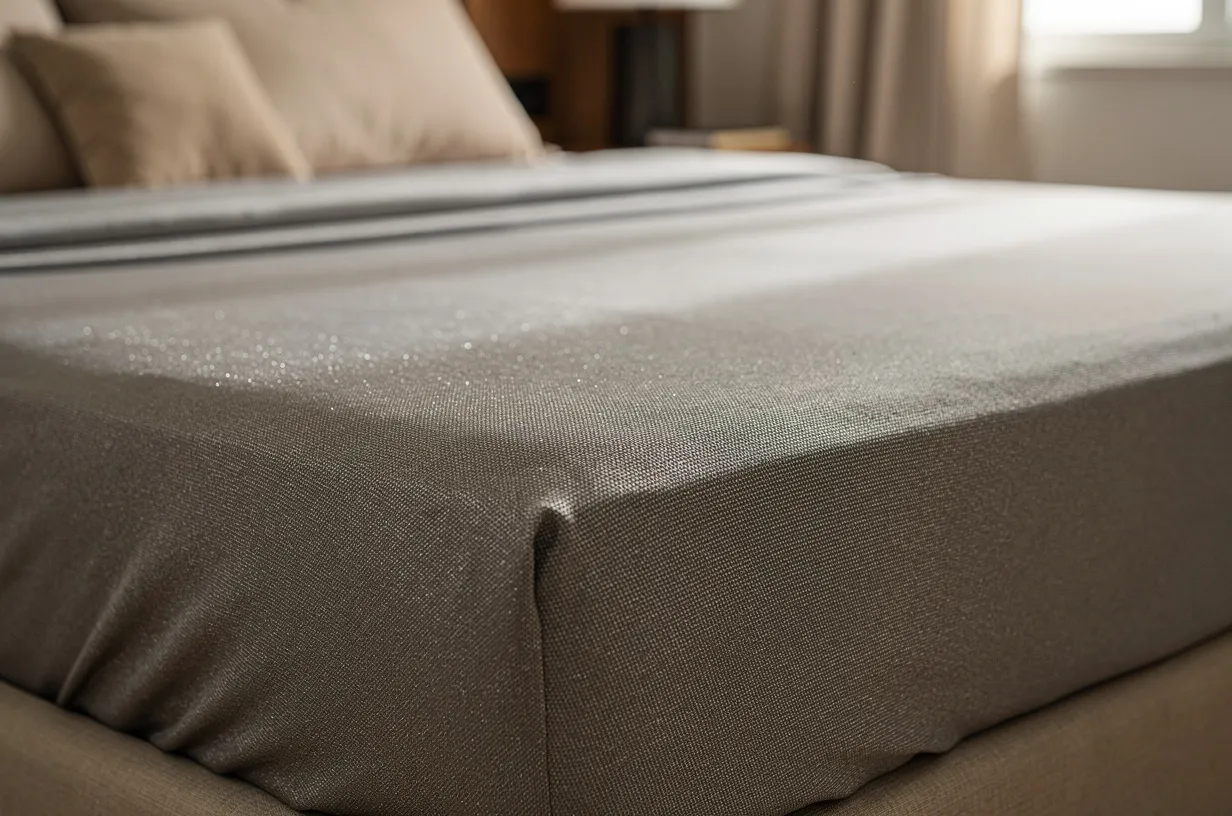
A grounding fitted sheet is the format built for direct skin contact. It stretches over your mattress with elastic corners, just like a normal fitted sheet, and you sleep right on the conductive fabric instead of adding it as an extra layer.
If the whole point of grounding is continuous contact overnight, this is the shape that gives you the most of it. It’s also the format that asks the most of you: you’re replacing your actual sheet, not stacking something under it.
A grounding fitted sheet gives you the most direct skin contact of any grounding bedding format. Good pick if you’re ready to swap out your current sheet; skip it if you’d rather keep your bedding as-is and ground from underneath instead.
What exactly is a grounding fitted sheet?
It’s cotton or a cotton blend woven through with a fine conductive thread, usually stainless steel or silver, and sewn into a standard fitted-sheet shape with elastic corners. We break down how that thread actually works in Conductive Grounding Fabric Explained.
A short cord snaps onto the sheet and plugs into the ground pin of a three-prong wall outlet. That’s it. No batteries, no live current, just a wire connecting the conductive fibers to the same ground path your building’s wiring already uses for safety.
The one thing worth doing before you trust any of this: test the outlet with a cheap plug-in tester first. The real risk isn’t the sheet, it’s a miswired or ungrounded outlet, and a five-dollar tester tells you in seconds.
How is a fitted sheet different from a flat sheet or half sheet?
A grounding flat sheet, which we cover separately in Grounding Flat Sheets: Pros and Cons, is a loose rectangle. You either lie on top of it or tuck it like a regular top sheet. It’s cheaper and works across mattress sizes without any elastic tension, but it shifts around more overnight, so your contact isn’t as consistent.
A half sheet is smaller still, a single panel roughly torso-sized rather than a full mattress cover. It’s the cheapest way to try grounding, but the trade-off is obvious: less surface area means you have to stay positioned on it to get any contact at all.
The fitted sheet sits in between cost and commitment. It stays anchored, covers the full mattress, and gives you contact wherever you happen to be lying, which is the closest thing to a set-it-and-forget-it setup.
What about a mattress pad or cover instead?
A grounding mattress pad or cover goes under your existing fitted sheet rather than replacing it. You keep your current bedding, and the conductive layer sits beneath, which some sleepers prefer because nothing about their sheets or feel changes. We compare the two approaches directly in Grounding Sheet vs Grounding Mattress Pad.
The honest trade-off is contact. With a layer of regular cotton between your skin and the conductive material, you’re relying partly on moisture and pressure to carry the connection, rather than direct fiber-to-skin contact all night.
| Format | Skin contact | Setup | Best for |
|---|---|---|---|
| Grounding fitted sheet | Direct, full mattress | Replaces your top sheet | Sleepers who want maximum contact and don’t mind swapping bedding |
| Grounding mattress pad or cover | Indirect, through your existing sheet | Sits under your current fitted sheet | Keeping your bedding as-is |
| Grounding flat sheet | Direct if you sleep on it, not under it | No elastic, drapes loosely | Testing on a budget, flexible sizing |
| Grounding half sheet | Direct but small area | Smallest panel, easiest to move | The cheapest way to try grounding at all |
What should you check before buying a grounding fitted sheet?
Material matters more than most buyers expect. Stainless-steel thread holds its conductivity through years of washing, while silver thread oxidizes over time and gradually loses its effect, even though it feels similar out of the box. That’s the real durability question, not a marketing detail.
Elastic pocket depth is the second thing to check, and it’s easy to overlook. Measure your mattress plus any topper, then compare it against the sheet’s listed pocket depth before you buy, the same way you’d check for a regular deep-pocket sheet.
Cord length matters too. Make sure it comfortably reaches your outlet without stretching across the room or running under the bed frame at an awkward angle, since a taut cord is one you’ll eventually stop plugging back in.
Is a grounding fitted sheet worth it, or should you keep your sheets and add a pad?
The evidence here is honestly still thin. The most-cited study, Ghaly and Teplitz (2004), was a small, unblinded pilot that found grounding during sleep shifted cortisol toward a more normal rhythm and improved how people reported their own sleep, pain and stress. That’s promising, not proof, and it’s the strongest data point this whole category has.
Given that, I don’t think the format matters as much as the marketing suggests. A fitted sheet gets you more direct contact, which is the theoretical mechanism at work, but a pad under your existing sheet still grounds you for most of the night without asking you to change your bedding.
If you’d rather test the idea without giving up your current sheets, that’s a completely reasonable way to start.
Premium Grounding Sheet
30% stainless-steel fibers instead of silver, so it will not oxidize and lasts about five times longer. Fits under your fitted sheet, ships worldwide, and comes with a 90-night trial and a 3-year warranty.
Check price on Premium GroundingOur tested top pick uses stainless-steel fiber instead of silver specifically so it holds its conductivity through repeated washing, and it’s built to sit under a fitted sheet rather than replace one, which keeps the switch low-commitment. For the full range of formats beyond sheets, including blankets, socks and pillowcases, see Grounding Products Beyond Sheets: Blankets, Socks, Pillowcases & More.
Frequently asked questions
Can I still use a top sheet over a grounding fitted sheet?
You can, but you’ll lose some of the direct contact that’s the reason to choose a fitted sheet in the first place. If you know you want a top sheet anyway, a mattress pad worn under your regular sheets is usually the better match.
Does the elastic wear out before the grounding effect does?
Elastic and conductivity are separate issues. The elastic follows normal fitted-sheet wear, while conductivity depends on the thread material, and stainless steel holds up longer than silver through repeated washing.
Will it fit a deep mattress or one with a topper?
Check the listed pocket depth against your mattress plus topper height before buying. Most grounding fitted sheets follow standard deep-pocket sizing, but it’s worth confirming rather than assuming.
How do I wash a grounding fitted sheet without damaging the threads?
Cold water, a mild detergent, and no bleach or fabric softener, which can coat and dull the conductive fibers. Air drying is gentler than a hot dryer cycle if you want the sheet to last.
- Grounding Blankets: How They Work and When to Pick One Over Sheets
- Earthing Blanket Guide: Conductive Throws Compared
- Grounding Pillow Cases: Small Upgrade, Real Contact Hours
- Grounding Socks: Do Conductive Socks Actually Ground You?
- Grounding Mattress Pads: Full-Coverage Earthing Under Your Sheet
- Grounding Shoes and Footwear: Earthing While You Walk
- Grounding Flat Sheets: Pros and Cons
- Grounding Half Sheets: A Simpler Option
- Grounding Mattress Covers: Full Coverage Earthing
- Grounding Throw Blankets: Earthing on the Couch
- Grounding Patches: Targeted Earthing Explained
- Grounding Bands and Wristbands: Do They Work?
← Grounding Products Beyond Sheets: Blankets, Socks, Pillowcases & More