Short answer: no study has tested grounding sheets on back pain specifically. What exists is a handful of small, early trials where people using grounding devices reported less pain in general, as one measure among several, not a dedicated back-pain trial. That’s a reasonable signal to try it if you’re curious, not proof it will fix a bad back.
Grounding sheets aren’t a treatment for back pain. Small pilot studies hint at less self-reported pain and better sleep, but none were designed or sized to test back pain on its own. Low-risk to try, not a substitute for seeing someone about a spine problem.
What the research actually measured
The study most people point to is Ghaly and Teplitz (2004), published in the Journal of Alternative and Complementary Medicine. It’s a small, unblinded pilot that had participants sleep grounded for several weeks and tracked cortisol rhythm alongside self-reported sleep, pain and stress. Pain scores improved on the questionnaires. That’s the entire dataset behind “grounding helps pain,” and it leaned on what people said they felt, not an imaging scan or a validated spine pain index.
No published study isolates chronic low back pain, sciatica or disc issues and tests grounding against a real control group. If a site claims grounding cures back pain, that claim isn’t coming from the research.
Could less inflammation be the mechanism?
The theory connecting grounding to pain runs through inflammation. Oschman, Chevalier and Brown published a 2015 review in the Journal of Inflammation Research arguing that skin contact with the earth’s electrons might act like an antioxidant, neutralizing the reactive oxygen species tied to inflammation and, in theory, the soreness that comes with it. It’s a genuinely interesting idea from researchers who’ve spent years on this topic.
It’s still a hypothesis, not a finding. A narrative review makes the case for why grounding might lower inflammation; it doesn’t report a trial where inflamed backs actually got better. Treat it as the “why this could work” chapter, not the “proof it does” chapter. We go deeper on the mechanism in Grounding and Inflammation: What the Research Actually Measures.
What about soreness after activity?
Closer to real pain data, small pilots by Brown, Chevalier and Hill (2010 and 2015) looked at delayed-onset muscle soreness, the ache that shows up a day or two after a hard workout. They reported markers suggesting grounded participants recovered somewhat faster. That’s exercise fatigue, not a structural spine problem, but if your back pain is more overexertion than old injury flaring up, it’s the closest evidence-based comparison available. More on that in Grounding for Muscle Recovery: What Research Says.
Is your mattress or sleep position the bigger factor?
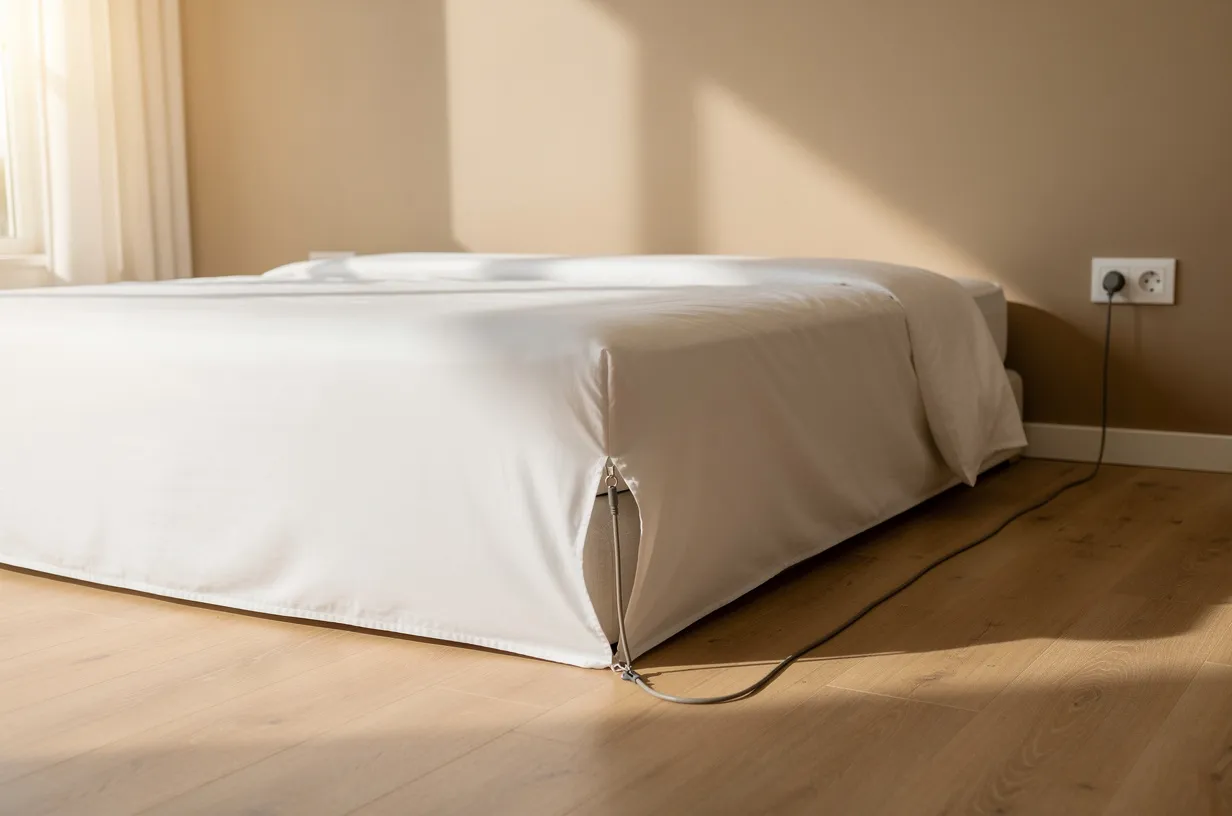
Worth saying plainly: if you wake up with a sore back most mornings, the mattress under you and how you’re sleeping on it are far more likely culprits than the electrical state of your sheet. A mattress that’s too soft or too old to support your spine, or a habit of sleeping on your stomach, will outweigh anything a grounding sheet can offer. A grounding sheet is a thin, breathable layer that sits under your fitted sheet, it doesn’t add cushioning or support.
That’s not a reason to skip it. It’s a reason to fix the bigger lever first and treat grounding as one small addition on top of a setup that already supports your back, not a workaround for one that doesn’t.
What’s proven, promising and unproven, at a glance
| Claim | Evidence level |
|---|---|
| Better subjective sleep | Small pilot support (Ghaly & Teplitz, 2004) |
| Less self-reported pain and stress, generally | Small pilot support, not back-pain-specific |
| Reduced post-exercise soreness | Small pilot support (Brown, Chevalier & Hill) |
| Anti-inflammatory mechanism | Hypothesis, not a clinical trial (Oschman et al., 2015) |
| Treats or cures chronic back pain, sciatica, disc disease | No evidence; none of these papers claim this |
Who should check with a doctor first?
Back pain that’s severe, sudden, spreading down a leg, or paired with numbness or weakness is a reason to see a doctor before trying anything, grounding sheet included. That pattern can point to a nerve issue like sciatica, which we look at on its own in Grounding Sheets for Sciatica: Fair Review. If you’re pregnant, on blood thinners, or have a pacemaker or other implanted device, check with your doctor before adding any electrical-adjacent product to your bed, even one running this little current.
The sheet itself connects you to your wall outlet’s ground pin, not to live power, so the electrical risk in normal use is low. The real-world hazard is a badly wired outlet, which is why it’s worth running a cheap outlet tester before you plug anything in.
So is it worth trying for back pain?
If your back pain is mild, exercise-related, or tangled up with poor sleep, grounding is a low-cost thing to test for a few weeks. The best-supported outcome across the research is still sleep and general relaxation, not pain relief on its own, so keep your expectations there. If it’s a real spine or nerve issue, treat grounding as something you might add after you’ve had it checked out, not instead of that visit. See the full benefit breakdown in Grounding Sheets Benefits: What’s Proven, Promising, and Hype.
We’ve tested a handful of grounding sheets for build quality and how they hold up after months of washing. Our current pick for anyone starting from scratch is the Premium Grounding sheet, mostly because the stainless-steel fibers outlast the silver-thread versions that dominate this market.
Premium Grounding Sheet
30% stainless-steel fibers instead of silver, so it will not oxidize and lasts about five times longer. Fits under your fitted sheet, ships worldwide, and comes with a 90-night trial and a 3-year warranty.
Check price on Premium GroundingFrequently asked questions
- Grounding Sheets for Sleep: Can Earthing Improve Your Nights?
- Grounding and Inflammation: What the Research Actually Measures
- Grounding Sheets for Restless Leg Syndrome: Does Earthing Help?
- Benefits of Grounding: The Full List, Ranked by Evidence
- How Long Should You Ground Yourself Each Day?
- Grounding Sheets and EMF: Protection or Misconception?
- Grounding Sheets for Athletes: Recovery, Claims and Reality
- Grounding Sheets for Seniors: What to Know Before Buying
- Grounding Sheets for Anxiety: What the Evidence Actually Says
- Grounding Sheets and Jet Lag: Can Earthing Help You Reset?
- Grounding Sheets for Inflammation: The Research
- Grounding Sheets for Arthritis: Honest Look
← Grounding Sheets Benefits: What’s Proven, Promising, and Hype