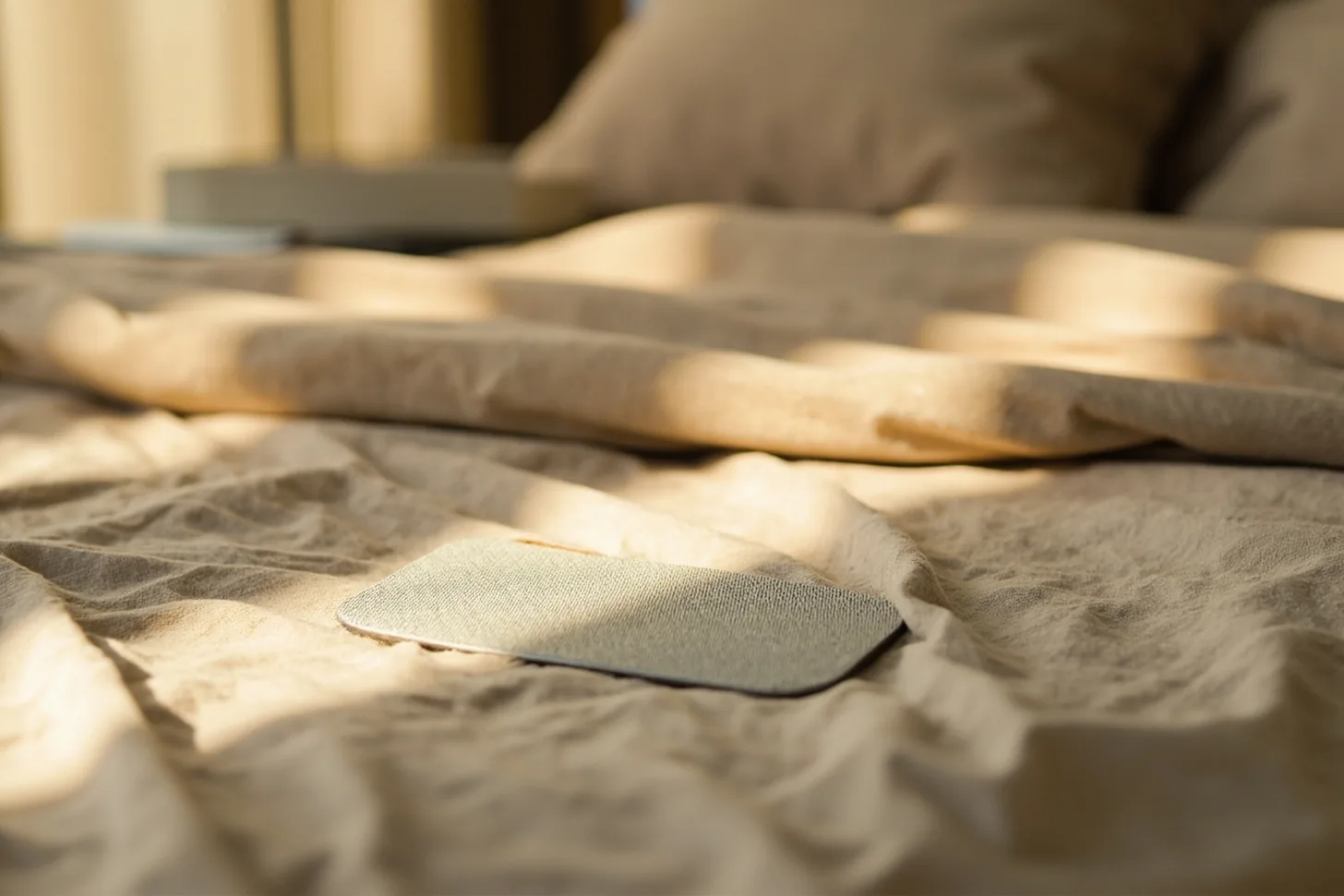
A grounding pad for bed is a small conductive mat, usually the size of a placemat, that you rest a foot or hand on while you sleep or work. It’s cheaper than a full grounding sheet and easier to move between rooms, but it only grounds whatever part of you is actually touching it. If you want to test grounding cheaply or you already sleep with your feet uncovered, a pad is a reasonable starting point. If you’re chasing the sleep benefits the small studies describe, a full sheet does a more thorough job.
A grounding pad works fine for spot-grounding a hand or foot, but a full sheet gives far more skin contact for the sleep-focused benefits most people are actually after.
What’s the difference between a pad, a mat and a full sheet?
All three do the same electrical job: conductive fibers connect your skin to a wire that runs to your wall outlet’s ground pin. The difference is coverage and how you use them. We cover the broader category in our Grounding Mats: The Complete Guide (vs Sheets, Setup, Picks) guide, but here’s the short version for beds specifically.
A pad is a small rectangle, often 12×24 inches or smaller, meant for one foot or hand. A grounding mat can be the same size or larger and doubles as a desk or floor accessory, which we get into in our Earthing Mats Explained: Types, Conductivity and Placement breakdown. A full sheet is fitted or flat bedding sized to your mattress, so your back, legs and arms all touch it while you sleep.
How much contact area do you actually need?
Any bare skin touching a properly grounded conductive surface completes the circuit. That part isn’t in dispute. What’s less clear is whether more contact area changes the physiological effect, since the small pilot studies behind grounding, like Ghaly & Teplitz (2004) on sleep and cortisol, used bedding people were in contact with for most of the night.
A pad under one foot is a real electrical connection. It’s just a much smaller one than lying on a grounded sheet for seven or eight hours. If you’re trying to replicate what the studies actually tested, more skin contact is closer to that setup, not further from it.
Grounding pad vs full sheet: quick comparison
| Feature | Grounding pad | Full grounding sheet |
|---|---|---|
| Typical price | $20-$50 | $80-$200+ |
| Skin contact | One foot or hand | Most of your body |
| Best for | Testing the concept, desk use, small budgets | Nightly sleep grounding, closest match to study conditions |
| Portability | Packs flat, easy to travel with | Stays on the bed, not really portable |
| Setup | Plug into a tested grounded outlet | Plug into a tested grounded outlet |
| Wear over time | Less fiber to wear out, but small tears matter more | More surface area, quality of fiber matters most |
When a pad actually makes more sense than a sheet
A pad is the right call if you’re not sure grounding is for you and don’t want to spend $150 to find out. It’s also useful at a desk, under bare feet while you work, which a bed sheet obviously can’t do. And if your mattress setup makes a fitted sheet impractical, a memory foam topper with an odd shape or a shared bed where a partner isn’t interested, a pad for your own side is a lower-friction option. We compare the two setups directly in Grounding Mat vs Grounding Sheet: Which One Fits Your Setup? if you’re still torn.
When you should skip the pad and get a full sheet instead
If sleep is the actual goal, size up. The studies most often cited for grounding and sleep quality used overnight, whole-body contact, not a foot resting on a small mat for part of the night. A full sheet also survives a restless sleeper better, since you don’t have to keep your foot in one spot for it to work.
Premium Grounding Sheet
30% stainless-steel fibers instead of silver, so it will not oxidize and lasts about five times longer. Fits under your fitted sheet, ships worldwide, and comes with a 90-night trial and a 3-year warranty.
Check price on Premium GroundingWe tested the Premium Grounding Sheet specifically because it uses 30% stainless-steel fiber instead of silver, which means it doesn’t oxidize the way silver-threaded sheets do over months of washing. It fits under your existing fitted sheet, comes with a 90-night trial and a 3-year warranty, and ships worldwide. knocks 10% off if you decide to try it. For setup specifics on bed-based mats generally, our Grounding Mat for Bed: How to Choose and Set One Up guide walks through outlet placement and cord routing.
Does conductivity actually differ between a pad and a sheet?
Fiber quality matters more than size here. A well-made pad with dense conductive thread grounds just as effectively, per square inch, as a well-made sheet. What changes is total contact area, not the strength of the connection itself. A cheap sheet with sparse fiber can underperform a good pad, so don’t assume bigger automatically means better if the materials are weak.
The honest takeaway: a pad is a low-cost way to try grounding on a foot or hand, and it’s genuinely useful for desk work or travel. But if better sleep is why you’re here, the research this whole niche rests on was done with people lying on grounded bedding, not resting a foot on a mat. Size the product to match what you’re actually trying to test.
Frequently asked questions
Can a grounding pad replace a full grounding sheet?
It can, for one specific body part. A foot pad or hand pad grounds whatever’s touching it, not your whole body. A full sheet grounds most of your skin all night since you sleep on it directly, which is why most people who want sleep benefits end up preferring a sheet.
How big does a grounding pad need to be to work electrically?
Size doesn’t determine whether the connection works. Any bare-skin contact with a properly grounded conductive surface completes the circuit, even a few square inches. Size only determines how much of your body is grounded at once, not whether grounding is happening.
Do grounding pads need bare skin contact to work?
Yes. Socks, pajama pants or a top sheet between your skin and the pad block the connection, since fabric doesn’t conduct electricity the way skin does. Your foot, hand or calf needs to touch the conductive fabric directly.
Is a small pad enough if I mainly want better sleep?
Probably not on its own. The sleep studies behind grounding, like Ghaly and Teplitz (2004), had participants grounded through bedding they slept on for hours, not a pad their foot brushed occasionally. A full sheet matches that setup much more closely.
- Grounding Mat for Bed: How to Choose and Set One Up
- Best Grounding Mats of 2026: Desk, Floor & Bed Picks
- Grounding Mat vs Grounding Sheet: Which One Fits Your Setup?
- Grounding Mat Benefits: What to Expect (and When)
- Earthing Mats Explained: Types, Conductivity and Placement
← Grounding Mats: The Complete Guide (vs Sheets, Setup, Picks)