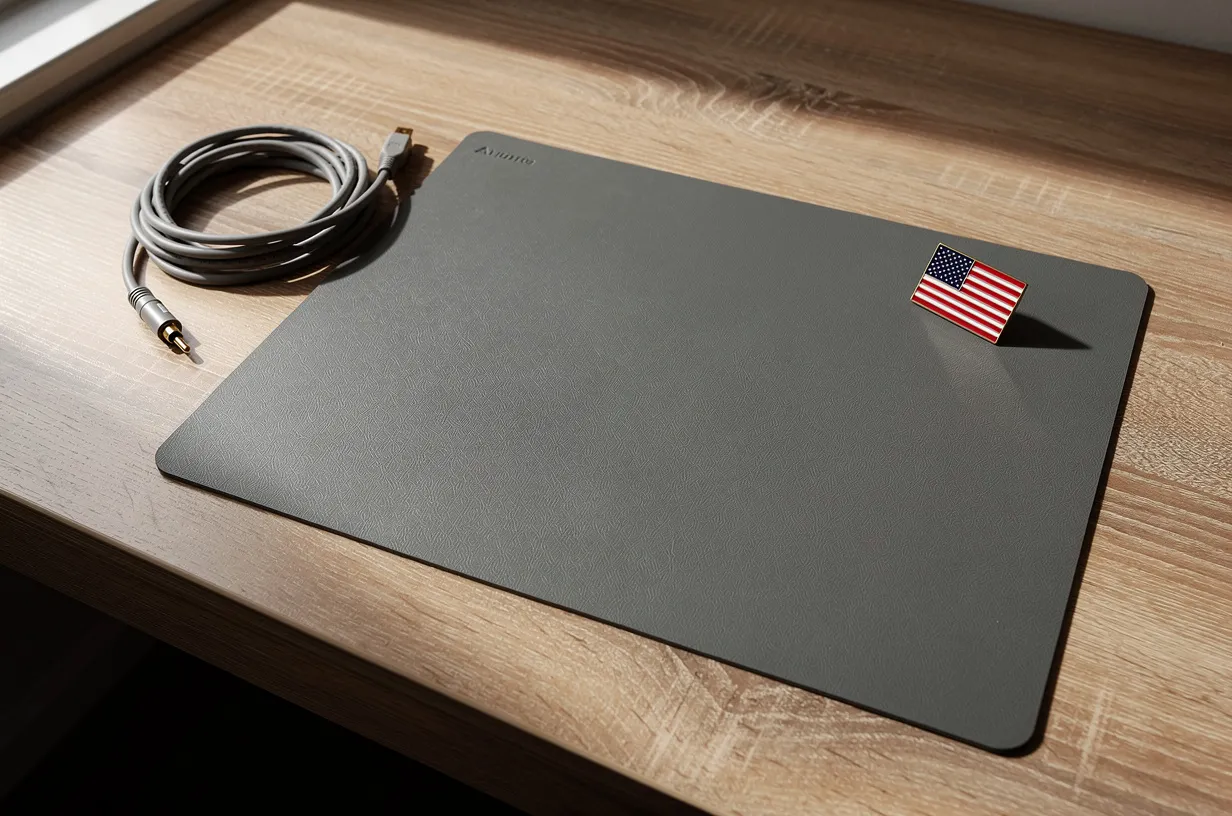
Short answer: a few grounding mat brands are genuine US companies, but “made in USA” on a grounding mat listing rarely means the whole product, cord included, was manufactured start to finish on US soil. Most of the time it means the company is US-based. The materials inside can still come from anywhere.
If domestic manufacturing matters to you specifically, ask the brand directly for country-of-origin confirmation. If you just want a mat that lasts, prioritize stainless-steel conductive thread over where it was assembled.
What does “made in USA” actually mean for a grounding mat?
In the US, an unqualified “Made in USA” claim is supposed to mean “all or virtually all” of the product was made and assembled domestically, a standard the FTC enforces. In practice, small wellness brands use looser phrasing all the time. “US company,” “designed in the USA,” and “American-owned” get used almost interchangeably with “made in USA” on product pages, even though they mean different things.
A grounding mat has a few parts: the conductive fabric (usually a carbon-infused vinyl or leatherette, sometimes a woven grid), a snap, and a grounding cord that plugs into your wall outlet. Any one of those can be sourced overseas even when the finished mat is packaged and sold by a US business. That’s not necessarily a red flag, it’s just how most consumer textile products work. It just means the label deserves a second look.
Which grounding mat brands are US companies?
Based on how these brands present themselves, a few are clearly US-based businesses. Earthing.com, the brand tied to Clint Ober and the original earthing movement, has been operating out of the US for years. Hooga Health is also a US brand and tends to sit at the more budget-friendly end, with mats built from carbon-leatherette and a simpler snap connection. Neither publishes a detailed manufacturing breakdown of every component, which is common for this category.
Other well-known names in the space, Grounding Well, The Grounding Co, GroundLuxe, are established brands with US customer bases, but their marketing leans more on materials and trial periods than on a domestic-manufacturing claim. That’s worth noting rather than assuming either way.
Does made in USA mean better quality?
Not on its own. What actually determines how long a grounding mat holds up is the conductive material. Silver-thread mats conduct well when new, but silver oxidizes with wear and washing, and conductivity drops off faster than most buyers expect. Stainless-steel fiber resists that oxidation and tends to stay conductive much longer, which is the honest, material-level reason we point people toward stainless steel over silver regardless of where either one was assembled.
Snap hardware, cord shielding, and stitching quality matter more day to day than a country-of-origin claim. A US-assembled mat with a flimsy snap will fail before a well-built mat sourced elsewhere. If a brand cares enough to publish a real warranty and a workable return window, that tells you more about their confidence in the build than a flag on the packaging does.
How to verify a mat’s actual origin
Three checks, in order of usefulness. First, read the actual product listing closely, not just the title, since the origin claim, if there is one, is often buried in a bullet point or the description. Second, look at the mat itself when it arrives; a printed tag with a country of origin is a stronger signal than marketing copy. Third, if you can’t find a clear answer, email the brand and ask them to state it plainly. How they respond, quickly and specifically versus vague and defensive, tells you something too.
| Brand | US-based company | Conductive material | What to know |
|---|---|---|---|
| Earthing.com | Yes | Silver thread | Original earthing brand, long track record, silver needs replacing sooner |
| Hooga Health | Yes | Carbon leatherette | Budget-friendly, simpler build, typically a 1-year warranty |
| Grounding Well | US customer base | Silver-coated | Mid-priced, trial and warranty offered, origin not heavily marketed |
| Premium Grounding | Ships worldwide | Stainless steel (30%) | Not marketed as domestically made, but the stainless-steel build is the longest-lasting option we’ve tested |
We cover the fabric side of this decision in more depth in our guide to Organic Cotton Grounding Sheets: Why the Fabric Base Matters, and if sizing or budget is the bigger question for you right now, our How to Choose a Grounding Sheet: A Practical Buyer’s Checklist checklist walks through the tradeoffs that matter more than country of origin for most buyers.
Is chasing a made-in-USA mat worth it?
If domestic manufacturing is a personal priority, non-negotiable for you, then yes, it’s worth the extra email to a brand’s support team to get a straight answer. That’s a values-based decision, and there’s nothing wrong with it. But if your actual goal is a grounding product that still conducts well in year three, the material spec matters more than the country stamp. Stainless steel over silver is the difference that shows up in your hands, not just on paper.
Premium Grounding Sheet
30% stainless-steel fibers instead of silver, so it will not oxidize and lasts about five times longer. Fits under your fitted sheet, ships worldwide, and comes with a 90-night trial and a 3-year warranty.
Check price on Premium GroundingFor sheets specifically rather than mats, our Grounding Sheets Made in USA: Brands That Actually Manufacture Here page breaks down the same origin question for full bedding, and our Stainless Steel vs Silver Grounding Sheets: Which Lasts Longer? comparison goes deeper on why that one material choice outlasts almost everything else in this category. For the full lineup of what we’ve tested, start at our Best Grounding Sheets of 2026: Tested Picks & Buying Guide hub.
Frequently asked questions
Are grounding mats actually made in the USA?
Some are assembled here, some are not, and very few brands publish real factory documentation either way. A handful of grounding companies are US-based businesses (design, customer service, and often final assembly here), but the carbon or silver-conductive fabric inside is frequently sourced internationally, which is normal for this kind of textile.
Does a US-based brand mean a US-made product?
No. Being a US company (headquartered, incorporated, selling here) is different from manufacturing every component domestically. If full domestic manufacturing matters to you, ask the seller directly and ask for something more specific than the word “American” on the packaging.
Is a made-in-USA grounding mat better quality?
Not automatically. Build quality comes down to the conductive material (stainless steel holds up better than silver over time), the snap and cord hardware, and stitching, not the country stamped on the box. Country of origin can correlate with quality control, but it isn’t proof of it.
How do I verify where a grounding mat was made?
Check the product listing for a country-of-origin line, look at the physical tag on the mat itself, and if neither is clear, email the brand and ask them to confirm in writing. A brand that answers plainly is a good sign regardless of where the mat ships from.
What should I prioritize instead of the made-in-USA label?
Focus on the conductive material (stainless steel over silver for longevity), the warranty length, and the return window. Those three tell you more about how the mat will hold up than a country of origin claim usually does.
- Grounding Sheets Made in USA: Brands That Actually Manufacture Here
- Organic Cotton Grounding Sheets: Why the Fabric Base Matters
- Stainless Steel vs Silver Grounding Sheets: Which Lasts Longer?
- Best Earthing Sheets: Top Picks Ranked by Conductivity & Durability
- King Size Grounding Sheets: Sizing Guide & Best Options
- Cheap Grounding Sheets: What You Sacrifice Below $100
- How to Choose a Grounding Sheet: A Practical Buyer’s Checklist
- Are Grounding Sheets Worth It? An Honest Cost vs Benefit Look
- How We Test Grounding Sheets: Our Rating Method
- Grounding Sheet Ratings 2026: Every Sheet We Tested, Scored
- Twin Grounding Sheets: Sizing and Picks
- Full Size Grounding Sheets: Options
← Best Grounding Sheets of 2026: Tested Picks & Buying Guide