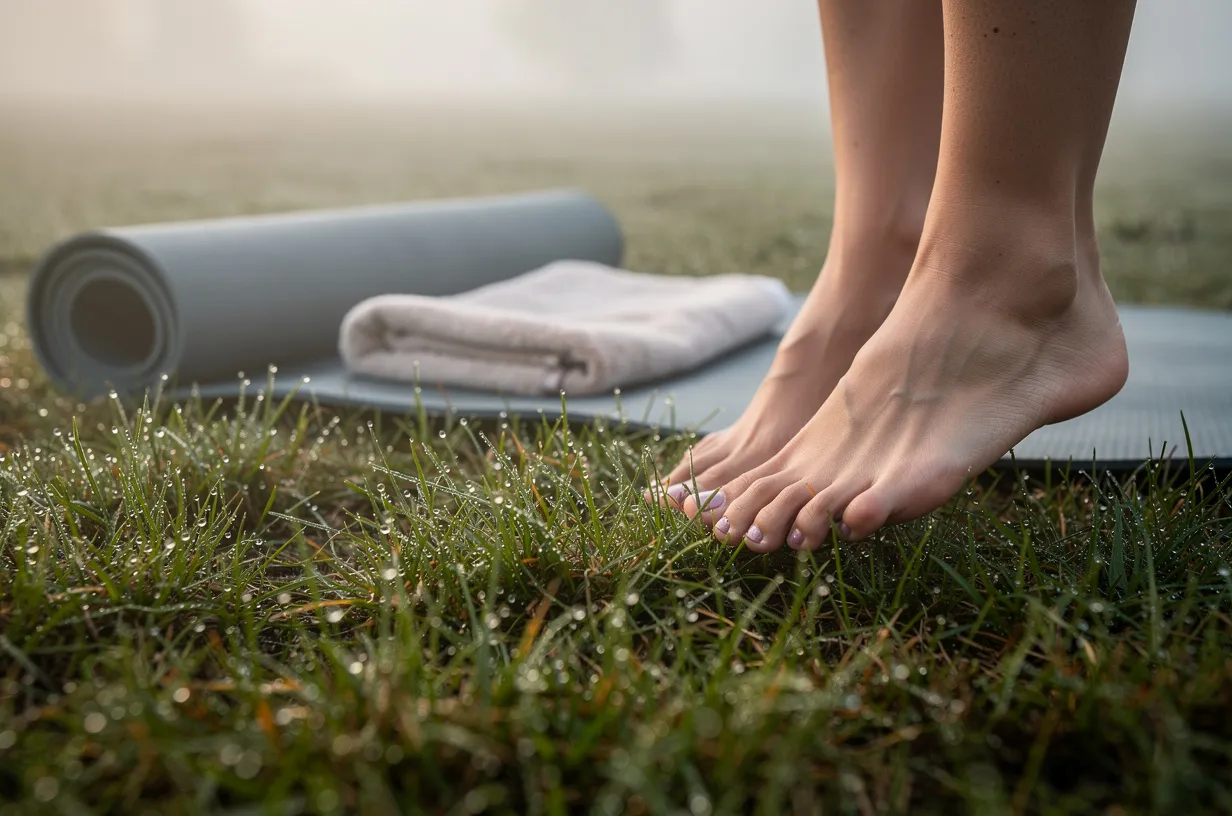
If you searched “grounding post workout” hoping for a shortcut past sore legs, here’s the short answer: a few small studies suggest grounding may calm some markers tied to muscle damage after exercise, but nothing here is proven at the level of, say, protein intake or sleep. It’s a low-risk add-on, not a recovery plan.
Grounding after exercise looks promising in a handful of small pilot studies on soreness and inflammation markers, but the research is early and thin. Treat it as a low-cost extra layer on top of sleep, hydration and stretching, not a substitute for any of them.
Does grounding actually speed up muscle recovery?
Maybe a little, according to a small body of research, but “speed up” is doing a lot of work in that sentence. The studies that exist are pilots with few participants, and most come from researchers who also have ties to grounding products. That doesn’t make the findings wrong, but it means you should read the results as a starting point, not a verdict.
What’s actually been measured is narrower than the marketing suggests: mostly self-reported soreness and a few blood markers linked to inflammation, not strength recovery, range of motion, or return-to-play time. If you’re picturing grounding shaving days off a hamstring strain, the research doesn’t support that.
What happens in your body after a hard workout
A tough training session creates small amounts of muscle fiber damage, which triggers an inflammatory response. That’s normal and mostly useful, it’s part of how muscle adapts and gets stronger over time. The soreness you feel a day or two later, delayed-onset muscle soreness (DOMS), is tied to this process, along with fluid shifts and nerve sensitivity in the affected tissue.
Grounding proponents argue that direct skin contact with the Earth’s electrons acts like an antioxidant, neutralizing some of the reactive molecules produced during this inflammatory response. That idea comes from a 2015 narrative review by Oschman, Chevalier and Brown in the Journal of Inflammation Research. It’s worth being precise about what that paper is: a hypothesis paper laying out a proposed mechanism, not a large clinical trial proving the effect happens in practice.
What the research on grounding and exercise recovery shows
The most relevant work is a set of small pilot studies from Brown, Chevalier and Hill, run around 2010 and 2015, looking at DOMS and recovery markers after exercise. The general finding was that participants who were grounded after a workout reported less soreness and showed some blood-marker changes consistent with lower muscle damage, compared to those who weren’t. These were small samples with modest designs, and I haven’t seen independent labs replicate them at scale.
Separately, Sokal and Sokal’s series of experiments looked at broader physiological effects of grounding, including immune markers, though that work wasn’t exercise-specific. It adds a little context but shouldn’t be read as direct evidence for post-workout recovery.
If you want the deeper research breakdown on this exact question, we’ve laid out the studies in more detail in Grounding for Muscle Recovery: What Research Says. For readers coming at this from a training-volume angle rather than a single hard session, Grounding Sheets for Athletes: Recovery, Claims and Reality covers how grounding fits into a broader training and recovery routine.
How stress hormones fit into the picture
One piece that gets less attention: cortisol. The Ghaly and Teplitz pilot from 2004, the study most often cited for grounding and sleep, found that sleeping grounded shifted cortisol rhythm toward a more typical day-night pattern in a small, unblinded group. Cortisol matters for recovery because chronically elevated levels can blunt the repair process. If grounding genuinely helps normalize that rhythm for some people, better sleep quality could be the real mechanism behind reported recovery benefits, more than any direct effect on the muscle tissue itself. We go deeper on this in Grounding Sheets and Cortisol: What Studies Found.
How to try grounding after a workout
Most people who use grounding for recovery aren’t standing barefoot on grass right after a lift. They sleep on a grounded sheet the night of a hard session, or sit or lie on a grounding mat during a cooldown or stretch. The sheet approach is the one with the most (small) research behind it, since most of the pilot studies involved sleeping grounded overnight rather than short daytime sessions.
A few practical notes if you go this route. Confirm your outlet is actually grounded first, a cheap plug-in outlet tester takes the guesswork out of it. Skin contact matters, so the sheet needs to touch bare skin, not just be under a blanket. And don’t expect an overnight fix, the studies that found benefits involved repeated use over days or weeks, not one session.
How grounding compares to other recovery methods
| Method | What it targets | Evidence strength |
|---|---|---|
| Sleep (grounded or not) | Overall repair, hormone regulation | Well established |
| Active recovery, stretching | Blood flow, stiffness, mobility | Well established |
| Cold plunge or ice bath | Perceived soreness | Moderate, mixed on strength adaptation |
| Compression garments | Swelling, perceived recovery | Moderate |
| Grounding sheet or mat | Soreness, inflammation markers (self-reported) | Early, small pilot studies |
None of that means skip grounding, it just means rank it correctly. Sleep and stretching aren’t optional. Grounding is the extra layer you add once the basics are already covered, not a replacement for them. For the wider list of what grounding is and isn’t backed for, Grounding Sheets Benefits: What’s Proven, Promising, and Hype sorts the proven claims from the hype.
If a grounding sheet is something you want to try alongside your regular sleep setup,
Premium Grounding Sheet
30% stainless-steel fibers instead of silver, so it will not oxidize and lasts about five times longer. Fits under your fitted sheet, ships worldwide, and comes with a 90-night trial and a 3-year warranty.
Check price on Premium GroundingFrequently asked questions
Does grounding reduce muscle soreness after exercise?
Small pilot studies on DOMS report less self-reported soreness and some favorable blood-marker changes in grounded participants, but the samples are small and the effect hasn’t been confirmed by larger, independent trials.
Should I use a grounding mat during my workout or a sheet after?
Most of the relevant research involved sleeping grounded overnight, not grounding during activity, so a sheet used the night of a hard session has more research behind it than a mat used mid-workout.
How soon after a workout should I use grounding?
There’s no established window from the research. Practically, using a grounded sheet the same night as a hard session, and on subsequent nights while you’re sore, matches how the pilot studies were structured.
Is it safe to combine grounding with ice baths or compression gear?
Yes, there’s no known conflict. Grounding connects you to your outlet’s ground wire, not to any other recovery equipment, so it can be layered with your existing routine without issue.
Will grounding replace the need for rest days?
No. Nothing in the research suggests grounding lets you train harder or skip recovery time. It’s positioned as a possible support for the recovery your body already needs, not a way around it.
- Grounding Sheets for Sleep: Can Earthing Improve Your Nights?
- Grounding and Inflammation: What the Research Actually Measures
- Grounding Sheets for Restless Leg Syndrome: Does Earthing Help?
- Benefits of Grounding: The Full List, Ranked by Evidence
- How Long Should You Ground Yourself Each Day?
- Grounding Sheets and EMF: Protection or Misconception?
- Grounding Sheets for Athletes: Recovery, Claims and Reality
- Grounding Sheets for Seniors: What to Know Before Buying
- Grounding Sheets for Anxiety: What the Evidence Actually Says
- Grounding Sheets and Jet Lag: Can Earthing Help You Reset?
- Grounding Sheets for Back Pain: What Evidence Shows
- Grounding Sheets for Inflammation: The Research
← Grounding Sheets Benefits: What’s Proven, Promising, and Hype