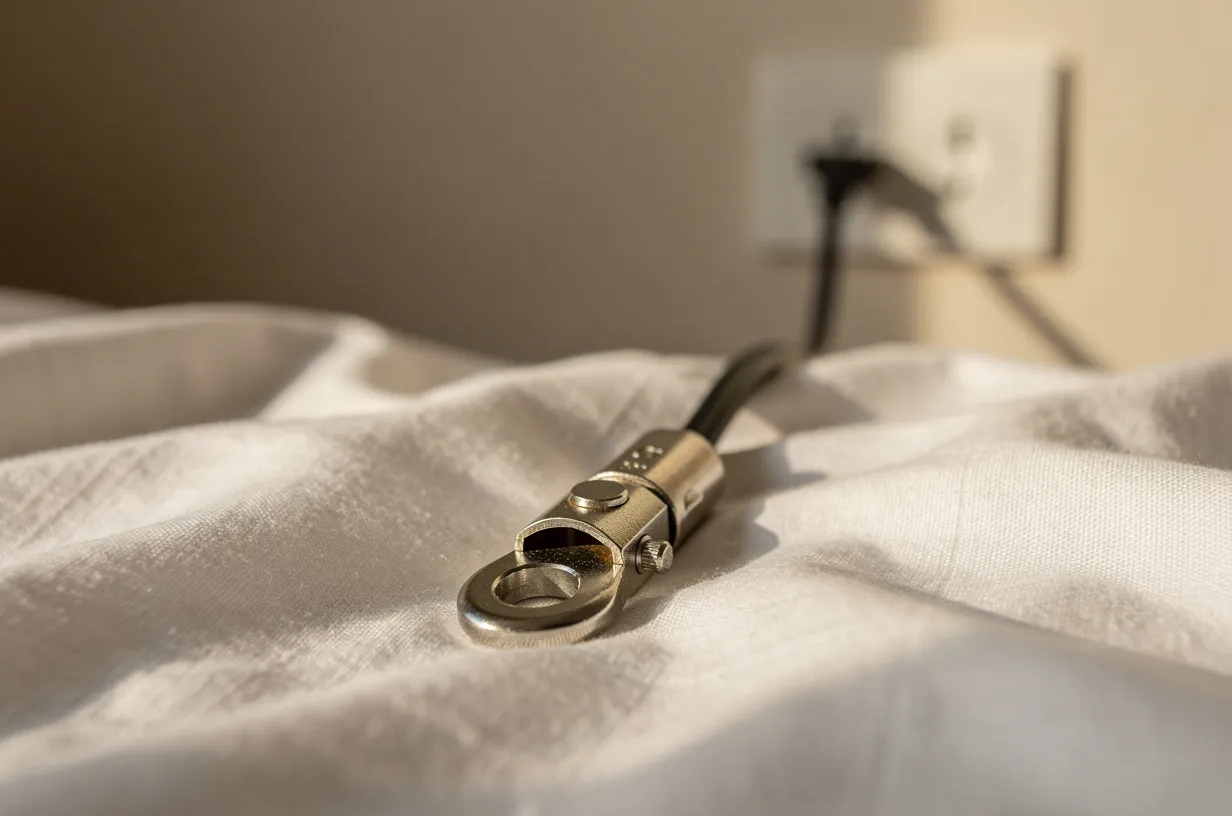
No, a grounding sheet cannot shock you under normal conditions. It connects to the ground pin in your wall outlet, not to the live wire, so there’s no path for household current to reach you through the sheet. The one real risk is a miswired outlet, and that’s a five-minute check, not a reason to panic.
No, a properly grounded outlet cannot shock you through a grounding sheet. The rare risk comes from bad household wiring, not the sheet itself.
How does a grounding sheet actually connect to the wall?
The sheet has a thin conductive thread, usually silver or stainless steel, woven through part of the fabric. A cord runs from that thread to a plug that goes into the ground port, the round third hole on a US outlet, or sometimes a metal rod pushed into the earth outside. That’s it. There’s no connection to the two flat slots that carry live current.
The whole point of the ground pin is that it’s supposed to sit at zero volts. It’s a safety return path, the same wire your washing machine and your laptop charger use. When you touch a grounding sheet, you’re touching a wire that’s designed to be electrically neutral, not one that’s designed to carry power to you.
So where does the fear of shock come from?
Honestly, most of it is just unfamiliarity. Plugging a bed sheet into the wall sounds odd the first time you do it, and “electricity” and “bed” in the same sentence sets off an alarm. We get it, we felt the same hesitation before we tested our first one.
The actual physics is closer to touching a metal pipe or an unpainted radiator than touching a live wire. You’re not closing a circuit back to the power company. You’re joining the same ground reference that already runs through your home’s wiring.
What’s the one real risk worth checking?
A wall outlet where the ground pin isn’t actually connected to earth, or worse, one that’s wired incorrectly so the “ground” hole is carrying some voltage it shouldn’t. This is rare in homes built or inspected to modern code, but it does happen, especially in older houses, rentals, or DIY wiring jobs.
A five-dollar plug-in outlet tester tells you in seconds whether an outlet is wired correctly. Push it in, read the lights, done. We’d call this the single most useful thing you can do before you start using a grounding sheet regularly, more useful than reading another study.
If you’re renting or living somewhere with old wiring and you’re not confident in the outlets, Grounding Mat Dangers: The 5 Real Risks and How to Avoid Them covers the same wiring-risk logic for mats, which is worth a read if a sheet isn’t the right fit for your setup.
| Scenario | Shock risk | What to do |
|---|---|---|
| Correctly grounded outlet, undamaged cord | Essentially none | Use normally |
| Outlet with no real ground (old 2-prong system, bad adapter) | Low, but ground protection isn’t working as intended | Test the outlet or use a different one |
| Miswired outlet (hot/ground reversed) | Real, but rare | Test with a $5 tester, call an electrician if it fails |
| Frayed or damaged cord | Low but avoidable | Stop using it, replace the cord or sheet |
What about tingling or a mild buzz?
A faint tingle sometimes gets reported, and it’s a different thing from a shock. It’s usually static discharge, a loose snap connection, or just the sensation of skin against a slightly different fabric than you’re used to. It’s not dangerous, but it’s also not something to ignore if it keeps happening. We go through the common causes and when to actually worry in Grounding Sheet Tingling: Normal or Not?.
Should you unplug it during a storm?
We’d say yes, as a habit rather than a strict rule. Any device plugged into your wall carries a small risk from a nearby lightning strike traveling through household wiring, and a grounding sheet is no exception. It’s not a special hazard unique to earthing products. We break down the actual odds and the simple habit of unplugging before bed during storms in Can You Use Grounding Sheets During a Thunderstorm?.
Who should ask a doctor before using one?
If you have a pacemaker or another implanted electrical device, talk to your doctor or the device manufacturer before adding any conductive product to your routine, including a grounding sheet. This isn’t about shock risk specifically, it’s just the sensible caution any doctor would give around implanted electronics. We cover this in more detail in Grounding Sheets and Pacemakers: Ask a Doctor, and the broader safety picture, including who else should check with a doctor, lives in our main guide, Are Grounding Sheets Safe? Risks, Side Effects & Who Should Ask a Doctor.
If the outlet tests fine and the cord is intact, a grounding sheet is one of the lower-risk purchases in your bedroom. Our top pick, tested over months of regular washing, uses stainless-steel thread rather than silver, which matters here too since silver can oxidize and degrade a conductive path over time. That’s less a shock issue and more a “does it still actually ground you in year two” issue, but it’s worth knowing.
Premium Grounding Sheet
30% stainless-steel fibers instead of silver, so it will not oxidize and lasts about five times longer. Fits under your fitted sheet, ships worldwide, and comes with a 90-night trial and a 3-year warranty.
Check price on Premium GroundingFAQ
- Are Grounding Sheets Dangerous? Separating Real Risks From Fear
- Grounding Mat Dangers: The 5 Real Risks and How to Avoid Them
- Are Grounding Sheets Legit? How to Spot Scams in the Earthing Market
- Are Grounding Mats a Hoax? An Honest Assessment
- Grounding Sheet Side Effects: What Users Report in the First Weeks
- Can You Use Grounding Sheets During a Thunderstorm?
- Grounding Sheets and Pacemakers: Ask a Doctor
- Grounding Sheets During Pregnancy: What to Know
- Grounding Sheets and Medication: Precautions
- Grounding Sheets and Lightning: Real Risk?
- Grounding Sheets for Kids: Is It Safe?
- Are Grounding Mats Safe? Risks Explained
← Are Grounding Sheets Safe? Risks, Side Effects & Who Should Ask a Doctor